

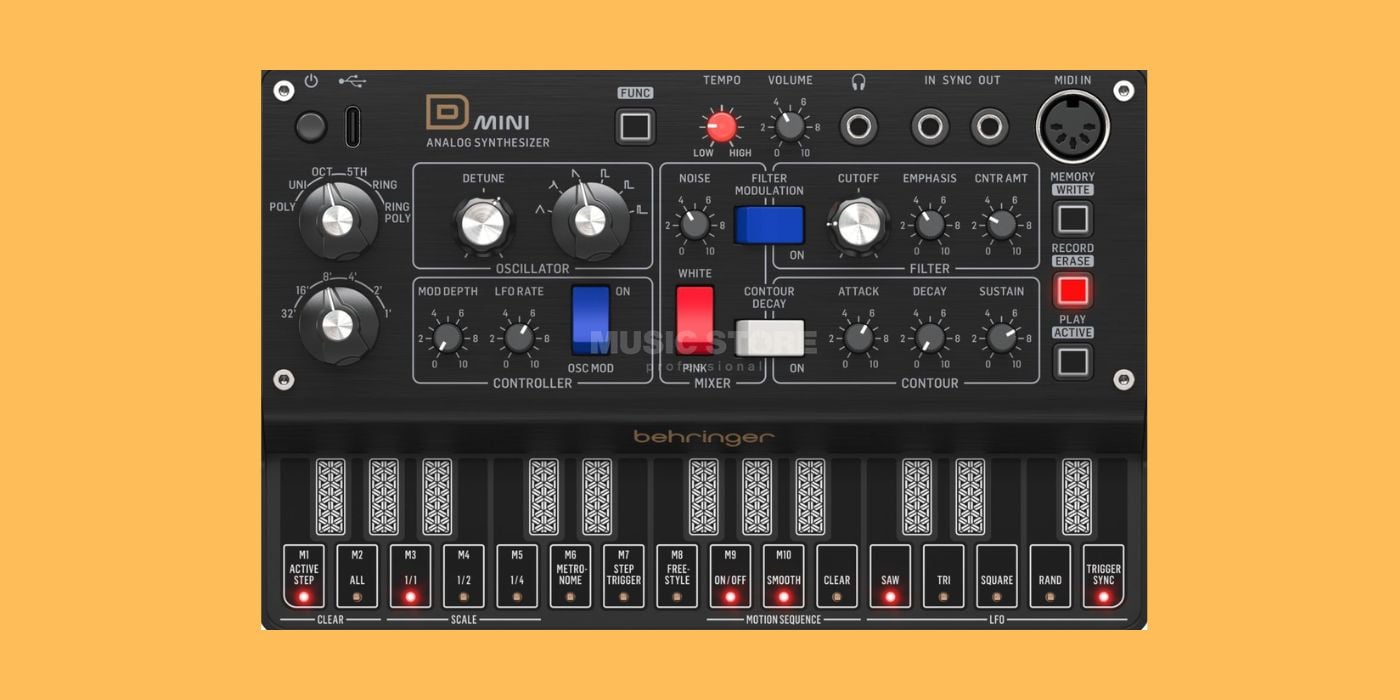

You can now pre-order the Behringer D Mini in the EU for €99, offering you a Minimoog Model D-inspired performance.
If you know anything about Behringer in recent years, you’ll know that I’ve made rather casual use of the word inspired in the header.
When I say inspired, I mean cloned to within an inch of trademark infringement (sometimes an inch over).
While the functionality of electronic circuits is nearly impossible to protect from copycats, Behringer consistently walks a very thin line on the edge of compliance with elements that other manufacturers can protect, like trademarked names, logos, and designs.
So much so that the company has been sued fairly regularly over the last couple of decades, including the legal action taken by BOSS/Roland, Mackie, and Klon.
Ironically, Behringer’s parent company, Empower Tribe, countersued BOSS for patent infringement related to the PolyTune polyphonic Tuner.
Lawsuit documentation stated of Roland, “it decided that instead of creating a polyphonic tuner itself, it would simply knock off Empower’s patented device instead.”
There had to be a room full of people thinking, “Are you ******* kidding me?”
Anyway, back to the story at hand.
Behringer announced the D Mini at NAMM 2026, and now you can pre-order it from Musicstore.de for €99 (stock is expected around mid August 2026).
It’s not new territory for Behringer; the Behringer Model D is a fairly successful copy of the iconic Minimoog.
The D Mini has six voice modes, including polyphonic (three-voice paraphonic), unison, and ring modulator.
Other key features include:
- VCA with six waveforms (triangle, sharktooth, sawtooth, square, and two pulse variants)
- Noise generator
- ADS envelope for filter/VCA
- 24 dB lowpass filter
- Arpeggiator
- Step sequencer with ten patterns
- LFO with four waveforms
- Motion sequence (recording controller movements)
- Sync in/out
- MIDI in
The step sequencer is an interesting addition, and certainly adds another layer of value to this small synth.
Rather than a typical keyboard, you get 27 touch keys, similar to Arturia’s MicroFreak. If you aren’t used to that sort of capacitive keyboard, it can feel quite strange and less expressive. But you can always use another MIDI keyboard.
If we know one thing about Behringer clones, including previous mini models, like the CZ-1 Mini (Casio CZ-1) and JT Mini (Roland Jupiter-8), it is that they often get remarkably close to the original sound.
Not every patch is perfect, but more often than not, it’s very close with slight differences that you can work around to get closer to the original sound.
It’s fair to say that Behringer’s clones have improved over time, too.
I can’t imagine getting less than €99 value out of the D Mini; I think there’s probably excellent value for money in all of Behringer’s synth clones.
It’s funny that we’re discussing the D Mini so soon after the Fender Copyright story; I’m sure there will be some cries of hypocrisy! It’s just too late to reverse the tide for Fender.
I can’t say I’m a fan of anyone blatantly putting their own name on someone else’s homework, so I understand the lawsuits, but I also understand that the average musician doesn’t have thousands of dollars to drop on an original, and see why clones are attractive.
It might be easier to stay righteous without such a price gap between devices.
Whatever the case, the I love Behringer/I hate Behringer vibe around tradeshows when products like the Behringer Model D first dropped was hilarious for a while.
As far as I’m aware, Moog has never taken legal action against Behringer despite the closeness of their copies.
Check out the deal: Behringer D Mini (Available for pre-order @ Musicstore.de – €99)
Last Updated on June 9, 2026 by Tomislav Zlatic.