

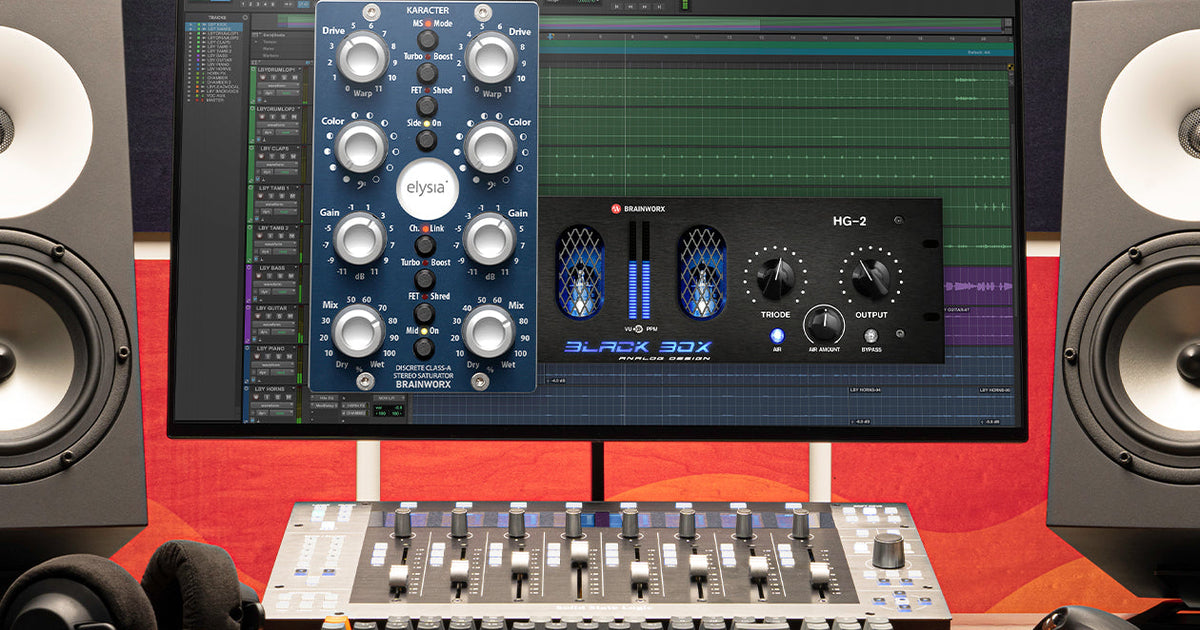

Black Box Analog Design HG-2 and elysia karacter are now available for Apollo.
Every engineer has a piece of gear that they reach for without thinking. You’ve likely seen a few of these “secret weapon” processors in someone’s rack. It’s the equipment that’s used quietly, but constantly.
The Black Box Analog Design HG-2 and elysia karacter Stereo Saturator are two pieces of gear you’ll hear discussed among pros and deep in the gear forums. Now, these coveted devices bring the same rich saturation and harmonics to Apollo owners.
Black Box Analog Design HG-2
The ultimate harmonic enhancer for your mix.
The HG-2 has a serious reputation among pros. It makes mixes sound more full and “finished,” but often in a way that you can’t fully understand or put words around.
At the heart of the HG-2 are two distinct tube stages. The Pentode stage generates smooth, even-order harmonics that add body and weight. The Triode stage pushes into grittier third-order harmonics, closer to the sound of a tape machine pushed a little too hard. Used together, you get a blend of the two.
A unique feature of the HG-2 is the Parallel Saturation circuit, which runs independently of the main tube path. This allows you to direct the saturation exactly where you want it: into the lows for extra weight, into the high end for shimmer and sheen, or across the full spectrum for broadband enhancement.
The Black Box Analog Design HG-2 UAD plug-in goes beyond the original hardware unit with settings like Density, Air, Calibration, Gain staging, and a Mix control. Now available for Apollo and UAD hardware, you can access incredible tube saturation with near-zero latency on Apollo DSP.
The best mastering-grade saturation tools do their work in secret.
elysia karacter Stereo Saturator
Savage saturation for your mix.
Where the HG-2 gives you refined tube sound, the elysia karacter is something else entirely. Based on elysia’s boutique Discrete Class A hardware, it covers a range of sounds from mastering-grade enhancement to aggressive harmonic destruction.
At moderate gain settings, the karacter behaves less like a distortion unit and more like a gentle leveler. It can make tracks perceptually louder and more dense without obvious clipping. As you move through the three modes, you can push into increasingly more intense tones.
Saturation mode adds gentle harmonic thickness with odd-order harmonics. This setting is useful for fattening up a piano, acoustic guitar, or an entire mix without making it sound over-processed.
FET Shred mimics the pleasing asymmetrical distortion of a driven tube amp, boosting harmonics in a way that can transform a clinical electric guitar or bass track into something with real attitude. It’s great for rock and pop when you need presence and grit without going completely off the rails.
Turbo Boost hard-clips signal peaks and shifts the distortion circuitry into extreme asymmetry. This is perfect for sound design or tracks that you truly want to sound “effected” — think crushed drum room mics, synth basses, re-samples, or anything you want to obliterate and rebuild sonically.

The elysia karacter UAD plug-in brings boutique Discrete Class A saturation to your Apollo. From gentle solid-state warmth to aggressive harmonic destruction, you can run it across tracks or full mixes with near-zero latency on Apollo DSP.
Two Plug-Ins Your Mix Was Missing
The best analog finishing processors are subtle. They simply make your mix sound like the best version of itself. But often, it’s that extra push that can make everything sound truly finished.
Together, the HG-2 and elysia karacter cover a huge range of sonic territory, whether you’re tracking a single vocal or building a master chain. These are plug-ins that you’ll use session after session, until you can’t imagine working without them.
UAD Black Box Analog Design HG-2 and elysia karacter Stereo Saturator are available now for Apollo and UAD hardware owners.
— UA Staff
Related Articles
Audio Mastering Basics
What Are Your Desert Island UAD Plug-Ins?
Emily Lazar on Mastering Hits with UAD Plug-Ins
Recording Tyler, the Creator with Apollo and UAD
What Makes Apollo Audio Interfaces Different
Frequently Asked Questions
What does the Black Box Analog Design HG-2 do?
The HG-2 is a tube saturation processor for individual tracks, subgroups, and mix buses. It adds harmonics, and a sense of finish to mixes utlizing separate Pentode and Triode tube stages, along with a parallel saturation circuit that can target specific frequency ranges.
What is the difference between the HG-2 and the elysia karacter?
The HG-2 is a tube-based processor focused on refined harmonic enhancement. The elysia karacter is a Discrete Class A solid-state processor with a wider range of tones, from gentle mastering-grade saturation to aggressive harmonic distortion.
Do the HG-2 and elysia karacter UAD plug-ins require Apollo hardware?
Yes. Both plug-ins run on Apollo DSP or other UAD hardware. This is what enables near-zero latency tracking, since the processing happens on the hardware itself instead of your computer’s CPU.
What is the parallel saturation circuit on the HG-2?
The HG-2 features a parallel saturation path that runs independently of the main tube signal chain. It lets you apply saturation selectively to lows, highs, or across the full spectrum.
Can I use the HG-2 on a mix bus?
Yes, and it’s one of the most common use cases. The HG-2 is particularly well-regarded among mastering and mix engineers for adding cohesion and perceived loudness without obvious coloration.
What are the three modes on the elysia karacter?
The karacter offers three saturation modes: Saturation adds gentle odd-order harmonic thickness; FET Shred mimics driven tube amp asymmetrical distortion for presence and grit; and Turbo Boost hard-clips peaks for extreme harmonic density.