



Sound Leaves Clues
“Everything in life is vibration.”
— Albert Einstein
Sound feels invisible.
You hear a kick drum.
You feel a bass note.
You notice the walls shake.
But you can’t see the wave moving through the room.
Water gives us a clue.
Drop a stone into a still pond…
And circles move outward from the point of impact.
The water rises.
Falls.
Collides.
Reflects.
Combines.
Sound behaves in many of the same ways.
Not because sound is water.
But because both can move as waves.
Once you understand water ripples…
Subwoofers become easier to understand.
So do phase.
Room modes.
Interference.
And why the bass can sound powerful in one part of a room…
Then almost disappear a few steps away.
What Is Sound? The Vibrational Chaos Behind Every Note 🌊
Quick Summary
👉 Sound and water can both travel as waves. Water ripples make wave behaviour visible, helping us understand frequency, wavelength, amplitude, reflection, interference, resonance, and phase. A subwoofer creates pressure waves in air, and those waves interact with the room much like ripples interacting inside a pool.
Sound begins when something moves.
A guitar string vibrates.
A drumhead moves.
A speaker cone pushes forward and pulls backward.
That movement disturbs the surrounding air.
The disturbance travels outward.
Not as air flying across the room…
But as neighbouring air molecules pushing and pulling on one another.
It is similar to a line of people gently passing a push from one person to the next.
The people stay roughly where they are.
The movement travels.
What Is the Fourier Transform and How Is It Used in Audio Engineering? ∿
Sound is energy moving through a medium.
Imagine dropping a pebble into a pond.
The pebble disturbs the surface.
Ripples spread outward.
Each part of the water moves up and down…
While the wave moves across the surface.
That distinction matters.
The water itself does not travel all the way to the edge of the pond.
The disturbance does.
Sound works similarly.
The air molecules vibrate around their resting positions.
The wave carries the energy forward.
A subwoofer is a speaker designed to reproduce low frequencies.
Its cone moves forward.
Then backward.
Forward creates higher air pressure.
Backward creates lower air pressure.
Those alternating pressure changes travel through the room.
This is the sound wave.
At very low frequencies, the subwoofer cone may move visibly.
That is one reason bass feels more physical.
You can sometimes see the speaker working.
You may feel the furniture move.
You may even notice nearby objects vibrating.
A subwoofer turns electrical energy into moving air.
Frequency describes how many times a wave repeats each second.
It is measured in hertz.
For example:
- 40 Hz means 40 cycles per second
- 100 Hz means 100 cycles per second
- 1,000 Hz means 1,000 cycles per second
Imagine tapping the surface of water.
Tap slowly…
And the ripples are far apart.
Tap quickly…
And the ripples appear closer together.
The same basic relationship applies to sound.
Low frequencies repeat slowly.
High frequencies repeat quickly.
Wavelength is the physical distance required for one full cycle of a wave.
Low frequencies have long wavelengths.
High frequencies have short wavelengths.
This is one of the most important ideas in room acoustics.
A 50 Hz bass wave is several metres long.
That means the wave can be comparable in size to the room itself.
So bass does not behave like a small object moving neatly from the speaker to your ears.
It spreads through the entire space.
It reflects from the walls.
It overlaps with itself.
It builds up.
It cancels.
Doqwnload my Free Guide: 10 Characteristics of a Sound Wave
Low frequencies are not just lower in pitch.
They are physically larger waves.
In water, a larger splash produces taller ripples.
In sound, greater amplitude means a larger pressure change.
We perceive that as greater loudness.
Turn up the subwoofer…
And the cone moves farther.
The pressure changes become stronger.
The bass feels more powerful.
But louder does not always mean clearer.
A wave can be large and still interact poorly with the room.
Water ripples reflect when they reach the edge of a container.
Sound waves reflect from:
- Walls
- Floors
- Ceilings
- Windows
- Furniture
When the original sound meets its reflection…
The waves combine.
Sometimes they reinforce each other.
Sometimes they reduce each other.
This creates the uneven bass response found in most rooms.
Imagine two water ripples rising at the same place and time.
They combine into a larger ripple.
This is constructive interference.
With sound, it happens when two waves arrive in a compatible phase relationship.
The pressure from one wave supports the pressure from the other.
The result sounds louder.
In a room, this can create bass hot spots.
Stand in one corner…
And the low end may sound enormous.
Now imagine one ripple moving upward while another moves downward.
They oppose each other.
The result becomes smaller.
This is destructive interference.
With bass, it can create a null.
You may hear plenty of low end beside the desk…
Then move your head slightly and lose the kick drum.
The speaker has not changed.
The room has changed what reaches you.
Bass problems are often not volume problems.
They are wave-interaction problems.
Phase describes a wave’s position within its cycle.
Imagine two people moving their hands up and down.
If both hands rise and fall together…
They are in phase.
If one rises while the other falls…
They are out of phase.
This matters when using:
- Multiple microphones
- Multiple speakers
- Subwoofers
- Layered kick drums
- Parallel processing
Two sounds can contain similar frequencies but combine very differently depending on their timing and phase relationship.
Download my Free Guide: 111 Music Production TERMS
A kick drum often contains strong low-frequency energy.
So does a bass instrument.
So does a subwoofer.
If those elements arrive in a compatible relationship…
The low end feels powerful and controlled.
If they conflict…
The bass can feel:
- Weak
- Hollow
- Inconsistent
- Boomy
- Unfocused
This is similar to overlapping ripples.
The result depends on when the waves meet.
Not just how large each wave was originally.
Imagine standing in a swimming pool while several people create waves.
The water may rise in one place.
Dip in another.
Become chaotic near the walls.
Remain calmer somewhere else.
A room with bass behaves similarly.
The subwoofer creates waves.
The room reflects them.
The reflections overlap.
This produces an invisible pattern of high-pressure and low-pressure areas.
You hear that pattern as changes in bass level.
At certain frequencies, reflections line up with the room’s dimensions.
The wave fits between two boundaries in a repeating pattern.
This creates a room mode.
Room modes can cause some bass notes to sound:
- Too loud
- Too long
- Too quiet
- Almost absent
The room is responding differently to different wavelengths.
This is why one bass note may shake the room…
While the next note sounds much weaker.
The room becomes part of the instrument.
A standing wave occurs when a wave and its reflection repeatedly interact in the same places.
Some areas barely move.
Other areas move strongly.
With water, you might see stable points where the surface remains relatively calm.
With sound, these areas are called:
A node has less pressure variation.
An antinode has more.
This is why moving the speakers or listening position can dramatically change what you hear.
Reflections help sound feel natural.
Without them, a room may feel unnaturally dry.
But uncontrolled reflections can create confusion.
Low frequencies are particularly difficult because their wavelengths are so long.
Thin acoustic foam may help reduce high-frequency reflections…
But it usually has little effect on deep bass.
Bass treatment requires:
- Thicker absorption
- Better placement
- Larger air gaps
- Bass traps
- Careful speaker positioning
The solution must match the size of the wave.
Imagine trying to stop a large ocean wave with a bath sponge.
The sponge may affect a few small splashes.
But the large wave keeps moving.
Thin acoustic foam works mainly on shorter wavelengths.
Bass waves are much larger.
That is why deep low-frequency control requires thicker and denser treatment.
Large waves require large solutions.
⭐️ Download my Free Music Production Guides or take my free Ableton Live Course ⭐️
Place a subwoofer near a wall…
And the reflected energy may reinforce the direct sound.
Move it into a corner…
And multiple boundaries may increase the bass even more.
This can make the system sound powerful.
It can also make certain frequencies uneven.
Placement changes how the subwoofer excites the room.
There is no universally perfect position.
The best location depends on:
- Room dimensions
- Listening position
- Crossover frequency
- Speaker placement
- Acoustic treatment
One practical method for finding a subwoofer position is called the subwoofer crawl.
The basic idea:
- Place the subwoofer where you normally sit.
- Play a bass-heavy reference or low-frequency sweep.
- Crawl around the room.
- Listen for the location where the bass sounds most even.
- Place the subwoofer there.
- Return to the listening position and check the result.
This works because the relationship between source and listener can be reversed.
It is not perfect.
But it can reveal locations that create a smoother response.
A subwoofer usually handles the lowest frequencies.
The main speakers handle everything above them.
The crossover determines where that transition occurs.
Think of two sets of water ripples meeting.
If the transition is smooth…
The waves support one another.
If the overlap is poorly aligned…
You may hear:
- A hole in the low end
- Too much upper bass
- Weak kick drums
- A disconnected subwoofer
The goal is not to hear the subwoofer separately.
The goal is to hear one complete monitoring system.
A well-integrated subwoofer should disappear.
Many subwoofers include:
- Polarity reversal
- Variable phase
- Delay
- Crossover controls
These tools help align the subwoofer with the main speakers.
A polarity switch reverses the direction of the waveform.
A phase control changes the timing relationship around the crossover region.
Delay can compensate for physical distance.
The goal is to make the waves arrive together at the listening position.
Audio engineers constantly use visual language.
We say:
- Bright
- Dark
- Wide
- Narrow
- Deep
- Sharp
- Smooth
- Dense
We look at:
- Waveforms
- Spectrograms
- Frequency analyzers
- Phase meters
- Oscilloscopes
These tools do not replace listening.
They help reveal patterns our ears already detect.
Water ripples do something similar.
They turn invisible wave behaviour into something easy to imagine.
The water analogy helps explain many mixing problems.
EQ
Changes the strength of different wave frequencies.
Compression
Controls changes in level over time.
Phase Alignment
Changes how similar waves combine.
Reverb
Creates many reflections over time.
Delay
Creates repeated versions of the original wave.
Stereo Width
Changes how sound reaches the left and right sides.
Many mixing tools are really methods of shaping waves.
Fill a shallow tray with water.
Tap the surface gently.
Watch the ripples spread.
Then try:
- Tapping faster
- Tapping harder
- Creating waves from two locations
- Moving closer to an edge
- Watching reflections return
- Creating two waves that collide
You will see:
- Frequency
- Amplitude
- Reflection
- Interference
- Phase relationships
It is not a perfect model of sound.
But it makes the core behaviour easier to understand.
Water ripples and sound waves are not identical.
Surface ripples move mainly across a two-dimensional surface.
Sound usually spreads through three-dimensional space.
Water ripples involve visible displacement of a liquid surface.
Sound in air is primarily a longitudinal pressure wave.
So the analogy is not exact.
But it remains useful.
It helps us visualize how waves:
- Travel
- Reflect
- Combine
- Reinforce
- Cancel
Are sound waves the same as water waves?
No. They are different physical phenomena, but they share many wave behaviours, including frequency, amplitude, reflection, interference, and resonance.
Why can I feel a subwoofer?
Low-frequency sound waves move significant amounts of air and can vibrate your body, furniture, walls, and other objects.
Why does bass sound louder in corners?
Boundaries can reinforce low-frequency energy. Corners involve multiple boundaries, which can create greater bass buildup.
Why does bass disappear in some parts of a room?
Direct and reflected sound waves can cancel at certain locations, creating low-frequency nulls.
What is a room mode?
A room mode is a resonant pattern created when a sound wavelength interacts strongly with the dimensions of the room.
Does acoustic foam fix bass problems?
Thin foam usually does not absorb deep bass effectively. Low-frequency treatment generally requires thicker absorbers, bass traps, and strategic placement.
Why does subwoofer phase matter?
Phase affects how the subwoofer combines with the main speakers. Poor alignment can create weak or uneven bass around the crossover frequency.
Should I hear where the subwoofer is located?
Ideally, no. A properly integrated subwoofer should extend the system’s low end without sounding like a separate speaker.
Sound may be invisible.
But its behaviour is not mysterious.
Drop a stone into water…
And you can watch a wave begin.
You can see it travel.
Reflect.
Collide.
Grow.
Disappear.
A subwoofer does something similar inside a room.
It fills the space with waves you cannot see…
But can clearly hear and feel.
The speaker creates the wave.
The room shapes the wave.
Your listening position decides which version you hear.
Once you begin thinking in waves…
Sound becomes much easier to see.
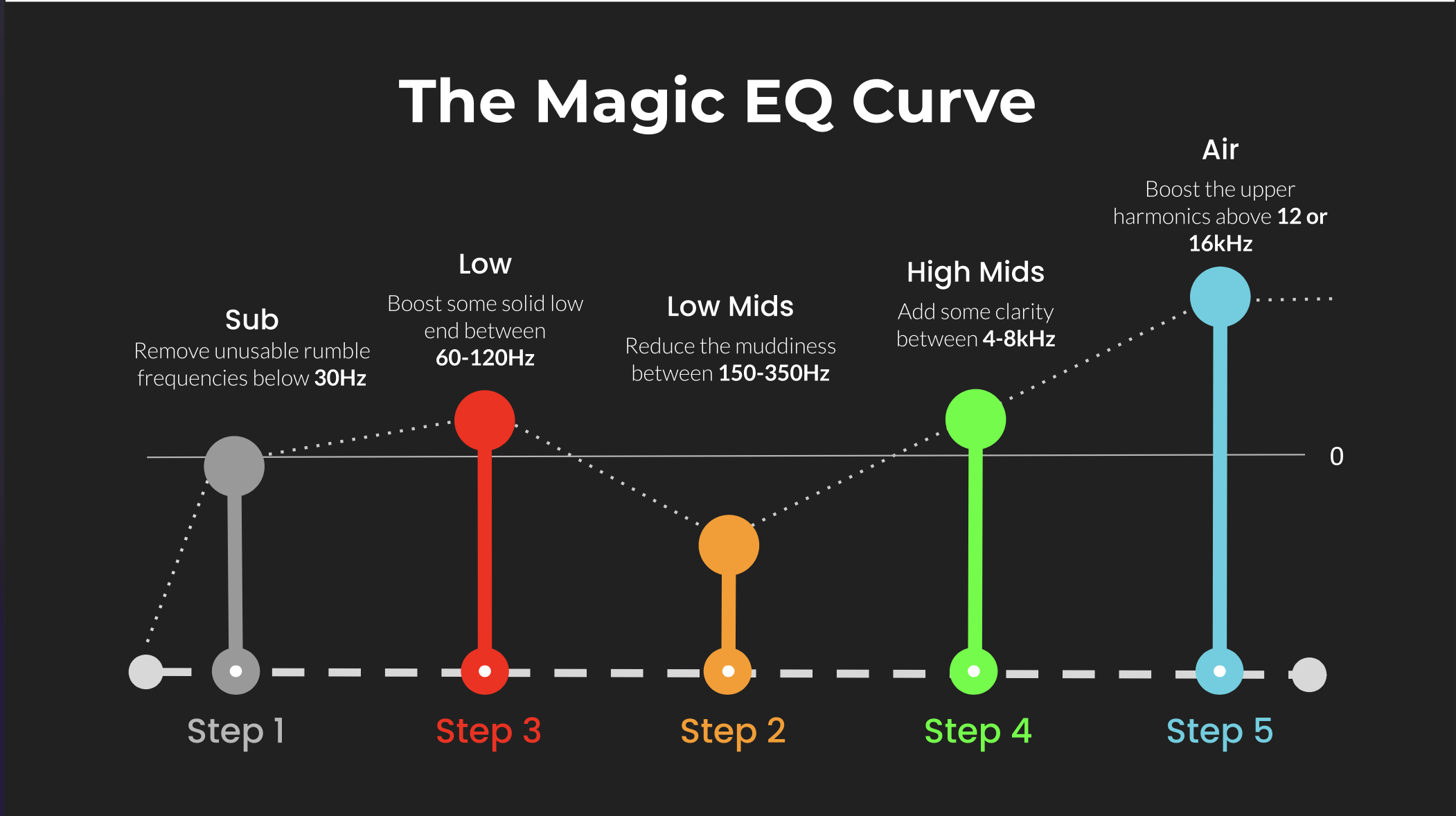 ⭐️ Download my Free Magic EQ settings Guide ⭐️

⭐️ Download my Free Magic Reverb settings Guide ⭐️
#protools #daw #homestudio #recordingschool #recording #musicproduction
Also read:
How to Start Your Own Online Business Teaching Music

Hey, I’m Futch – Music Production Coach and Ableton Certified Trainer

Learn how to make your first song and beat in Ableton Live with my
FREE 90-minute Ableton Live course
I’ve been teaching audio engineering and music production for 35 years.⭐️
Check out my new online music production program: Music Production Ninja…