

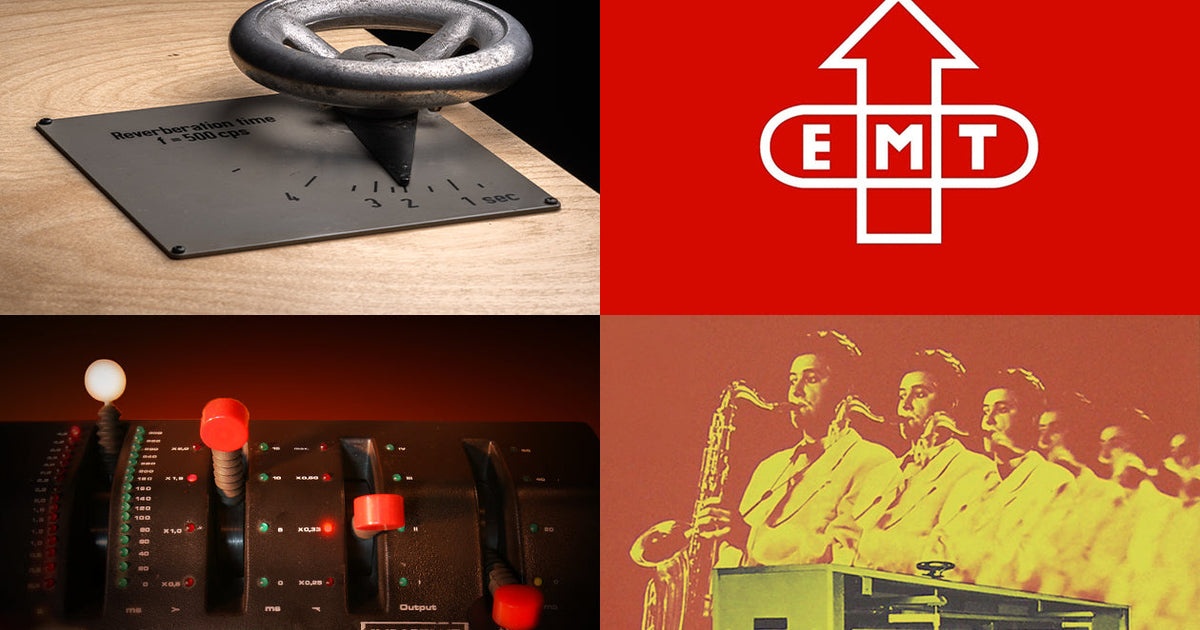

Audio engineers have been using reverb creatively for over a century, finding ways to not only add this effect, but also control it. Here we’ll look back at how a team of engineers brought two groundbreaking reverb units to life as UAD plug-ins.
Available natively for the first time ever, the EMT 140 Classic Plate Reverberator and EMT 250 Classic Electronic Reverberator are the only emulations endorsed by EMT International, giving you the magical sound of original vintage plate and electronic reverbs in stunning end-to-end detail.
Reverb History
With the birth of electro-acoustic recording, reverb as creative expression was essentially the audible byproduct of the physical distance between sound sources and the microphones in any given space. Record companies sought out or built environments for a desired sound. Right from the outset, the early pioneers were already working with rooms and mic placement for a desired ambient effect. As the years went on, recording and playback equipment improved. With this, so did the opportunity to experiment with new ways to create ambience.
Engineer Bob Fine was famous for the use of distant miking, typically using a single mic. This gave Mercury’s “Living Presence” series of classical recordings a stunning, natural reverberation. By pulling the mic back and letting the concert hall do the work, he captured the ensemble as a unified acoustic event, the way a listener might actually experience it.
To the Chamber
It was UA’s own M.T. “Bill” Putnam Sr. who first used artificial ambience on a pop recording in 1947, with the use of the first reverb chamber. The result was a huge hit by The Harmonicats with “Peg o’ My Heart” on Putnam’s own Universal label. A reverberant space was outfitted with a speaker and microphone (in this case, the studio men’s room) to selectively send and return harmonica phrases during the mix process. Having the ability to control reverb amount at will was a major breakthrough developed by Putnam, and a big part of the record’s success.
Putnam went on to build dedicated chambers for his studios in Chicago, as well as his famed Los Angeles studios. The sound Putnam created captured the public’s imagination, and artificial reverb was forever popularized as a production tool for the studio. But for ten years, room recording and echo chambers were the only options. Purtam’s studio and chamber designs can be explored with Ocean Way Studios Deluxe, available as a native UAD plug-in.
Enter EMT
German company EMT (Elektromesstecknik) made a huge breakthrough in 1957 with the release of the electronic EMT 140 Reverberation Unit. This “plate” reverb was born from the Broadcast Technical institute in Nuremburg and the Institute for Broadcast Engineering in Hamburg.

UA’s own EMT 140 plate reverb: the control panel [left] and plate housing [right].
What’s a Plate?
And what are the defining sonic elements of a plate? I got to find out with my own ears during a visit to The Plant Studios in Sausalito, where they have multiple EMT 140 plate reverb units. How does it sound? It has an incredibly fast onset with dense and heavy diffusion. It is warm, open, and wonderfully natural. Not necessarily like a chamber, yet it has chamber-like qualities.
Plates are still used in many studios for their incredible sound. However the detracting trait is their enormous size and weight. An EMT 140 weighs 600 pounds and must have acoustic isolation. Still, it’s an easier alternative to the limits of a dedicated chamber, At least that was the idea, particularly in 1957. Many studios repurposed their chambers as acoustic isolators for their new plates.
“When I heard the EMT 140 plug-in, I instantly remembered standing in a chamber in Detroit. It was that close.”
David Isaac (Marcus Miller, Leonard Cohen, Luther Vandross)

The EMT 140 plate reverb’s amplifier and transducer system allows send and return to the studio control room
Interior of the EMT 140
The plate reverb is made up of a thin, 2 x 3m sheet metal suspended from a steel frame with tensioner clips at each corner. The plate is tuned not unlike tuning the head of a drum. An electrical transducer mounted to the center of the suspended plate induces plate movement, which creates the effect. One or two (mono or stereo) pickups are mounted to the plate for the reverb return. A fiber board damper is controlled by a mechanical wheel remotely by servo motor, Either allow adjustment of the reverb time. All of these elements are built into a heavy wooden enclosure. In 1961, EMT hit another first by adding a stereo return, and by the ’70s, they were manufactured as solid-state instead of the original tube circuit. EMT later made compact plate systems, but the EMT 140 is still considered the final word in plate reverb.

The EMT 140 product sheet from 1960. Better make sure you have a place to put it!
EMT Goes Digital
EMT designed a proof of concept digital reverb in 1972, the EMT 144. But its capabilities were limited. EMT then teamed up with American electronics company Dynatron and Dr. Barry Blesser to create the EMT 250 Electronic Reverberator Unit. In 1976, the first commercial digital reverb was born.

Behold, the entire EMT 250 Digital Reverb. Note the “lollipop” levers and push‑button controls.
A floor-standing unit that looked like a prop from Star Wars, the EMT 250’s controls were simple: Large lollipop-shaped levers and a few pushbuttons. The feature set was impressive: High and low frequency decay controls, built-in predelay and and quad outputs made for an incredibly flexible reverb effect. But the EMT 250 was more than a reverb – it was really the first multi-effects unit also featuring stereo chorus and phasing, as well as a dual delay.
The 250 was soon updated to the EMT 251 and featured a larger set of effects programs and an LCD control display. The 251 also offered an expanded control set and an extended frequency response. But the 250 is the one that became a studio icon.Only 250 EMT 250’s were manufactured. These early digital units are considered some of the best sounding artificial reverb units ever made-quite a legacy for anything considered early digital technology. Both units are nearly impossible to find the used market.
“Forget any other digital emulation, the EMT 250 UAD plug-in could actually be the real thing. Deep, wide reverb, full of personality.”
Rick Simpson (Coldplay, Portishead, Jay Z)
The Studios of EMT
Even with countless alternatives later appearing for both the EMT 140 and 250, each design retained its place as go to processors for the audio community’s most storied studios.
The 140 has held strong to its title as the most ubiquitous reverb, appearing on many of the most celebrated records of all time. Four of the original mono units were installed at Abbey Road Studios, the very first year of production in 1957.
These four early units lended their distinct character to both The Piper at the Gates of Dawn and later Dark Side of the Moon by Pink Floyd, as well as Sgt. Pepper’s Lonely Hearts Club Band and subsequent records by The Beatles. John Lennon was so fond of its distinct sound, he later acquired a stereo EMT 140 to use on his Imagine solo record.
Still relevant to this day, Abbey Road’s four examples are still in use. In the USA, Blackbird, Sonic Ranch, and many other notable studios utilize the legendary EMT 140 plates today.

EMT reverbs can be heard on some of the most beloved albums of all time
Heavily featured by 80’s engineers and artists, the EMT 250 can be heard on both Prince’s Purple Rain and Michael Jackson’s Thriller among other essential releases of the decade. Utilized by everyone from The Red Hot Chilli Peppers to Brian Eno, it’s still recognized today for its undeniable versatility
— Will Shanks and UA Staff
Related Articles
EMT 140 & 250: Classic UAD Reverbs Explained
Everything You Need to Know About Reverb
Recreating the Reverb of Motown
Frequently Asked Questions
What is plate reverb?
Plate reverb is an artificial reverb effect created by sending an audio signal through a large, thin sheet of metal suspended in a frame. Vibrations travel across the plate and are picked up by one or two microphones, producing a dense, warm sound that is distinctly its own.
What is the difference between plate reverb and digital reverb?
Plate reverb is an analog, electro-mechanical process that relies on the physical vibration of metal to create its sound. Digital reverb uses computer processing to simulate the behavior of acoustic spaces, plates, and other reverb sources. Where plate reverb tends to be warm, dense, and organic, digital reverb can be more expansive, malleable, and precise, capable of effects that no analog unit could produce.
What records was the EMT 140 used on?
The EMT 140 has appeared on some of the most iconic recordings ever made. Four of the original units were installed at Abbey Road Studios in 1957, where they were used on albums by The Beatles and Pink Floyd, including Sgt. Pepper’s Lonely Hearts Club Band and The Dark Side of the Moon. John Lennon later acquired a stereo EMT 140 for use on his solo album Imagine.
What was the first digital reverb?
The first practical digital reverb was the EMT 250, introduced in 1976. A floor-standing unit developed in partnership with American electronics company Dynatron and Dr. Barry Blesser, the EMT 250 was also the first multi-effects unit, offering modulation effects like chorus and phasing alongside its reverb.
Can I get the sound of the EMT 140 and EMT 250 without the hardware?
Yes. Both units are authentically modeled as native UAD plug-ins, available without any additional hardware required. The EMT 140 Classic Plate Reverberator and EMT 250 Classic Electronic Reverberator bring the sound of these legendary units directly into your DAW. No 600-pound plate or hard-to-find vintage rack gear needed.