

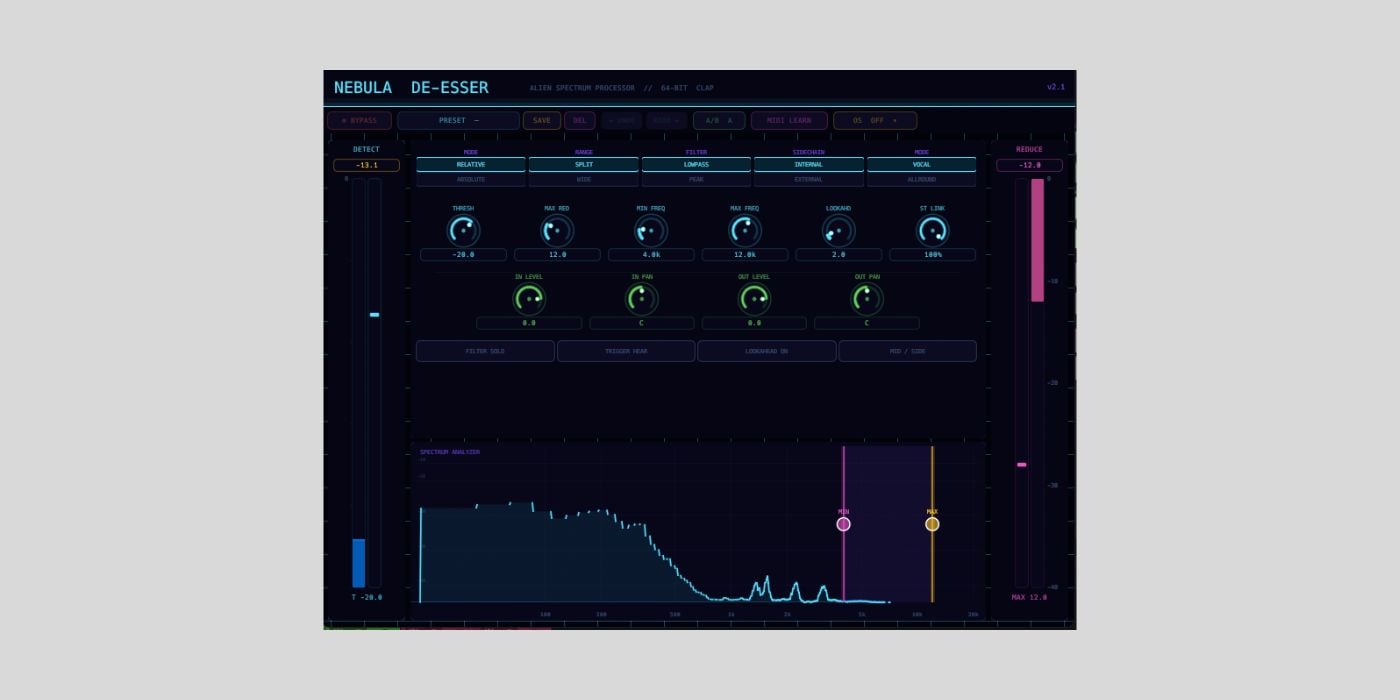

Developer Subhankardas has released Nebula De-Esser, a free de-esser plugin for macOS, Windows, and Linux.
If you tried (or wanted to try) De-Esser NXT, you are aware that it presented a few potential setbacks for some users.
The first is that users had to compile the plugin from source code, and the second is that it’s exclusive to Windows 11.
Therefore, you should be pleased to hear that Nebula De-Esser addressed both of those issues.
Nebula De-Esser is a cross-platform plugin available in 64-bit CLAP format for macOS, Windows, and Linux.
I say it’s a replacement of sorts because it’s a new release in its own right, but it does fill the gap left by the now-discontinued De-Esser NXT.
Both plugins share a few things in common, nothing more significant than the fact that precision is a priority.
Nebula De-Esser boasts a DSP engine running entirely in double-precision (f64), utilising 64-bit IEEE 754 arithmetic for a virtually infinite dynamic range.
One obvious area where Nebula differs from its predecessor is the synthwave/alien aesthetic interface. Purely from a design perspective, I prefer the look of the De-Esser NXT, but obviously, that’s just a preference, and not a problem.
Nebula offers two detection modes: Relative and Absolute.
Relative Mode compares the filtered signal to the full bandwidth, and Absolute Mode triggers on an absolute threshold, acting like a classic de-esser.
You can also adjust the processing range to apply gain reduction across the entire frequency range or within a set band. There’s a Filter Solo function to hear the isolated detection band.
Setting the detection band is easy with a lovely spectrum analyser that lets you drag nodes to set the min/max values.
Additionally, Nebula offers two processing modes: Vocal and Allround.
Vocal Mode is optimised for vocal de-essing, and Allround offers a general approach for mixed material.
Nebula is free to download, but you can purchase it on Gumroad if you’d like to support the developer and the project.
Windows 11 users who tested De-Esser NXT, let us know how Nebula De-Esser compares in the comments.
More:
Last Updated on March 24, 2026 by Tomislav Zlatic.