

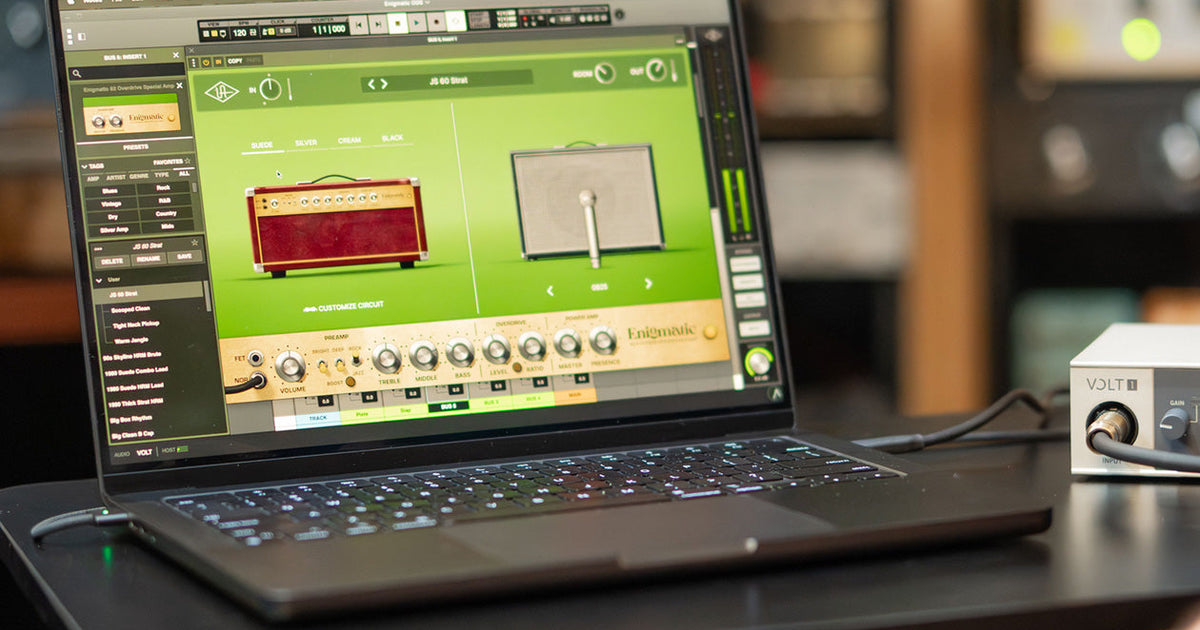

We recreated the sound of guitar amplifiers that sell for a million dollars. Now, they’re available to music creators everywhere.
For guitar players, the Dumble Overdrive Special* is arguably the most immortalized piece of gear ever made. Custom-built in small numbers, and used by artists like Stevie Ray Vaughan, Carlos Santana, and Joe Bonamassa, these amps often sell for well over $250,000.
We sat down with UA product designer and tone guru James Santiago to discover the magic behind the Dumble ODS, and how Universal Audio brought these ultra-rare amps to life as a UAD plug-in.
The UAD Enigmatic ’82 plug-in is built upon two distinct Dumble voices: the clean “Jazz” channel that blooms with shimmer and warmth, and the “Rock” channel that delivers the amp’s signature overdrive and compression.
You already built Enigmatic ’82 as a UAFX pedal. What made you want to put it in a plug-in?
It’s funny, because when I develop these things, I’m on the computer already. It’s almost like the code runs on a computer first and then ends up in hardware, so coming back to a plug-in is an interesting full-circle moment.
But honestly, it almost makes more sense as a plug-in than it did as a pedal. When you pull up the plug-in, you see the full amp panel. All those customizable features that were buried in the alt pages of the pedal, or in the phone app — the HRM section, Deep control, and tone stack mods — you can see them all at once. Visually, it’s just so much fun to work with.
And then there’s the recording context. The DAW is where records are actually made. So having the Enigmatic ’82 as a UAD plug-in means you can drop it on any track that could use a little of that harmonic color. Unlike a Fender or a Marshall, which kind of are what they are, the Dumble is whatever you make of it.
When would you use an amp sim plug-in over an effects pedal?
With the pedal, you commit that sound the moment you track through it. The plug-in stays in the session – so you can come back three weeks later and push the master up a little more, change the preamp mode, or try a different cabinet.
There’s also something to be said for the headspace you’re in when you’re in the DAW. You’re in production mode. You think differently about how a guitar tone sits in a mix. The pedal is a tactile, in-the-moment thing. The plug-in lets you be deliberate.

“These are tones you associate with uniquely great players,” says James Santiago, Senior Product Manager at Universal Audio. “We modeled more than four different eras of amps, from early Santa Cruz builds to later LA studio favorites. No two were exactly alike.”
UA is known for modeling original “golden unit” versions of gear. But with Dumbles, that’s difficult. How did you approach that?
Honestly, it was one of the main reasons I was hesitant to do Enigmatic in the first place. There’s no “perfect” Dumble. There are at least four distinct eras with wildly different circuit topology and components. And within those eras, no two are exactly the same.
So I said, “Look, we’re not just doing this as one amp. We’re doing all four eras, and we’re putting in all the known mods.” That’s the only way to honor what Dumble was attempting to do. You weren’t supposed to just buy one of his amps. You were supposed to make it your own.
“Unlike a Fender or Marshall, two Dumble’s from the same era could have completely different circuits.”
The mic and cab options feel like an underrated part of this thing. Can you walk us through your approach to selecting and modeling the different combinations?
At the end of the day, the cabinet and mic are the number one thing that colors your tone. I’ve had amps that sounded incredible, and then you swap the cabinet and it falls apart immediately. That’s because the original designers were voicing specific circuits and speaker layouts. If you take a Fender Deluxe Reverb and run it into a closed-back 4×12, it can get completely woofy.
Every Dumble player used a different cabinet and speaker configuration. Robben Ford and Larry Carlton went with 65-watt Celestion 2x12s, others used EVs for a cleaner, tighter response. And some went with JBLs. So I went through the history methodically, tallied what the notable players were using, and built out the collection from there. 1x12s, 2x12s, 4x12s — each pairing can be used for different sounds.
A good way to approach Enigmatic ’82 is to find your amp sound first, then flip through the cabinets. Something that sounds weird on its own will suddenly cut through a track. You start to understand why there are nine of them. Frequencies that stand out in a mix with acoustic guitar, drums, and vocals may not be the ones that sound amazing in isolation.

“Along with the speaker cabinet, the mic matters just as much,” explains James Santiago. “A vintage ribbon mic versus a 421 off-axis changes everything. So each cab in Enigmatic ’82 is paired with a mic that makes sense for it.”
Dumble amps don’t have an obvious player archetype like a Vox, Fender, or Marshall. So who is this type of plug-in for?
That’s the point! The famous Dumble players didn’t go to these amps because they were Fender or Marshall guys. They gravitated to them because they were chasing something specific that none of the standard options were giving them. Maybe one guy needed the perfect bloom for slide playing. Someone else needed an amp that wouldn’t collapse under the physical force of how hard they played. Another person wanted a pedal platform with a warmth that didn’t exist anywhere else.
That’s why Enigmatic ’82 ended up with nine cabinet options instead of the usual six. The arrangement dictates the amp. The amp dictates the cabinet.
Out of all the amps we make, the Enigmatic ’82 has the least tonal baggage. When you plug into a Vox, you know what it is. You’ll start playing a Beatles song before you even realize it. D-style amps don’t do that. They ask you: what have you got? You have to play the amp. It won’t play you.
If you had to describe the Dumble sound in three words or less…
Everything I need.
In an age of analysis paralysis and the world’s biggest pedalboards, there’s something freeing about plugging into an amp that makes you just want to put all of that away for a while. If it’s not doing the thing, I know it’s not the amp — it’s me.
— McCoy Tyler, Austin Lyons
FAQ
Why are Dumble amplifiers so expensive?
Howard Alexander Dumble built his amplifiers one at a time, by hand, for a small circle of elite players. He didn’t advertise. He didn’t produce them at scale. He chose his clients. The result was an amp with an almost mythological reputation: dynamic, touch-sensitive, musical in a way that many players struggle to articulate, but immediately recognize.
Learn more about the history of Dumble amplifiers ›
Are Dumble amps worth it?
For most players, owning an original Dumble amp isn’t a practical option. With only a few hundred ever made, they’re nearly impossible to find, rarely heard in person, and often priced well above six figures. That puts them firmly in the realm of collectors and elite session players, not everyday recording tools.
So are they worth it? In terms of tone and feel, absolutely. But in terms of access, cost, and usability, most players are better served by modern alternatives. The real challenge lies in capturing the essence of what makes a Dumble special.
Since these amps weren’t built to a fixed spec, each one was a unique instrument tailored to a specific player. So recreating that experience isn’t just about getting a perfect replica of an original Dumble amp. It’s more about learning to perform with the type of amp that responds to your touch, cleans up with your guitar’s volume, and pushes into rich, musical saturation without ever getting harsh.
Are there good alternatives to a Dumble amp?
Today, getting the experience of playing through a Dumble is far more accessible. Whether you choose a high-end amp modeler or effects pedal, or modern plug-ins built to bring the same dynamic response and harmonic depth to your DAW recordings, you can get incredible “D-style” tones in live or studio settings.
When should you use amp sims vs real amplifiers?
Most modern workflows rely on both, depending on what the session or situation calls for.
In general, you’d use amp sims when you need speed, flexibility, and consistent results. Plug-ins like UAD Enigmatic ’82 Overdrive Special Amp let you dial in great tones instantly without mics, room treatment, or committing early. They’re ideal for in-the-box production, home studios, and sessions that demand quick recall.
Real amps are better when you want the physical feel of air moving and natural feedback. They shine in dedicated studio setups or live environments where volume and speaker interaction shape the performance.
Related Articles:
The Amazing History of Dumble Amplifiers
Introducing Paradise Guitar Studio
The Secrets Behind UAFX Guitar Amp Emulators
UAD Showtime ‘64 Tube Amp Plug-In: Get Big Bold Clean Tones Inside Your DAW
*All trademarks property of their respective owners. Use of artist names does not constitute endorsement of UAD Enigmatic ’82 Overdrive Special Amp.