

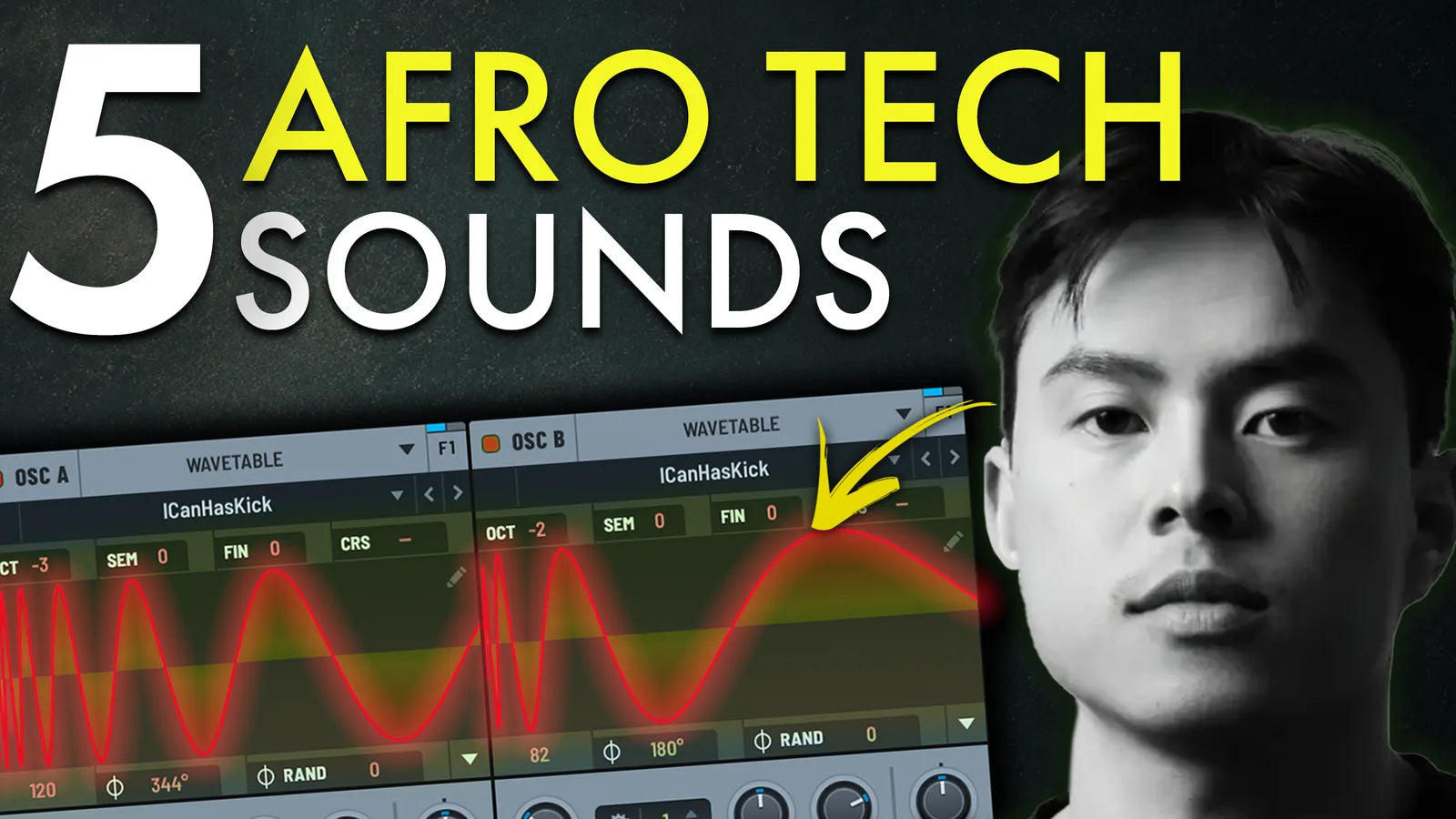

Getting the signature Afro Tech aesthetic right is the hard part. The genre lives on its percussion, but that is only half the story. The other half is a handful of melodic and bass sounds that give these tracks their soul, and that is what we are building today.
This breakdown covers five sounds pulled from the biggest records in the genre, inspired by the Magnifik label sound, Juno, HotLap and more: the energetic bass lead, the groovy bassline, the Afro House pluck, the chord stabs, and the atmosphere. Here is what makes each one tick and how to dial it in with Serum, so you can drop them straight into your own tracks.
The Energetic Bass Lead
This lead lives on the lower side of the spectrum: aggressive and driving, but not your bassline. High-passed around 100 Hz it sits above the sub and reads as a lead instead of fighting for space. Its grit comes from FM modulation on the noise oscillator, and the menace is in the notes too, a half-step move (root, F, then F to F#) for a tense, Phrygian colour.
Key settings:
- ICanHasKick and Supersaw combination
- FM from the noise oscillator for grit
- High-pass near 100 Hz to make space for the main bass
- Half-step Phrygian movement for the aggressive edge

The Groovy Bassline
An Afro Tech bassline is almost never one instrument. It is a stack of three, each with one job, and the groove comes from syncopation. The sub carries the weight, the mid bass carries the character, and a sub drop adds low-end weight in key moments.
Key settings:
- Sub: custom Serum waveform on a single fundamental for weight
- Mid bass: shaped in-synth with filter and built-in EQ for character
- Sub drop: extra low end for impact moments
- Syncopated timing to create the groove

The Afro House Pluck
One note, one saw, and one of the most powerful rhythmic tools in the genre. Without extra tweaking it sounds generic, so all the life comes from modulation.
Key settings:
- Subtle pitch LFO so the note never sits still
- Short, plucky envelope so it reads as rhythm, not harmony
- Mod wheel mapped to envelope decay and filter cutoff for hands-on builds

The Chord Stabs
A big chord stab almost never comes from a single preset. It comes from layering sounds that complement each other in frequency and stereo width, so “massive” is about arranging space, not turning things up. Stab one is deep, stab two is brighter with more reverb, and stab three is distorted for grit and presence, while the one-note pluck running through the track adds rhythm and energy.
Key settings:
- Layer roles: deep, bright-and-reverberant, distorted
- One frequency range and stereo position per layer
- EQ carving where layers mask each other
- Separation over loudness for size

The Atmosphere
The sound most people skip, and the one that quietly glues the track together. It is usually a single held note, the root or the fifth, running under everything, with a second, higher drone brought in only for bigger moments.
Key settings:
- Low pad from a custom choir wavetable, bins reshaped by hand
- Band-pass into the mids so it supports, not clutters
- Second atmosphere: filtered supersaw drone
- LFO on drone level and filter for movement through transitions

Grab the full project
Want the exact sounds instead of rebuilding them? Savanna Vol. 1 has the project files, MIDI, Serum presets, and drums behind this whole breakdown, and the drums work well beyond Afro Tech too.
Watch the full breakdown
See every sound built step by step in the video: