

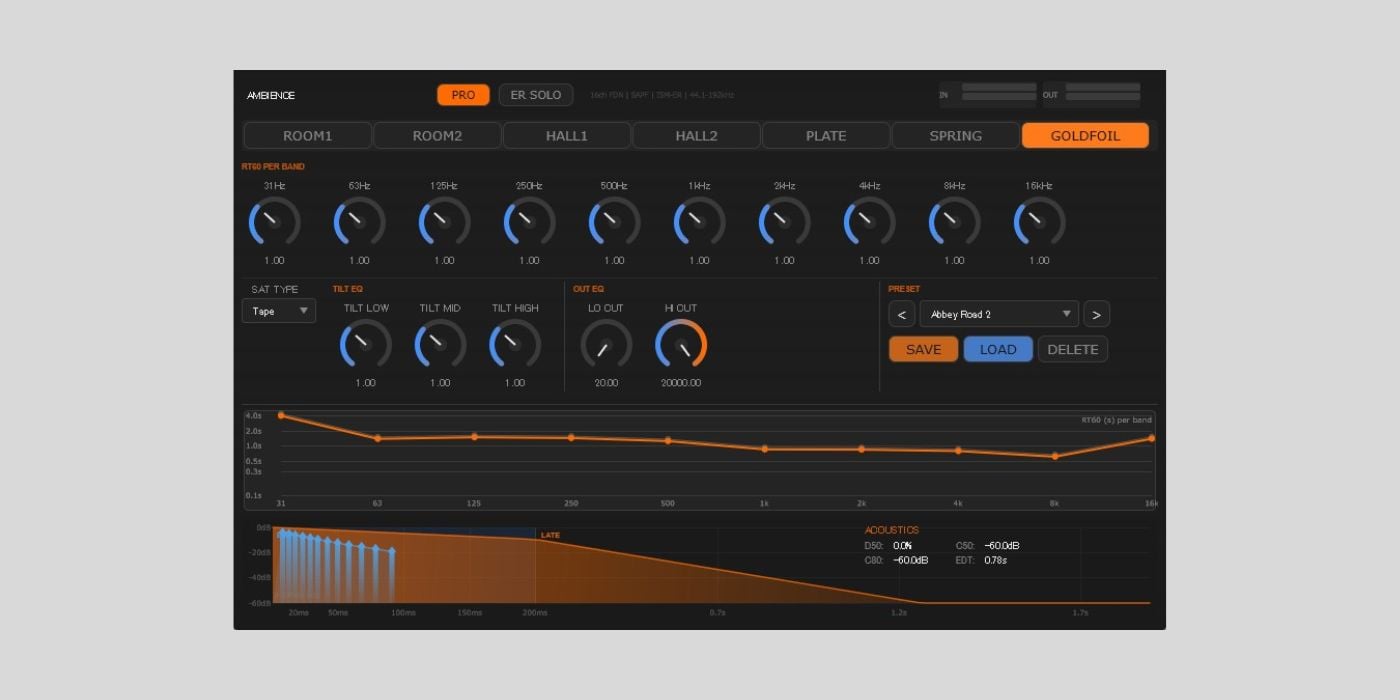

OTODESK has released Ambience, a free and open-source algorithmic reverb plugin for Windows.
Ambience is a 16-channel Feedback Delay Network reverb from Makoto Iida, a solo developer and hobbyist producer behind OTODESK.
I asked the developer how he made the plugin and was surprised to learn that it is not based on convolution and that there are no impulse responses involved. Makoto says the hall and studio presets are algorithmic approximations shaped with RT60 curves, early reflection patterns, and absorption settings rather than sampled spaces.
I asked Makoto about this directly because reverb plugins often mix algorithmic design and sampled spaces. His answer was clear. Ambience uses a 16-channel FDN for the reverb core, while the early reflections are generated with the Image Source Method.
The development story is interesting, too. Makoto says he is not a trained audio engineer, so he rebuilt the plugin from academic papers while using AI heavily as a pair-programming and debugging partner.
In other words, AI helped him write and fix the C++ code, but Makoto says the design choices came from reading the research, choosing the algorithms, setting the FDN topology, tuning the absorption model, and adjusting the presets by ear against reference recordings.
Also, since the project is open-source, anyone can inspect the code on GitHub.
Ambience includes seven reverb algorithms, covering ROOM1, ROOM2, HALL1, HALL2, PLATE, SPRING, and GOLDFOIL. The factory preset list includes 21 spaces and reverb types inspired by Abbey Road Studio 2, Vienna Musikverein, Concertgebouw, Carnegie Hall, EMT 140 plates, spring tanks, cathedrals, and more.
The FDN core uses a Fast Walsh-Hadamard Transform feedback matrix, with 16 prime-tuned delay lines designed to avoid obvious comb filtering.
Each FDN channel also has a 10-band GEQ absorption stage based on the Valimaki-Liski approach for frequency-dependent RT60 shaping. In plain English, the reverb can decay differently across the frequency spectrum, which is a big part of making a space feel more natural or more stylized.
There is also an ADAA saturator with Warm, Tape, Tube, and Hard modes, plus live acoustic readouts for D50, C50, C80, and EDT. The Pro mode unlocks per-band RT60 multipliers from 31 Hz to 16 kHz, Low/Mid/High Tilt controls, and the saturation type selector.
Ambience is available as a free GPLv3 release. It runs on Windows 10 and 11 in VST3 and standalone formats, requires an AVX2-capable CPU, and was developed and tested in Ableton Live 11 and 12. macOS and AU are not supported, and OTODESK recommends Ableton Live because other DAWs are unverified.
Download: OTODESK Ambience (FREE)
Deal of the day 🔥: EXCLUSIVE ROLAND SALE (up to 80% OFF)!
More:
Last Updated on June 2, 2026 by Tomislav Zlatic.