

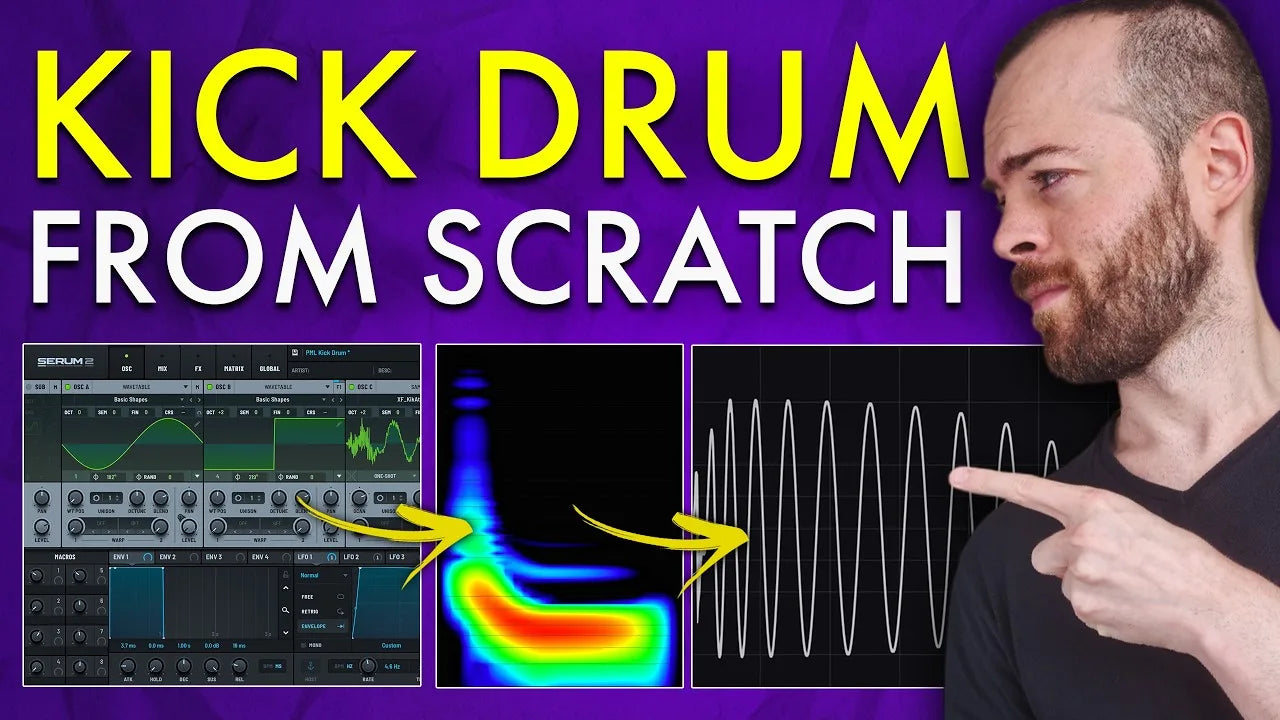

A great kick is not one sound, it is three parts working together: the click, the punch, and the tail. This breakdown builds a kick from scratch in Serum 2, shaping each part with the oscillator, the pitch envelope, and the amp envelope.
The Anatomy of a Kick
Click, punch, tail. The amp envelope controls the amplitude and shapes the overall sound, while the pitch envelope modulates the oscillator’s pitch and creates the punch.
Key settings:
- Click: the very start, the high-frequency attack
- Punch: the pitch dropping fast, driven by the pitch envelope
- Tail: the sustained low-frequency body, shaped by the amp envelope

The Body and Pitch Drop
Start with a pure sine for the body. The punch comes from a fast pitch drop, an envelope routed to the oscillator’s coarse pitch.
Key settings:
- OSC A: a sine wave, with phase randomness (RAND) set to 0 so the kick stays consistent and stationary
- Route an envelope (LFO 2 in envelope mode) to CRS (coarse pitch) for a fast pitch drop, the punch
- Shape the pitch envelope’s decay for how snappy the drop feels

The Punch and Body
The amp envelope sets the length and shape of the body: a fast attack and a decay that fits the groove.
Key settings:
- Route an envelope (LFO 3 in envelope mode) to level for the amp shape
- A short, snappy decay for a tight kick, longer for more body
- Watch it on a spectrum analyzer or spectrogram to check the low-end shape

The Click and Drive
The click and character come from drive and distortion, so the kick cuts through on any system.
Key settings:
- Add a Distortion in the FX chain, with an envelope (LFO 3) to DRIVE so it hits hardest at the transient
- Use FM or noise for extra click if needed
- Check it against a reference on a spectrum analyzer

Go deeper on your low end
Want powerful kicks and bass from start to finish? The Low End Course covers the sound design and metering behind a professional low end.
Watch the full breakdown
See the whole kick built in the video: