


Most producers have imagined it at least once: what if I had my own plugin?
Something with your name on it. Something that takes a piece of your sound, your taste, your workflow, and turns it into an instrument that other people can use inside their own music.
For a long time, that idea felt just like a dream and a long-term vision.
I’m Fabio, the producer and sound designer behind HydraTek. My background sits somewhere between electronic music production, sound engineering, teaching, and experimental sound design. Over the years, I’ve worked on soundbanks, demos, educational content, and collaborations with several companies in the audio world.
I’ve also spent a lot of time writing about plugins here on BPB alongside Tomislav, testing them, and trying to understand what makes a tool feel inspiring rather than just functional.
But releasing my own plugin always felt like a different level. Not because I didn’t have ideas. I had too many. The hard part was turning one of those ideas into something real, finished, distributable, and useful to other producers.
That is how Erebos was born.
What HydraTek Means To Me
HydraTek started as my artistic identity in my 20s, but over time, it became something broader.
The name itself contains the two sides of what I do. “Hydra” represents the dark, multi-headed part of my sound: cinematic, aggressive, emotional. “Tek” represents the technical side: synthesis, research, sound design, modern electronic music culture, and a forward-thinking approach to production.
I never wanted HydraTek to be only a music project. I wanted it to become a sonic world.
That world lives between dark cinematic storytelling and underground club music. It is where heavy basses, distorted textures, horror atmospheres, industrial techno energy, and experimental processing can coexist. The common thread is not a genre. It is a feeling: the idea that sound can reveal hidden forms, hidden emotions, hidden violence, or hidden beauty.
At a certain point, I started asking myself a bigger question: could I create a tool that gives other producers access to that same kind of transformation?
Why I Wanted To Create A Plugin
When I work on music, especially darker electronic or cinematic material, I often look for the “shadow” of a sound. I may start with a vocal, a pad, a piano, a brass texture, or a synth line, but I’m rarely interested in leaving it as it is. I want to find its darker counterpart.
Sometimes that means adding a specific movement, distortion, filtering, spectral tension, or a layer that feels like it is hiding underneath the original source.
The problem is that this usually takes a chain of different tools. You open a distortion plugin, a filter, a modulation effect, an EQ, or even a reverb processor. You gain-stage everything, automate parameters, balance it, and eventually arrive at something interesting. That can be powerful, but it can also break the creative flow.
I wanted something more immediate and performative. A tool where the artist could insert it into a sound and start playing with a dark cinematic layer in real time, almost like a live guitar pedal. Something that was not about surface-level technical complexity but still had enough depth beneath to feel alive and deeply musical. That became the core concept of Erebos.
The name comes from Greek mythology: Erebos is associated with darkness, shadow, and the space between worlds. That felt right for what the plugin does. It does not simply “alter” the source. It reveals another version of it.
From Concept To Controls
One of the biggest challenges was deciding what Erebos should not be.
When you design a plugin, especially your first one, it is tempting to include everything in your head. Every possible parameter, every advanced feature, every small control you think someone might need. But I knew that would go against the point.
Erebos had to feel like a user-friendly modern performance tool. The user should not need to study a manual for an hour before getting something inspiring out of it. It had to be direct, visual, tactile, and aesthetically captivating.
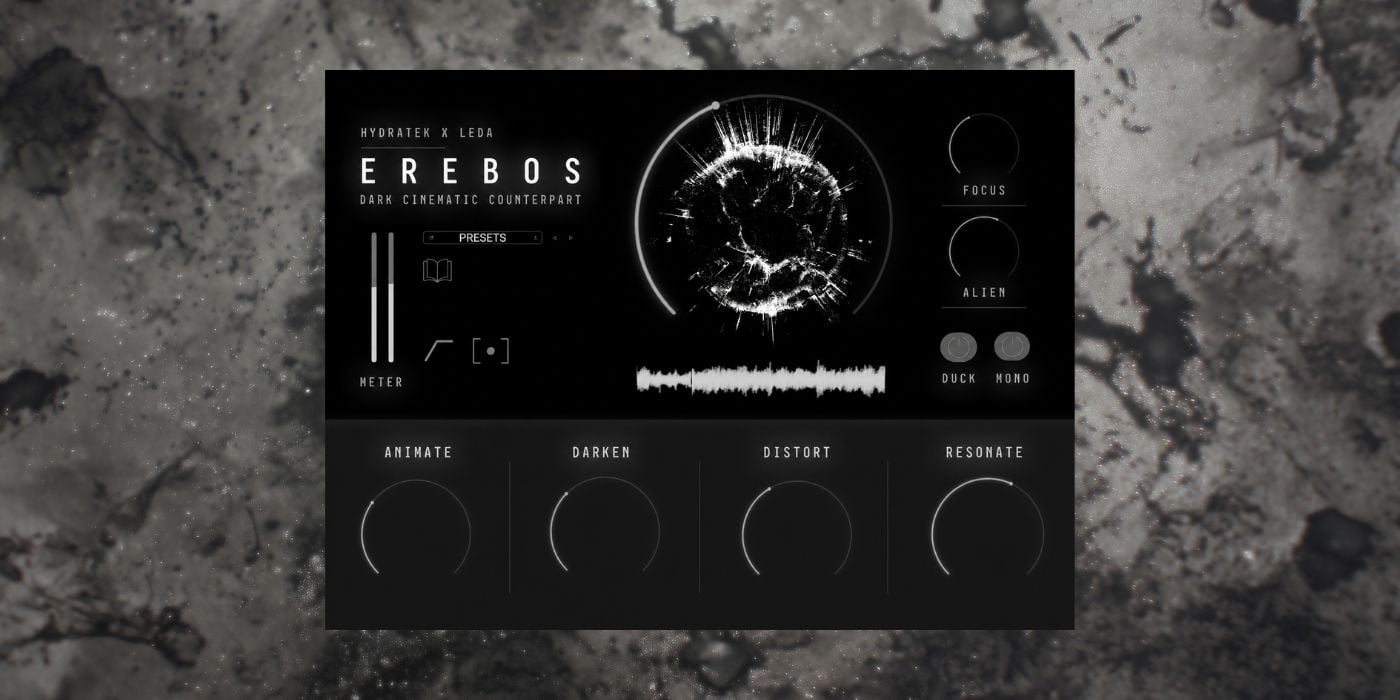
The final interface is built around a central interactive dry/wet control and a small number of expressive macro controls. Each one is designed to invite immediate interaction rather than deep analysis.
- Animate brings motion and life into the processed layer.
- Darken pushes the signal into a heavier, more obscure tonal space.
- Distort introduces saturation, weight, and aggression.
- Resonate shapes the ringing, filtered part of the sound.
Around those main controls, there are additional performance-oriented options such as grain pitch, mono switch, high-pass filtering, ducking, and focus modes for more experimental tonal behaviors.
The main philosophy remains simple: put the plugin on a source, turn up the central dry/wet dial, play live with the controls, and listen to how the sound starts revealing another nature.
I wanted Erebos to feel especially effective on tonal sources like pads, vocals, piano, sax, brass, drones, and atmospheric material. Those kinds of sounds give the processor enough harmonic information to create eerie layers, cinematic shadows, and strange evolving textures.
Designing The UI With A Human Touch
The interface was another essential part of the process.
The visual side had to feel connected to the sonic concept: minimal, modern, obscure, tactile, and slightly mysterious.
The UI was designed by Leda, a brilliant audiovisual composer, programmer, and old friend of mine, who helped me translate the emotional world of the plugin into a visual object. That collaboration was important because the interface needed to communicate the tool before the user even touched a knob.
A good plugin UI is not only decoration. It tells you how to behave.
With Erebos, I wanted the user to feel invited to perform. The central control had to feel like the heart of the plugin. The surrounding parameters had to feel close enough to encourage experimentation, but not so crowded that the user would feel lost.
Discovering Audioloom
As a producer and sound designer myself, I could imagine the sound and the concept. I could think about the creative direction, the controls, the use cases, the audience, and the identity. But then came the other side of the process: technical development, coding, licensing, installers, store management, customer support, updates, compatibility, and distribution.
Those are not small details. They are often the reason why many producers never move beyond the idea stage.
I came into contact with Markus years ago while supporting their Yum Audio products, and we crossed paths again when discovering their new ambitious project: Audioloom. This platform lets creators build and distribute their own audio plugins without writing code. The process happens directly in the DAW, including UI design, while the platform handles the infrastructure around the product: store, licensing, customer support, updates, and distribution, without any upfront costs.
For me, that changed the equation. It did not remove the creative work. Actually, it made the creative work an essential part of the process. But it removed many of the technical and logistical barriers that usually stand between an idea and a release.
Erebos still needed a concept, a sound, a direction, a UI, testing, refinement, naming, positioning, and a reason to exist. But Audioloom made it possible to focus on those things without having to become a full software company overnight. For independent artists, that is huge.

No AI Development
One thing that mattered to me was keeping the process human.
We live in a moment where audio tools, music, and marketing can quickly collapse into generic AI-generated aesthetics. I understand why that happens. Everyone is trying to move faster, release more, and keep up with the constant pressure of content. But for Erebos, I wanted the opposite.
The DSP, interface, and technical support were curated and developed by humans. The concept came from years of music production, sound design, and obsession with dark sonic worlds.
That matters to me because I do not see HydraTek as a content machine. I see it as a body of work.
If someone buys and supports Erebos, I want them to feel that they are not just downloading a utility. They are entering a specific sonic perspective. They are taking a piece of my HydraTek world and bringing it into their own workflow.
That is also why the plugin is not presented as a “magic fix.” It is not supposed to replace taste. You still have to listen, choose the source, play with the controls, and find the point where the sound starts speaking back. That is where the fun is.
What Other Producers Can Learn From This
If another producer is reading this and thinking, “I would love to build my own plugin one day,” my advice is simple: start from your vision.
Do not just begin by asking, “What plugin could sell?”
Ask, “What do I keep doing in my own music that other people might find useful and inspiring?”
A plugin needs to express one strong idea clearly. Erebos does not try to represent everything HydraTek can be. It focuses on one small part of my world. That focus made the product possible.
The other advice is to respect the technical side without letting it kill the idea. Licensing, support, updates, installers, and store infrastructure are indeed real barriers. Ignoring them is naive. But today, platforms like Audioloom can make that side much more accessible for independent creators.
That means the question becomes less “Can I technically build a plugin?” and more “Do I have a strong enough idea to justify one?”
What Comes Next
Erebos feels like the beginning of a new chapter for me.
I still want to release music, create soundbanks, share my knowledge with other artists, and keep exploring dark electronic sound design. But now I also see a path where HydraTek can become a small ecosystem of creative tools, each one focused on a specific emotional or sonic function.
The biggest challenge will be keeping my identity strong. It is easy nowadays to release products. It is harder to build a world where every product feels necessary and has a story. I do not want to create hundreds of tools just because I can. I want each one to come from a real creative need and vision, the same way Erebos did.
For now, I am happy that the first one exists, and people around the world are downloading it and resonating with the work we did. And that is the most exciting part: not just releasing a plugin, but realizing that your sound can become a creative tool in someone else’s hands.
This article contains affiliate links, which means BPB may earn a commission if you purchase through those links at no extra cost to you.
More info: Erebos
Last Updated on July 1, 2026 by Tomislav Zlatic.