

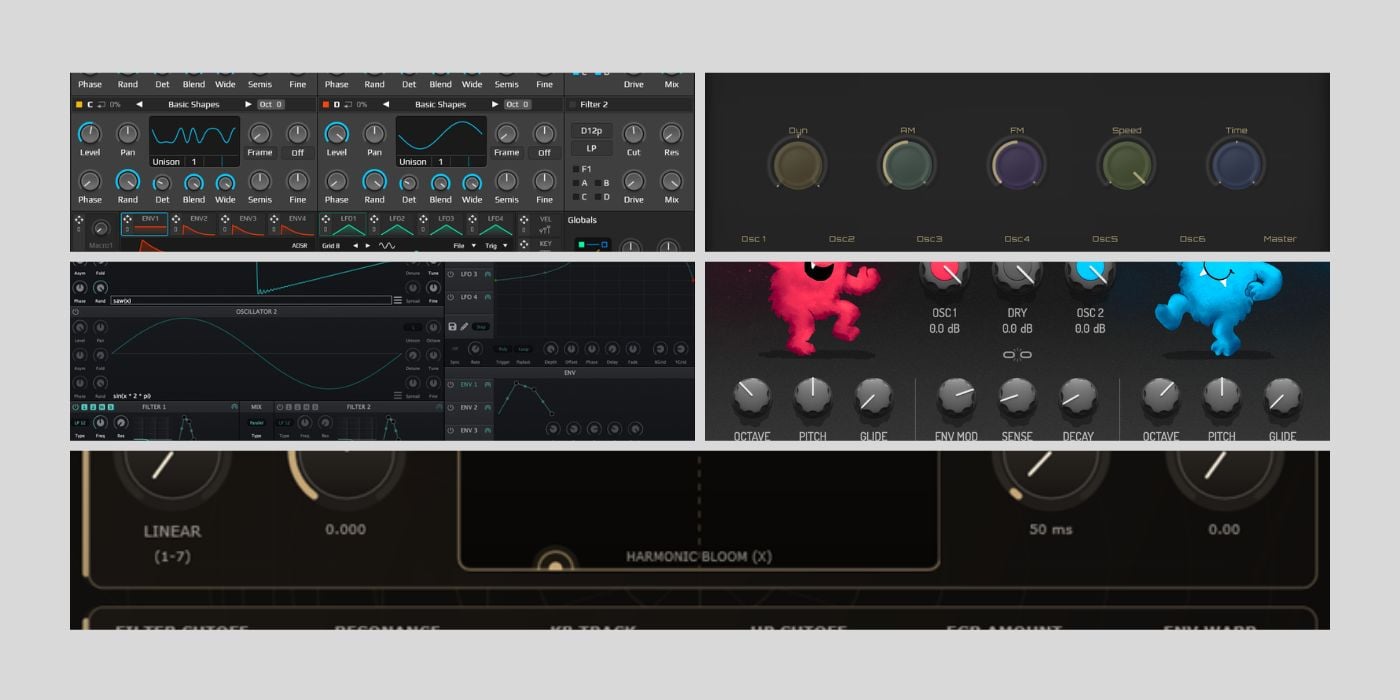

The KVR Developer Challenge 2026 is underway, and with over 50 freebies on offer, we’ve got lots to choose from.
We’re taking a quick look at some of the synths from this year’s contest, and it’s a pretty impressive lineup.
We have almost a month before the winners are announced on August 4, 2026, but you’d best get started now if you want to try out everything before the voting closes.
Tilr – TetraOP
Tilr is a developer that really hit the ground running, and has gone from strength to strength over the last year or so.
Tilr’s entry for the KVR Developer Challenge 2026 is TetraOP, a four-oscillator/operator wavetable and FM synth.
TetraOP functions as a wavetable synth, an FM synth, or a hybrid of the two.
It offers sixteen unison voices per operator, five unison modes, and eight phase distortion modes.
There are ten built-in FM/RM algorithms and an FM/RM routing matrix for creating more.
You also have two multi-mode resonant filters, four envelopes, four LFOs, and four macros, completing a drag-and-drop modulation setup.
There’s even a very aptly named Sharknado preset.
The interface is well-designed and includes dedicated FX and Mod tabs (built-in FX include compression, distortion, chorus, phaser, delay, reverb, and EQ).
In terms of sound, it has a lot to offer, from 80s-style bell piano tones to funky synth brass to ambient sounds ideal for media composition.
TetraOP is available in AU, VST3, and LV2 formats for macOS, Windows, and Linux.
John Crosby Acoustics – Ouranos7
Ouranos7 is a love letter to one of the most iconic, era-defining, and frustrating synths of the 1980s: the Yamaha DX7.
This six-operator FM synth comes from over four decades of exploring the DX7 sub-menus, a journey many wouldn’t have survived. But John Crosby made it, and now we have another way to get legendary sounds for free, without the hardware headache.
Ouranos7 features a 7×6 FM/AM modulation matrix, 25 tuning tables, and seven Bézier-curve ADSR envelopes.
I know the electric piano might be a little played out, but don’t tell me you won’t rock that Kenny Loggins Danger Zone bass!
Ouranos7 is available in AU, VST3, AAX, and CLAP formats for macOS and Windows.
SocaLabs – Identity
Identity is a polyphonic synth centered on two formula oscillators.
What I like about Identity, even before spending any proper time with it, is that it crams some complex stuff into a very manageable package.
As unappealing as it sounds to think about maths when making music, the formula oscillators offer vast potential by breaking the boundaries of traditional waveshapes.
The synth also features a sub-oscillator, white/pink noise generator, four MSEG LFOs, and two multi-mode filters with envelopes.
Additionally, three modulation envelopes complement a multi-mode modulation matrix.
A built-in arpeggiator offers even more rhythmic movement.
SocaLabs has added seven reorderable effects, including Gate, Chorus, Distortion, Delay, and more.
One of my favorite things about Identity is that it offers per-voice vibrato and analog drift with MPE support. So, it has the potential to be an extremely expressive synth.
Identity is available in AU, VST3, LV2, and CLAP formats for macOS, Windows, and Linux.
Bjango – Double Freak
Congratulations to our recent Bjango giveaway winners. And if you didn’t win, now you can grab a freebie from Django.
Double Freak is the perfect name for this unruly two-oscillator synth plugin; on one hand, it does exactly what it says on the tin without complications, on the other, it’s entirely unpredictable.
The catch is that what it says on the tin is I’m going to be unpredictable.
Double Freak follows the pitch of incoming audio, offering sawtooth, square, and triangle waves to thicken (monsterize?) your sound.
As well as the analog-modeled distortion, envelope modulation and decay allow you to bend the start of notes up or down.
So, you can alter the shape of your melodic lines along with the texture.
I think it sounds great on vocals.
It’s important to note that the pitch tracking is intentionally erratic on polyphonic and atonal input.
Double Freak is available in AU and VST3 formats for macOS and Windows.
bdEnergy – The Hydra
The Hydra is a monophonic additive synth plugin that constructs timbre from first principles.

With a seven-voice harmonic engine, The Hydra builds sound partial by partial.
Rather than using filters to carve out the perfect timbre, you’re creating it from the ground up.
As you release more partials from silence, you have complete control over the Harmonic Bloom and Spatial Spread with a large X/Y pad.
The Hydra also features analog-modeled saturation and a nonlinear delay-feedback ladder filter.
This synth is for keen sound designers, but not because it has endless parameters or a complex GUI; it’s about enjoying the process and the craft of building your sound.
The Hydra is available in AU and VST3 formats for macOS and Windows.
Any favorites so far?
It’s still early days, but feel free to share your favorites and what you like about them in the comments.
Thank you again to the developers who take part in the KVR Developer Challenge.
More:
Last Updated on July 9, 2026 by Tomislav Zlatic.