

Learn how Tony Award-winning Stereophonic captured the tone of a vintage studio onstage.
With a staggering number of Tony Award nominations — including wins for Best Play, Best Sound Design for a Play, and Best Director — Stereophonic centers around a 1970s recording studio where an up-and-coming rock band records their new album while standing on the brink of superstardom.
To recreate the warmth and fidelity of a classic analog studio live onstage, the production’s team turned to Universal Audio. Sound designer Ryan Rumery, music director Justin Craig, and composer Will Butler (formerly of Arcade Fire) developed a hybrid live-studio sound design that allowed actors to perform as a real band while audiences heard the polished sound of a finished record.
We caught up with Rumery and Craig to understand how they used Apollo interfaces and UAD plug-ins to capture the actors’ performances in realtime.
The cast of Stereophonic in the control room. Note vintage ’70s G Series Cadac 36 channel desk and authentic — and operable — Studer A80 24-track tape machine on the right.
Hybrid Live-Studio Sound Design for Broadway
Can you tell us how Apollo and UAD plug-ins were used for Stereophonic?
Ryan Rumery: From the start, we needed a common language for this ambitious thing that we were attempting to do. Apollo interfaces, UAD plug-ins, and the Console app are tools that Will, Justin, and I have used for years, so we’re all fluent in that language.
Because of that, we could communicate ideas immediately. We could literally share screens and look at the same inserts, buses, sends, and returns together — just like engineers working together in a recording session.
That level of transparency made it possible to bring a studio workflow onto a Broadway stage, where the cast could perform as a band while we shaped the sound in realtime.
Have you ever worked like that before?
Ryan Rumery: That kind of close technical collaboration is somewhat rare in theater sound design. But when you’re trying to create a live band sound onstage, latency becomes a huge concern.
With Apollo interfaces and UAD DSP processing, we could run plug-ins in realtime through the Console app with near-zero latency monitoring. That meant vocals, guitars, drums, and keyboards could all be processed live while still feeling natural to the actors performing onstage.
It allowed us to treat the production like a live recording session rather than a traditional theatrical sound system.
Justin, tell me about your role as Music Director.
Justin Craig: Part of what’s unusual is that I’m both the music director and the co-orchestrator, alongside Will Butler. And for this show, we were in somewhat uncharted territory.
Usually when I’m in the MD role, I’m the bandleader by way of actually playing an instrument. But here, the cast is the band, and I’m not performing onstage. In my non-theater life, I produce and mix records. So I approached the show with that mindset.

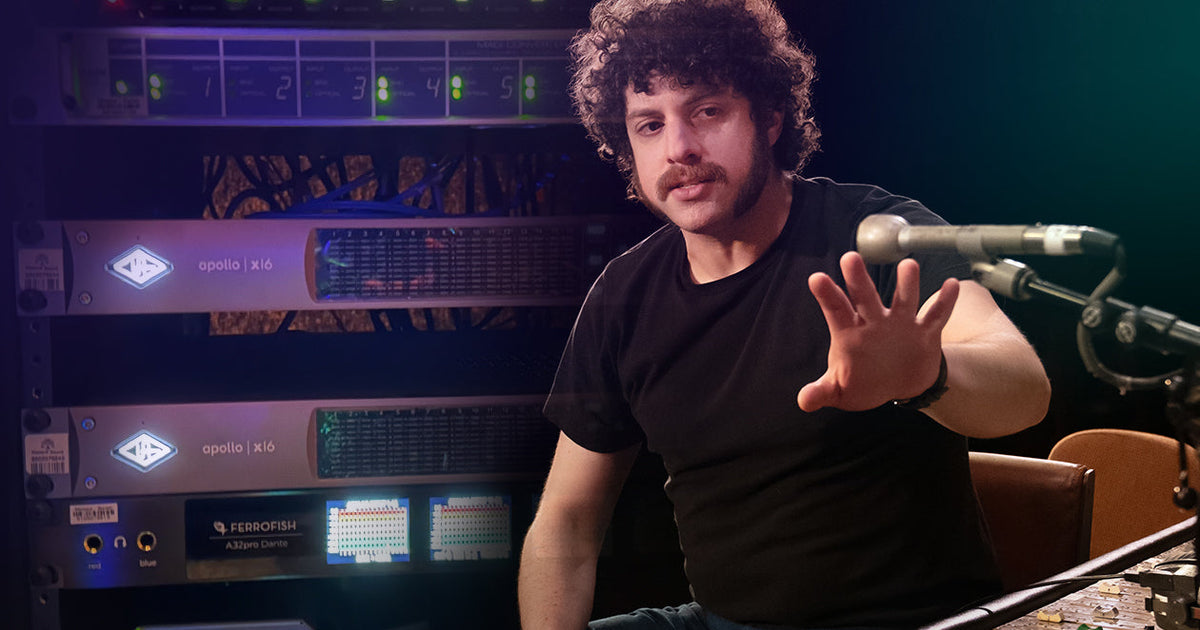
Every instrument on the set of Stereophonic went through two Apollo x16s.
How did your “producer brain” tackle some of the problems that can arise when actors are cast as musical performers?
I set out to create an authentic band. I needed to understand the skillset of each actor, and play to their strengths and find musical phrases and parts that suited their individual skill sets.
One of the actors had a little experience on their instrument, and others had to learn pretty much from square one. Vocal arrangements were a big deal. They were key to defining the overall sound of the band, and helping the actors really connect musically.
And, of course, we wanted to create a strong 1970s aesthetic. And Ryan was equally important to this process.
“UAD plug‑ins are far more than just the ‘icing on the cake’ in Stereophonic. UAD is literally the cake and the icing.”
Ryan Rumery
Creating Classic 1970s Recording Sound
What were some of your reference points for the analog tones you were after?
Justin Craig: When we were developing the sound of Stereophonic, I was referencing a lot of classic ’70s recordings — Fleetwood Mac, 10CC, Steely Dan, and early Tom Petty records.
That great snare sound from Al Green records was also in my head.
Ryan and I agreed that if we’re staging a recording studio, the sound should already feel like a finished record coming out of the monitors. So anytime the audience hears something — whether it’s the band playing or a playback moment — it should have that 1970s studio polish.
Ryan Rumery: Fortunately, capturing those exact sounds is one of the greatest strengths of UAD plug‑ins. They give you that tone from the golden age of analog studios, and it evokes the mid-’70s aesthetic incredibly well.

Recording engineers Charlie (Andrew L. Butler) and Grover (Eli Gelb) at the console. For certain scenes, the actors will ride six to eight “live faders” and operate the Studer tape machine with the Cadac console’s custom-made, in-console tape transport.
How are the sources routed and processed?
Ryan Rumery: We wanted the audience to hear something that felt like it came straight off a vintage record. So everything onstage routes into Apollo interfaces and the Console app, exactly like a studio tracking session.
Them we bus everything — vocals, guitars, keyboards, and especially drums — so that we can shape the sound with compression and EQ in realtime.

A garden of analog delights with Pultec, Studer, and Teletronix UAD plug‑ins giving Stereophonic classic, album‑ready sound.
What plug‑ins did you use to capture that vintage ’70s sound?
Ryan Rumery: The first thing we did was place the Studer A800 Tape Recorder plug-in on the master bus. That gave everything the saturation and glue of analog tape.
We also relied heavily on the 1176 Classic Limiter Collection and the Pultec Passive EQ Collection. And sometimes we’d record guitars through a Neve 1073 and crank the input gain for that fuzzed-out Beatles White Album tone.
Many plug-ins struggle with that kind of aggressive gain staging. But with UAD plug-ins, you get the harmonic behavior and saturation you’d expect from the original hardware.

The look and sound of a vintage ’70s studio, with Apollo and UAD plug‑ins providing the realtime analog sound to front‑of‑house.
Have you worked with any of the vintage hardware?
Ryan Rumery: Justin and I have both worked with plenty of vintage analog gear, and the UAD plug-ins capture many of the same harmonic and timbral qualities. They are far more than just the “icing on the cake” in Stereophonic. UAD is literally the cake and the icing.
Honestly, I can’t imagine what the show would sound like without Universal Audio gear. And it’s not just the plug-ins. The reliability of Apollo’s converters is critical when you’re running a complex live show eight time a week on Broadway. Between Apollo interfaces and UAD plug-ins, that’s essentially the entire sound of the show.
— James Rotondi
About the Author
James Rotondi is a music journalist and longtime contributor covering recording technology, artists, and music production. His work has appeared in publications including Premier Guitar, Rolling Stone, and Guitar Player.
The Stereophonic Signal Chain
To recreate the sound of a 1970s recording studio onstage, the team built a hybrid signal chain combining stage microphones, DSP processing, and classic analog emulations.
Their signal chain looked like this:
This workflow allowed the cast to perform live while audiences heard the cohesive sound of a fully produced record.
Frequently Asked Questions
What audio interfaces were used for the Broadway show Stereophonic?
The production used two Apollo x16 audio interfaces to handle the high channel count while providing the low-latency DSP processing required for a live theatrical performance.
Can UAD plug-ins be used for live sound and theater?
Yes. By using Apollo interfaces and the Console app, sound designers can run UAD plug-ins in realtime with near-zero latency, making them well suited for live theater, touring productions, and Broadway sound design.
Which plug-ins created the ’70s analog sound in Stereophonic?
The team relied heavily on:
- Studer A800 Tape Recorder
- 1176 Classic Limiter Collection
- Pultec Passive EQ Collection
- Neve 1073 Preamp & EQ
How does the Studer A800 plug-in affect live performance sound?
In Stereophonic, the Studer A800 plug-in was placed on the master bus, providing tape saturation and analog glue that helped the live band sound like a finished record.