


Words like clipping and saturation get thrown around often in music production circles. But what do they really mean? Analog equipment like guitar amps and preamps can clip and distort, but so do digital mixers and rack gear.
Distortion is one of the most powerful and least understood tools in recording. And it can be hard to understand the nuance. So we put together a guide covering everything you need to know.
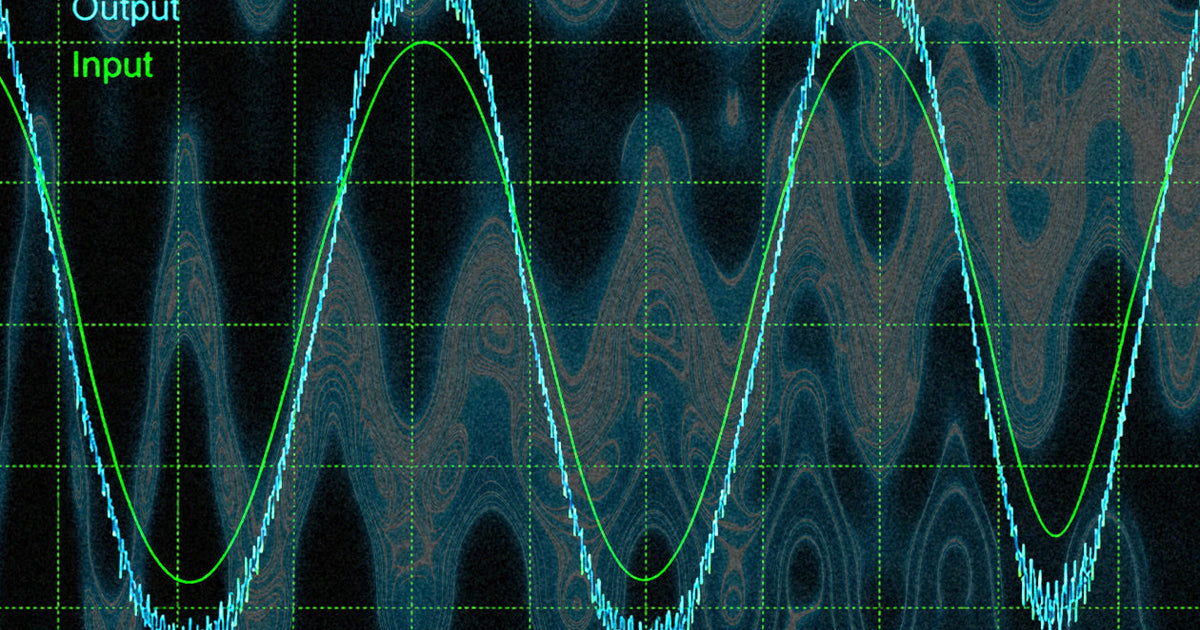
When distortion occurs, a waveform is deformed to create flattened peaks.
What Is Distortion?
Distortion happens when an audio signal is pushed beyond what a system can faithfully reproduce. The peaks of the waveform are flattened, introducing new harmonic content. These added harmonics can give the signal warmth and grit, but they can also create unpleasant effects if used improperly.
Here are the key terms to know:
-
Saturation. The soft, gradual compression of peaks as a signal approaches a circuit’s headroom ceiling. This is the warm coloration you associate with analog gear.
-
Overdrive. When a signal is driven hard enough to produce noticeable smooth clipping, like a guitar amp.
-
Fuzz. A heavily clipped, near-square wave producing the thick, buzzy sustain made famous in 1960s rock.
Distortion can be a powerful tool But it’s often overlooked in favor of compressors, limiters, and broadband mix enhancers.
Audio Clipping Terminology
Hard clipping. This occurs when a signal exceeds a fixed threshold and gets abruptly cut off, flattening peaks into a squared-off shape. Hard clipping has a bright,aggressive character and can be used for extreme effects like adding aggression to drums or grit to guitars.
Soft clipping. When a signal approaches its threshold gradually, its peaks are rounded off in a smooth curve. This generates even-order harmonics that blend musically with the original signal. It’s what gives tube gear and tape machines their characteristic warmth and glue.
Analog vs. digital clipping. Analog circuits clip through a physical process that produces pleasing warmth and harmonics. Digital clipping is something else entirely: once a sample exceeds 0 dBFS, you get hard, flat-topped waveforms and harsh artifacts. While it can be used intentionally under the right circumstances, careless digital clipping can destroy your mix if you’re not careful.
Symmetrical clipping. This occurs when the positive and negative halves of a waveform are treated identically, producing a balanced harmonic profile.
Asymmetrical clipping. This is common in tube circuits, where each half of the signal travels through a different portion of the tube’s operating curve. Each half is treated differently, generates even-order harmonics that sound natural and musical to the human ear.

The UA 610 Tube Preamp & EQ Collection recreates the rich harmonics, gentle saturation, and musical EQ of one of recording’s most influential tube preamp designs.
Tube Distortion
Vacuum tubes control the flow of electrons within a high-vacuum enclosure. In music production, tubes can add natural compression and saturation to an audio signal. The result is soft clipping and harmonics that help tracks sit naturally in a mix.
From tube channel strips to classic rack gear and guitar amplifiers, tube equipment is beloved for its ability to add character. Today, many engineers rely on digital emulations of classic tube hardware like the UA 610 Tube Preamp, or modern tools like the Black Box Audio HG-2 and Thermionic Culture Vulture.
UAD plug-ins like the elysia karacter and Empirical Labs FATSO bring solid-state saturation into your DAW.
Solid-State Distortion
FET clipping produces a gentle, present quality with a harmonic profile that shares some sonic similarities with tubes. But where tubes are softer around the edges, FET-based circuits can be slightly more forward.
Diode clipping is more aggressive. Diodes limit waveforms much more abruptly, producing edgy distortion with strong odd-order harmonics. They’re found in many classic overdrive and distortion pedals.
Transformer saturation has a smooth, thick quality that’s become a hallmark of classic summing consoles and a key reason analog mixers are still relevant, even for fully in-the-box mixing workflows.

Classic tape machines are known for gluing together different mix elements.
Tape Distortion
Tape machines are beloved for their ability to “glue” mixes together, compressing signal peaks, adding harmonics, and rolling off high-end. When engineers talk about tape saturation, they’re usually referring to all of these effects happening at once.
On tape machines, distortion occurs as the tape’s magnetic particles approach their alignment limit, causing the signal to saturate and compress before ultimately distorting. Driving tape hard is a common technique, and different machines bring their own color.
The Ampex ATR-102 is open and detailed, with wide stereo imaging and refined high-frequency character. The Studer A800 is an iconic multitrack machine with a dense, harmonically rich midrange and an ability to make any mix feel more coherent and three-dimensional.

Mastering saturators combine hard clipping and limiting to create maximum loudness.
Digital Distortion
When recording and mixing in a DAW, digital clipping can occur due to improper gain staging. While other types of distortion can be used as an effect, digital clipping often results in grating, unpleasant distortion that should be avoided at all costs.
That said, digital hard clippers used intentionally have become central to modern mastering chains and bus processing. These processors catch transient peaks at a precise threshold without the pumping, phase shift, or tonal changes that a limiter introduces.
In modern, aggressively-processed genres like hyperpop, industrial, and electronic music, engineers often push digital distortion to the extreme. Overdriven 808s, bit-crushed vocals, square-wave bass are all sounds that wouldn’t exist without embracing the harshness of extreme digital clipping.
Digital mastering enhancers like the Precision Maximizer introduce subtle harmonic distortion to increase perceived loudness, clarity, and detail.
Teamwork Makes the Dream Work
For decades, the best-sounding recordings have combined multiple types of distortion to create a coherent sound. Classic analog workflows layer saturation from multiple sources — with tape, tubes, and solid-state gear each contributing something distinct.
Many of the world’s greatest guitar sounds relied on pedals pushing the front end of a tube amp to shape the frequency content before it hit the preamp and power amp. So for guitarists, running a solid-state pedal into a tube amp is always a winning combination.
Modern mastering rely heavily on distortion, but less as an effect and more for sonic weight. Analog tube or transformer saturation adds density and glue. And digital hard clippers catch transient peaks without pumping. Finally, a brickwall limiter sets the overall ceiling of your mix. Together, all these devices add more transparency and dynamics than any single stage could produce.
The common thread: multiple saturation stages each add up to something magical, and greater than the sum of their parts.
— Austin Lyons
Related Articles: