


Different Instruments has released PartialString, a free cross-platform synth that takes a less traditional approach to physical modeling.
PartialString is available in AU and VST3 formats for macOS (10.13 or later), Windows (10 or later), and Linux.
Developer Christian Baker of Different Instruments began working on PartialString as a side project after the release of GoStringSynth back in 2022 (available via GitHub).
Four years later, we have PartialString v1.0.1.
The less traditional approach I mentioned is that PartialString uses the finite-difference time-domain (FDTD) method to simulate the vibration of a plucked string.
We’re probably more used to hearing about the use of Karplus-Strong algorithms to mimic the vibration of a plucked/struck string.
A very crude and simple comparison might be that the Karplus Strong method of looping a short waveform through a filtered delay to simulate the depleting energy of a plucked string as it vibrates is less accurate but more CPU-efficient.
Meanwhile, the FDTD method, which discretizes space/time into computational grids (in this case, the one-dimensional string) and numerically solves equations in real time, is more accurate but more CPU-intensive.
It’s worth noting that, despite my crude description, Karplus Strong isn’t just for crude simulations, and experts like Applied Acoustic Systems with plugins like Objeq Delay have advanced and refined methods based on the core principles of Karplus Strong.
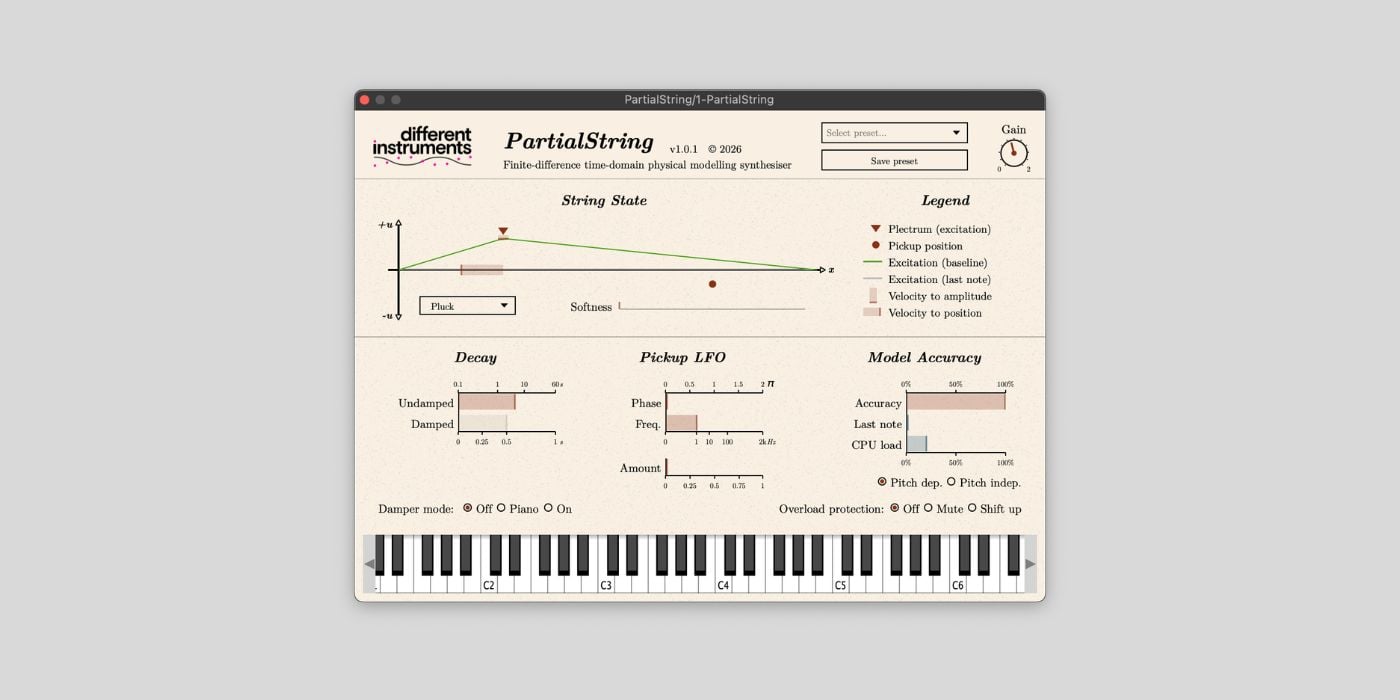
The PartialString GUI looks like something from a maths textbook, which is fitting, and it’s well put together.
There are only a handful of sections to consider: String State, Decay, Pickup LFO, and Model Accuracy.
The String State section features a Plectrum (exciter) and Pickup that allow you to shape where/how the string is excited and where the displacement is measured to generate the audio output.
PartialString supports up to 10-voice polyphony, dynamically adjusted based on your computer’s capability.
In contrast to the FDTD method’s noted accuracy, PartialString aims to encourage more experimental sound design, and you can explore that side of the plugin through the Decay, Pickup LFO, and Model Accuracy settings.
The short demo video highlights the ability to transition through various sound profiles, including dull and bright/harsh plucks, as well as modulating pad-like textures.
It doesn’t hurt to hear a little bit of Everything in Its Right Place, either.
More:
Last Updated on July 20, 2026 by Tomislav Zlatic.