



The Retromulator controversy and the unwritten rules of open-source audio
Earlier this week, discoDSP donated $1,000 to The Usual Suspects, the team behind some of the best free synth emulations out there. The Usual Suspects sent the money back.
If you’ve been following the Retromulator situation on KVR, GearSpace, or in BPB comments, you probably already have some opinions.
But I think there’s more to this story than the comments and forum threads covered, and it’s worth unpacking.
I’ll try to explain the situation below as clearly as possible and without taking sides. My goal is not to say who is right or wrong. What I find interesting here is that there’s really no black-and-white.
Despite the clear licensing, we are in a gray area.
What happened with Retromulator
In early March, discoDSP released Retromulator, a free plugin that bundles seven classic hardware synth emulations into one rack-style interface. The emulations come from Gearmulator, the open-source project by The Usual Suspects.
If you’re not familiar with TUS, they’ve built cycle-accurate recreations of the Access Virus, Waldorf MicroQ and Microwave XT, Nord Lead 2X, and Roland JP-8000. We’ve covered their work here on BPB multiple times, including OsTIrus, Xenia, and JE-8086.
discoDSP reused that code (which is published under GPL v3), added a DX7 core from a separate open-source project, built a unified preset browser, added code signing and AAX support, and released the whole thing for free.
The product page credited TUS. The plugin was free, GPL-licensed, same as the original.
But there was also a $29 “Buy” button on the page. The fine print said this was for priority support, not the plugin itself.
That $29 button is where things went sideways.
The reaction was loud
The backlash hit KVR, GearSpace, Synthtopia, and our own comments section here on BPB pretty much overnight. The KVR thread ran to hundreds of posts.
Here’s the thing, though. Most people weren’t saying discoDSP broke the law. GPL v3 explicitly allows forking, redistribution, and even selling. The anger was about something else.
The feeling across forums was that someone had taken years of volunteer work, put a new wrapper on it, and was making money off it without adding much value.
A TUS member said on Discord that it “goes completely against what our open source project stands for.” Another was more pointed, as quoted on MatrixSynth: “He basically took our source, put his own wrapper on it, and is trying to sell it and use it to promote his own business.”
But there were defenders too. Some users on KVR and Synthtopia pointed out that if you release code under GPL, you’re giving consent for exactly this. Open source means open source, and getting upset about someone exercising the license you chose doesn’t make a lot of sense.
discoDSP clarified that Retromulator was free and would stay free. They redirected the support button to TUS’s own donation page. And then they donated $1,000 to TUS, citing “Retromulator’s recent sales success.”
TUS sent it back. They said they wanted to stay transparent and free of corporate funding.
The “preset player” problem
There was also a practical criticism that I think is fair.
Retromulator, at launch, was basically a preset browser. You could load ROM presets and play them, but there was no way to actually edit or program the synths.
If you’ve used TUS’s own plugins, you know they replicate the full hardware interface of each synth, with all the knobs, menus, and modulation you’d expect. Retromulator had none of that.
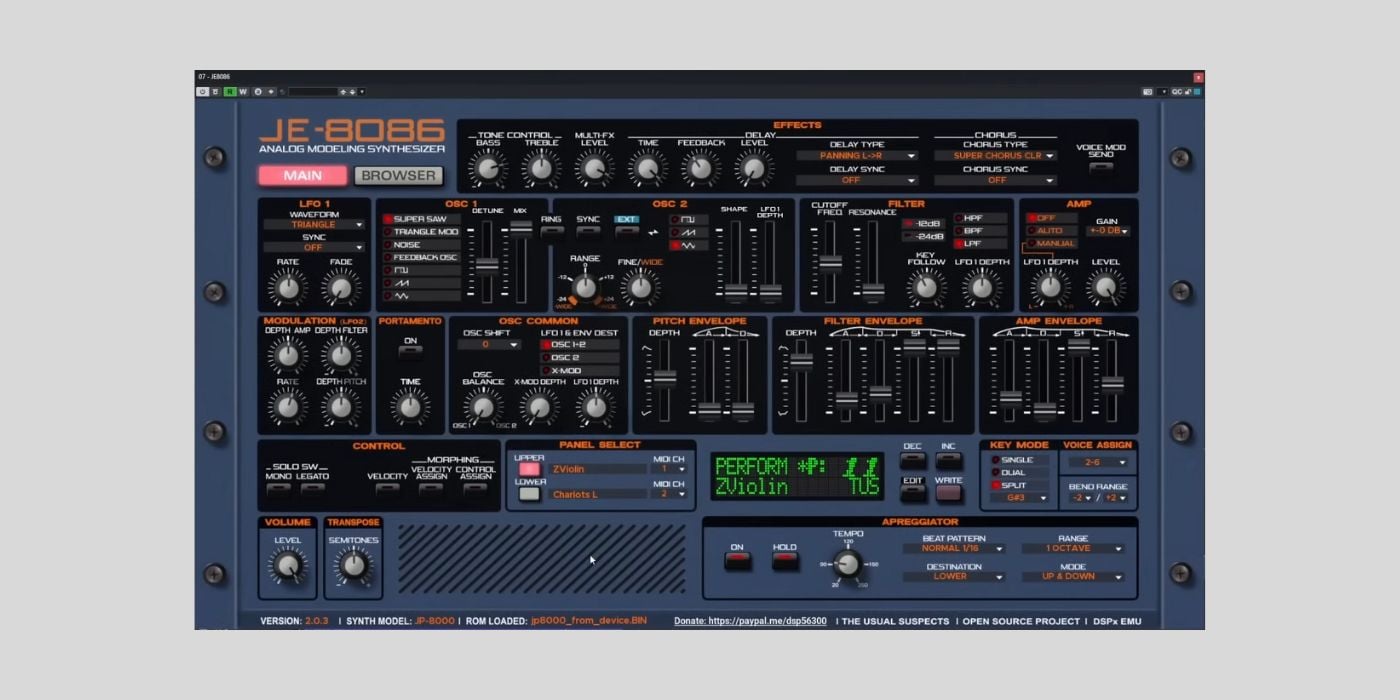
discoDSP did add some things beyond the TUS code, though.
The DX7 core, an Akai S1000 sampler engine, code signing for easier installation, and AAX format for Pro Tools users. Version 1.2 expanded to ten hardware cores and added a Wurlitzer 200A and Yamaha OPL3.
But if you want to actually program and tweak these synths, TUS’s own plugins are the better option. That’s not really up for debate.
The part nobody talks about
Here’s where it gets interesting, and a bit more gray.
TUS’s emulations work by running the original firmware from the actual hardware. The Virus TI, the Waldorf Microwave XT, and the Roland JP-8000. That firmware is copyrighted by Access, Waldorf, and Roland.
TUS doesn’t distribute the ROM files, and users have to supply their own, but the whole project depends on running firmware that was never licensed for this kind of use.
Rob Puricelli at GearNews made a good point about this in his Synth Journal column. He said he “had to chuckle at how so many people were getting upset about a company supposedly breaking open source etiquette when the company behind said open source code was recreating other people’s work on the original hardware.”
I’m not saying that invalidates the frustration with discoDSP. But it does add a layer that most of the discussion skipped over.
Like many preservation-focused emulation projects, TUS relies on user-supplied firmware from original hardware. That’s a generally accepted but long-debated gray area in the synth community.
discoDSP operating within the terms of a GPL license got condemned because it felt like someone was cashing in.
The difference comes down to intent, or at least how people read the intent. That’s a lot harder to put into a license than people think.
The OB-Xd thing didn’t help
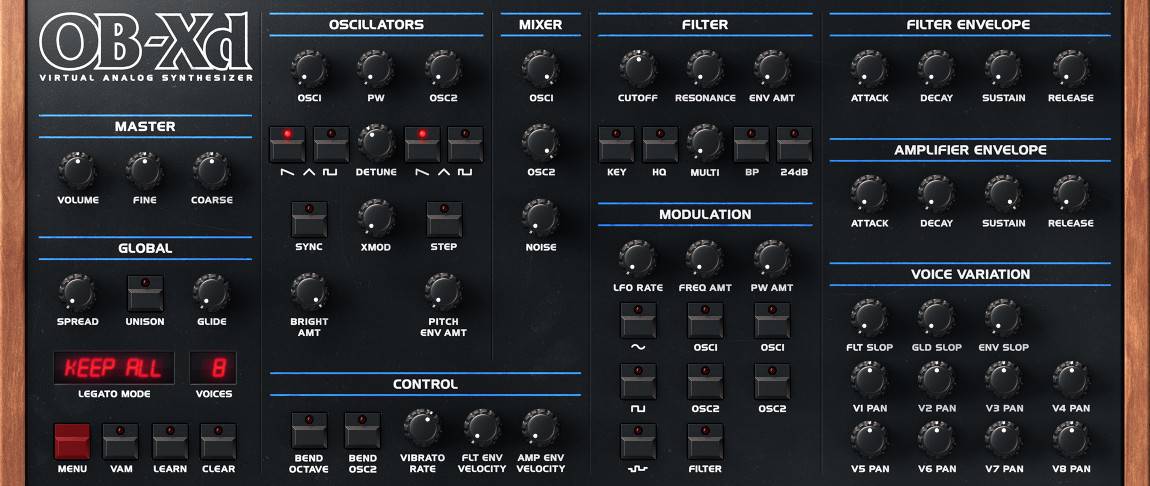
For some users, this also brought back memories of the OB-Xd transition, which added to the skepticism. The developer previously took over OB-Xd, a free GPL-licensed Oberheim emulation, and eventually changed it to proprietary closed-source, releasing version 3 as a paid product.
To be fair to discoDSP, prior versions of OB-Xd remain free and open-source, and version 3 was a complete rewrite.
But some people read Retromulator as part of a pattern rather than a one-off. Whether that’s entirely fair is debatable. Retromulator is GPL and free. But trust is hard to rebuild once you’ve lost it.
What this is really about
I think the Retromulator situation is interesting, not because someone was clearly right or wrong, but because it showed something about how we understand licensing.
We have unwritten rules about open source, and nobody fully agrees on what they are.
GPL v3 was designed to guarantee freedom, including the freedom to do things the original authors might not like. TUS chose that license. But when someone used those freedoms in a way that felt wrong, the community treated it like a violation of something bigger than the license.
That “something bigger” is basically the social contract around volunteer open-source projects. The expectation is that if you build on someone’s free work, you give something meaningful back (for free). You don’t repackage it and charge for support.
That’s not written into GPL v3 anywhere. It’s a community norm, not a legal one.
The $1,000 donation and its return kind of sum it up perfectly. discoDSP tried to settle what felt like an ethical debt with money. TUS refused because taking it would have blurred a line they wanted to keep clear.
But where that line sits seems to depend on who you ask.
For anyone building or using open-source audio tools, it’s worth thinking about.
A license tells you what’s legal. It doesn’t tell you what the community will accept. And in a space as small as music production software, that gap matters.
Last Updated on March 21, 2026 by Tomislav Zlatic.