

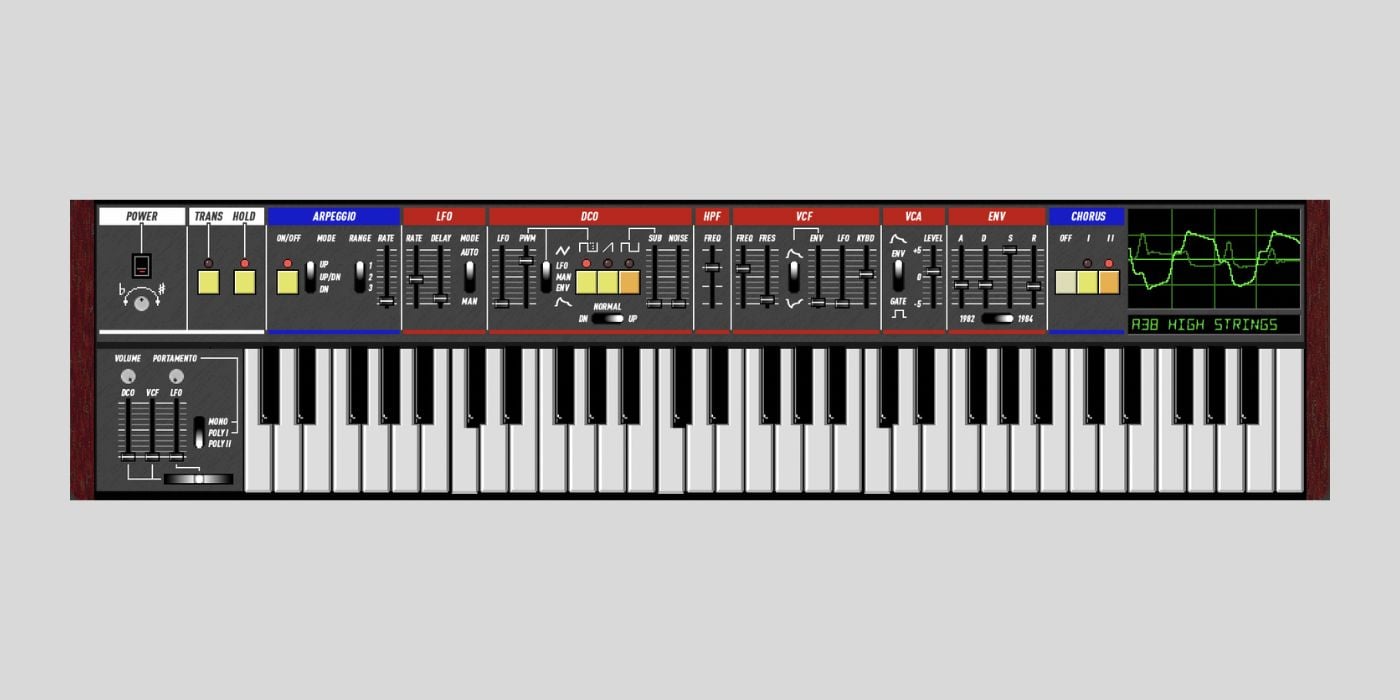

Ultramaster KR-106 is a free, open-source virtual analog synthesizer inspired by the Roland Juno polysynths. It was shared in our BPB community, and the backstory alone makes it worth a look.
The project started in the year 2000 in a Brooklyn loft, when two developers set out to build professional audio software for Linux.
Life took them in different directions (one founded Kayrock Screenprinting, the other ended up at Google), but they eventually returned to the code. Twenty-five years later, KR-106 is here as a free GPL release.
I’m not sure if this was publicly available before, but the latest version is v2.1.9, released on March 19, 2026.
Since I’m always up for a retro synth emulation, I couldn’t wait to fire this one up on my MacBook Air and give it a spin.
And, I’ll be honest, the sound is far from great. But the plugin has a lo-fi charm that you’ll probably appreciate if you started using VSTs 20+ years ago like me.
The interface looks like something straight out of the early 2000s, with a pixel-art style that’s very much of its era. And the sound perfectly matches the look.
The chorus, filters, and oscillators don’t really sound like a real Juno to my ears, despite the developers stating that the DSP is calibrated from hardware measurements, firmware analysis, and factory schematics.
What it sounds like are those very old VST synths we had in the early 2000s, things like Steinberg’s Model E and Neon. If you remember those, you’ll know exactly what I mean.
But here’s the thing. I really like it exactly because of its thin retro sound.
I wouldn’t use KR-106 to recreate the Juno-106 in your DAW. There are better free options for that, like TAL-U-NO-LX.
But if you’re into that old-school VST sound from the early 2000s (whether for a lo-fi project or pure nostalgia), this is actually a treat.
Again, the sound reminds me of this ancient Steinberg plugin.

And it’s double retro: a retro-style plugin emulating a retro synth.
As our reader Numanoid put it in our community thread, “I hope this doesn’t sound as it looks,” but it really does sound exactly like it looks.
For me, that’s part of the charm.
Despite its old-school appearance, the interface has some handy features, such as an oscilloscope and visualizers for the filter and ADSR envelope.
The synth closely mirrors the hardware’s functionality with a 6-voice polyphonic architecture featuring per-voice DCO, VCF, VCA, and ADSR envelope, plus a shared LFO, high-pass filter, chorus, and arpeggiator.
It offers Mono, Poly I, and Poly II key modes with portamento, and all 128 factory presets are decoded from original SYSEX data.
The filter is modeled on the IR3109, and the chorus emulates the MN3009 bucket-brigade delay. There’s also an analog variance feature that models per-voice component tolerances.
Again, this all makes it sound like a fancy emulation, but the sound doesn’t really come too close to the original hardware. But I think it’s pretty cool.
KR-106 is available for macOS, Windows, and Linux in AU, VST3, CLAP, LV2, and standalone formats. You can also grab the source code.
What’s also cool is that there’s no sign-up required. Just click the download button for your OS, and you’re good to go.
Download: Ultramaster KR-106 (FREE)
Deal of the day 🔥: Get BABY Audio Parallel Aggressor for only $5! (92% OFF)
More:
Last Updated on March 19, 2026 by Tomislav Zlatic.