

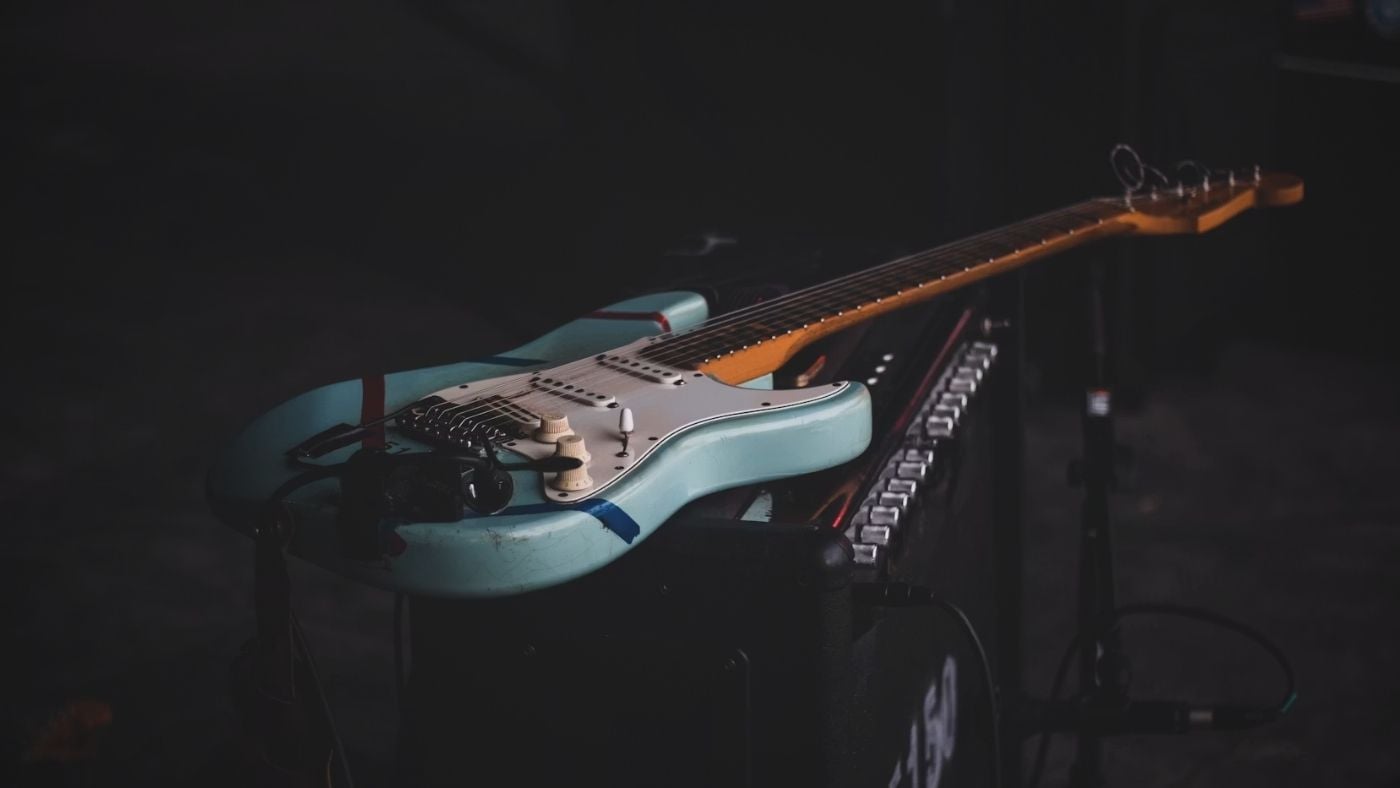

Thomann has taken legal action against Fender, adding another chapter to the Stratocaster copyright story.
Until now, this has mostly looked like Fender sending cease-and-desist letters and smaller guitar makers trying to figure out how much legal firepower they could afford. Now Thomann, one of the biggest names in music retail, is stepping in, and it is doing so with its own Harley Benton brand directly affected.
I’m not saying Fender has no right to protect its work. If someone is selling a near-identical Stratocaster copy for pocket money on AliExpress, I understand why Fender would go after it.
But there is a difference between stopping obvious clones and using one uncontested ruling to pressure the wider S-style guitar world.
That difference is exactly where this story gets interesting.
This started with a default judgment
That’s the part everyone should keep coming back to
The whole dispute goes back to a ruling from the Regional Court of Dusseldorf in December 2025.
Fender won a case against a China-based seller offering Strat-style guitars through AliExpress, with the guitars available for shipment into Germany. According to Bird & Bird, the court found that the guitars reproduced Fender’s Stratocaster body design, which qualifies as a copyrighted work of applied art under German and EU law.
Now, that could be a big deal.
Bird & Bird says the ruling creates enforceable rights against guitars using the Stratocaster body shape that are manufactured, sold, or distributed in Germany or other EU countries, regardless of where they are made.
But here is the part that matters just as much.
Thomann says this was a default judgment against a Chinese company that missed deadlines. In other words, Fender’s argument was not tested in the way it would be if both sides showed up and fought the case properly.
Thomann puts it plainly in its official statement.
“This judgment is based on missed deadlines, i.e. pure formalities, and does not, in our opinion, represent a comprehensive review of the legal claims.”
That’s the key point for me.
The current pressure on guitar makers and retailers is being built on a ruling that may be enforceable, but was not tested in a fully contested case.
Fender says this is about close copies
The letters made it feel much bigger than that
Fender CEO Edward “Bud” Cole recently tried to calm things down. Speaking at a dealer event, he said, as reported by Guitar.com, “First and foremost, Fender is not suing anybody.”
He also said Fender had reached out to “a handful of companies whose guitars come extremely close to replicating the iconic Fender Stratocaster design.”
That may be how Fender wants this to be understood now.
The problem is that cease-and-desist letters do not feel like friendly conversations, especially when reports say they include demands to stop selling products, recall stock, hand over sales data, and deal with potential penalties.
Most small builders don’t have the money, time, or stomach to test a legal theory against Fender. A letter like that can do the job before anyone ever gets to court.
That is why Thomann’s move is important.
The retailer says it wants the issue settled in “unbiased court proceedings” where Fender can present its arguments, and the court can examine the facts properly.
Thomann has skin in the game
This is not just a friendly gesture for boutique builders
Thomann is framing this as a stand for diversity, innovation, and competition in the guitar industry.
That is true, but it is also a business fight.
Thomann owns Harley Benton, and Harley Benton sells affordable S-style guitars (my neighbor owns one, and it’s quite good). If Fender’s position holds broadly across Europe, Thomann is not just defending some abstract principle. It is defending a product category that it sells every day.
I don’t think that weakens Thomann’s argument.
If anything, it makes the case more useful because Thomann is big enough to take the hit and close enough to the issue that it has a reason to push back.
Hans Thomann framed it this way.
“We used to be a small music store ourselves and know exactly where we have come from. Diversity, fairness and respectfully dealing with each other have always been part of our philosophy. Many of those affected do not have the financial and legal means to conduct such a legal dispute. We therefore see it as our responsibility to have this matter clarified in court not only for our own company, but for all parties involved.”
In my opinion, the guitar market really does depend on smaller builders.
Thomann names Tyler, Tom Anderson, Suhr, LSL, Maybach, Pensa, FGN, PRS, and others as examples of the kind of companies that helped build the modern S-style scene. Some of those brands make premium instruments. Some are far from being lazy Fender clones.
PRS is probably the most obvious example because of the Silver Sky. You can look at it and immediately understand why Fender cares. You can also look at it and understand why PRS would argue that it is not simply a counterfeit Strat.
That gray area is exactly why a proper court case matters.
Form follows function
This might be the strongest argument against Fender
Thomann’s central argument is simple. The Stratocaster shape became universal because it works.
The upper horn helps balance the guitar, and the double cutaway makes the upper frets easier to reach. Also, the body contours make the instrument more comfortable to play. These are not small details if you actually play guitar.
That’s why the S-style shape became a starting point for so many builders.
I think Fender deserves credit for that. Leo Fender and his team created something brilliant. I mean, the Stratocaster is not famous by accident.
But when a design becomes one of the synonyms for an instrument for 70 years, things can get complicated.
At some point, players stop thinking of it only as a Fender design and start thinking of it as a type of electric guitar. That doesn’t erase Fender’s history, but it does make broad enforcement feel very different from protecting a logo, a headstock, or the Stratocaster name.
This is where Cole objected to the “S-style” wording. He said calling it an S-style or S-shape is an attempt to diminish Leo Fender’s contribution.
But musicians use generic language because they need it. We say S-style, T-style, P-style, J-style, 808-style, 909-style, and a hundred other things because music gear is full of designs that became categories.
Sometimes it is just how a design becomes part of the culture.
The affordable guitar angle matters
Not everyone starts on a Custom Shop instrument
One reason this story has hit so hard is that S-style guitars are everywhere, from beginner instruments to boutique builds that cost more than a decent used car.
For BPB readers and all of us bedroom producers, the affordable end of the market is important. A lot of people start making music with what they can afford, not with what looks best in a lawyer’s filing.
Harley Benton is a big part of that world. So are Fender’s own Squier guitars, Yamaha, Ibanez, Jet, Donner, Sire, and plenty of other brands that give beginners a way in without spending serious money.
To be clear, I don’t think any company should be allowed to sell a fake Fender.
Put a Fender logo on something that isn’t a Fender, copy every detail, and try to confuse buyers, and I’m not going to defend that.
But a boutique builder’s modified take on the Strat formula is a different thing. A SuperStrat with humbuckers, a flatter radius, locking tuners, and modern hardware is a different thing.
Fender may still win the law and lose the room
Trust is harder to rebuild than inventory
The awkward part for Fender is that the company appears to have lost goodwill with many players, even before a new court looks at the issue.
That doesn’t mean Fender is doomed. People say that about big brands every other week, and most of them keep selling products.
But guitars are not phone chargers.
Players build attachments to instruments, brands, artists, and stories. The Stratocaster became iconic because musicians loved it, modified it, copied it, broke it, rebuilt it, and made music history with it.
That is the uncomfortable part of this case for Fender.
The more the company argues that the Stratocaster shape belongs only to Fender, the more it risks shrinking the story that made the Stratocaster bigger than Fender in the first place.
Thomann’s legal action does not settle anything yet, but it forces the fight into a place where both sides can be heard.
That’s better than a legal campaign where small builders quietly remove products because they cannot afford to answer.
If Fender wants to stop exact clones, I think most musicians will understand. If Fender wants to control the entire S-style category in Europe, that’s a much harder sell.
The Stratocaster is one of the greatest electric guitars ever made.
But part of what made it great is that players and builders kept adding to the idea for 70 years.
Fender can protect its name and stop obvious copies, but it may not be able to put that whole history back under one roof.
Read more: Fender and the Stratocaster Copyright Saga: Is There a Winner?
Last Updated on June 23, 2026 by Tomislav Zlatic.