



The Most Common Low-End Problem
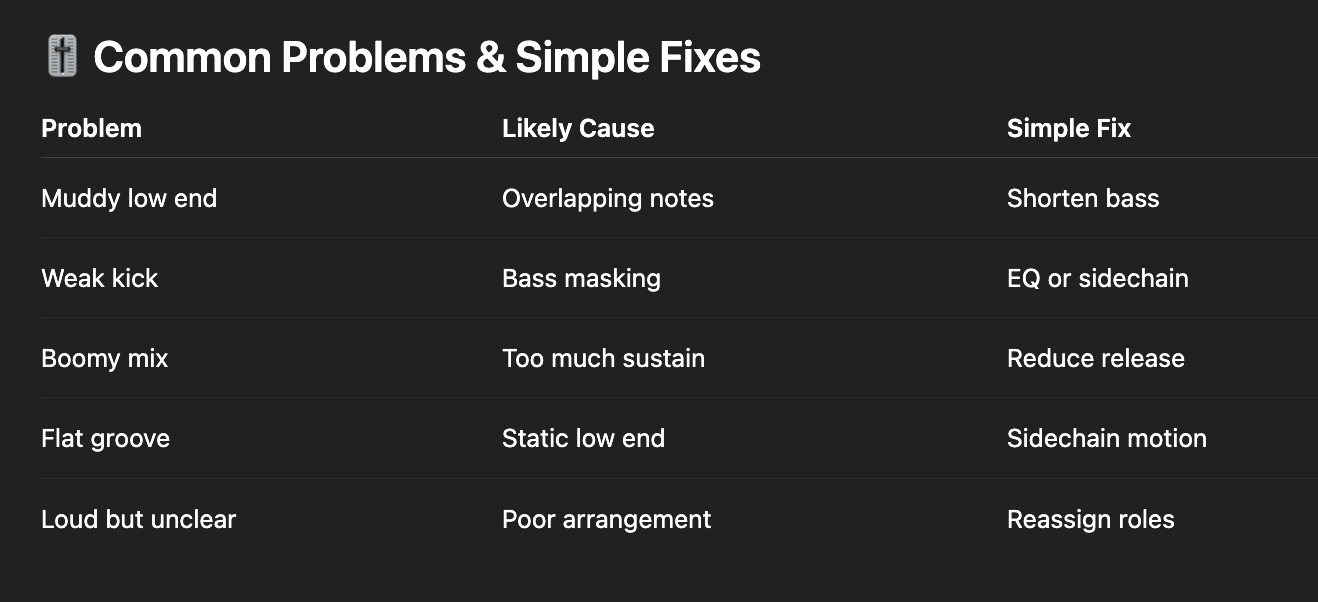
If your mix feels muddy, weak, or unfocused, there’s a good chance the problem lives in the low end.
Specifically:
the kick and the bass are fighting.
This isn’t a plugin problem.
It’s not a loudness problem.
It’s a relationship problem.
When kick and bass work together, the mix feels powerful and clear.
When they don’t, nothing else can save it.
Quick Summary
👉 Kick and bass work together when they are separated by arrangement, programmed with intention, shaped by EQ, and coordinated with sidechain compression.
The most important decision happens before EQ or compression.
Ask one simple question:
Who is the boss of the low end — the kick or the bass?
You can’t have both dominating the same moment.
Common approaches
-
Kick leads, bass supports (EDM, pop, dance)
-
Bass leads, kick supports (hip-hop, R&B, funk)
-
Alternating roles by section
Practical move
If both hit hard at the same time, remove one — even briefly.
Arrangement fixes what plugins can’t.
Explosive Rhythms: Mixing Drums Like a Pro With Your Home Studio DAW
Even perfectly EQ’d sounds will clash if they’re triggered at the same time.
Look at:
-
note length
-
rhythmic placement
-
sustain
-
release times
Simple fixes
-
shorten bass notes so the kick punches first
-
delay the bass slightly after the kick
-
remove bass notes where the kick hits
-
simplify one part
Practical move
Zoom in on the waveform.
If transients stack, energy collapses.
⭐️ Start by downloading all of my FREE Music Production Guides ⭐️ It took me years to learn this stuff!
EQ is about separation, not boosting everything.
Decide where each element lives.
Typical starting points
Practical EQ strategy
-
boost the kick where the bass is quieter
-
cut the bass slightly where the kick hits hardest
-
high-pass what doesn’t need sub energy
-
clean low-mid buildup (200–400 Hz)
Small EQ moves here change the entire mix.
Balance in Mixing: Subtractive vs. Additive EQ ⚖️
Sidechain compression isn’t a crutch — it’s coordination.
By triggering a compressor on the bass using the kick, you:
-
create space instantly
-
preserve punch
-
add groove and movement
How to use it musically
The bass shouldn’t disappear — it should breathe.
Sidechain isn’t about ducking — it’s about cooperation.
Compressor vs Limiter: What’s The Difference?
 ⭐️ Download my Free Guide The Magic EQ Settings that work on EVERYTHING!
Q: Should I always sidechain bass to kick?
A: No — only when timing and EQ alone aren’t enough.
Q: Why does my low end sound loud but weak?
A: Because kick and bass are masking each other.
Q: Can EQ alone fix this?
A: Rarely. Arrangement and timing matter more.
Q: What should I fix first?
A: Arrangement — always start there.
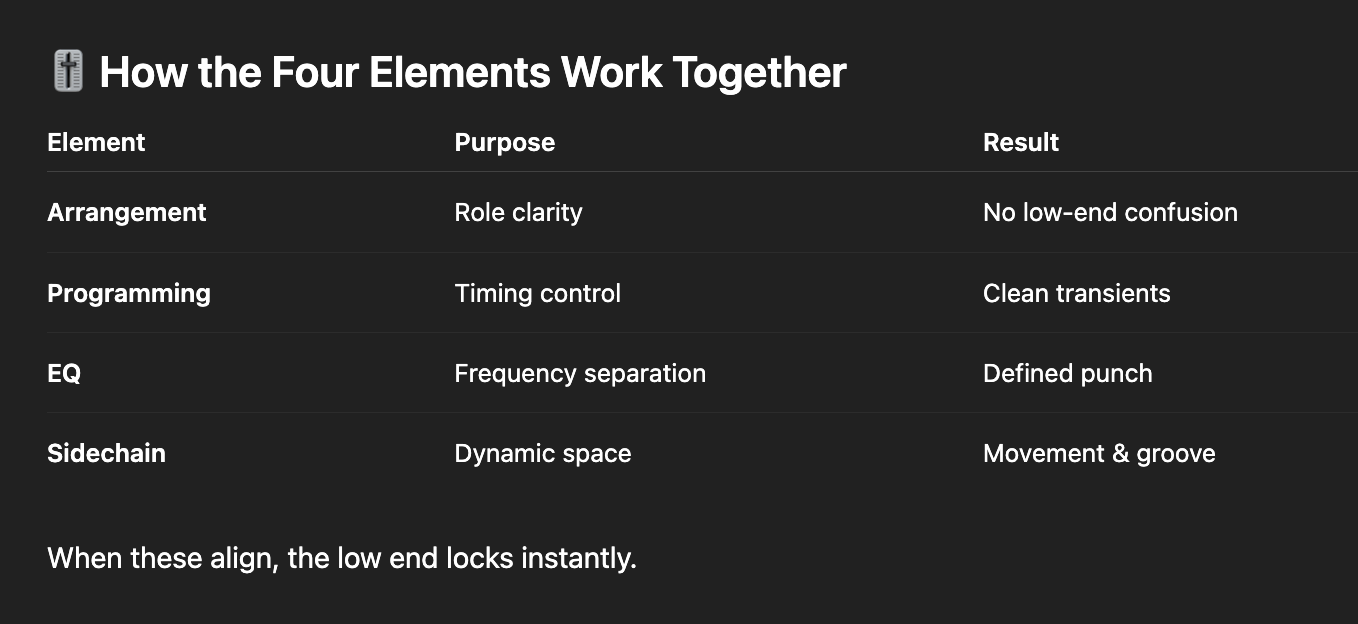
The low end is the foundation of your mix.
If it’s unclear, everything feels unstable.
Great mixes don’t have more bass — they have clearer bass.
When kick and bass stop competing and start cooperating, the entire mix opens up — louder, cleaner, and more confident.

⭐️ Download my Free Magic Delay settings Guide ⭐️

⭐️ Download my Free Magic Reverb settings Guide ⭐️
#protools #daw #homestudio #recordingschool #recording #musicproduction
Also read:
How to Start Your Own Online Business Teaching Music

Hey, I’m Futch – Music Production Coach and Ableton Certified Trainer

Learn how to make your first song and beat in Ableton Live with my
FREE 90-minute Ableton Live course
I’ve been teaching audio engineering and music production for 35 years.⭐️
Check out my new online music production program: Music Production Ninja…