

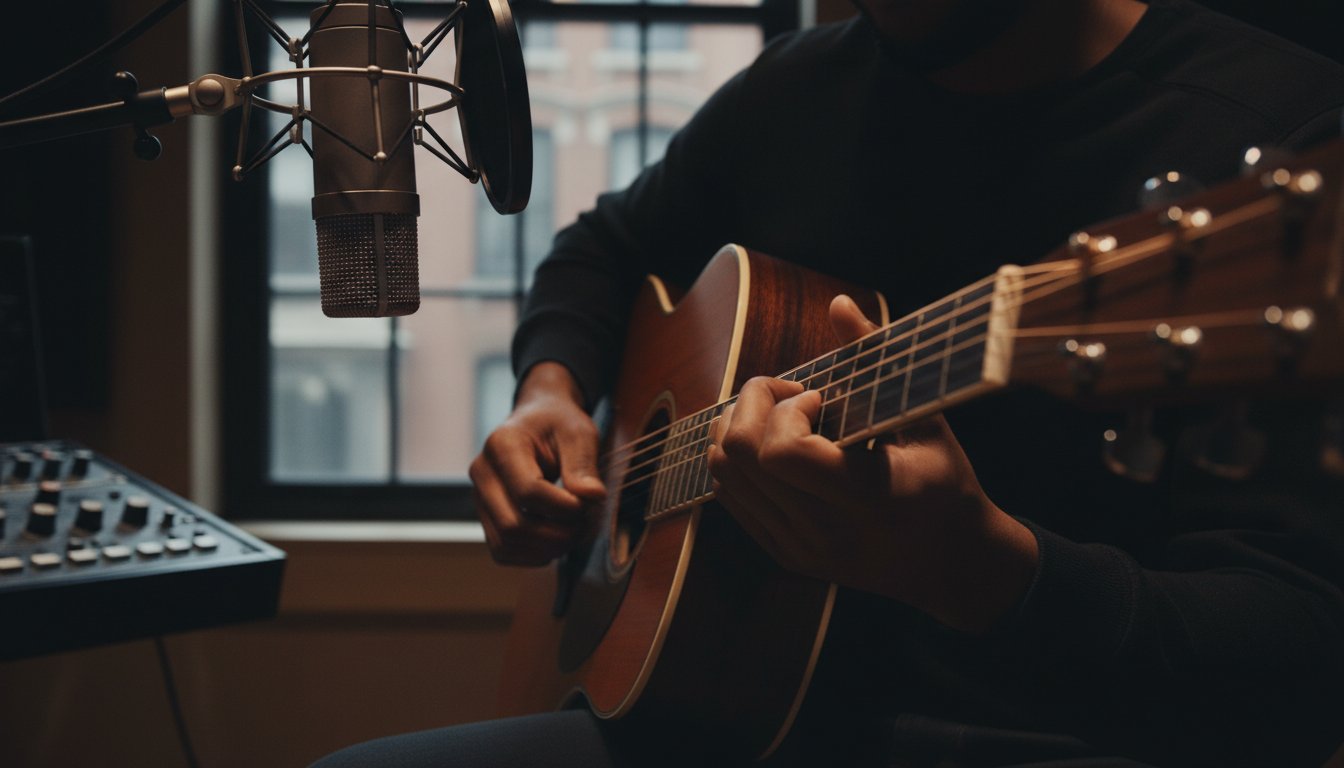

Why does a $5,000 vintage Martin often sound like a $50 toy once it hits your DAW? It’s a frustrating reality for 85% of independent artists. You spend hours perfecting your technique, only to end up with acoustic guitar recordings that feel thin, boomy, or cluttered with distracting room noise. We understand that struggle. In over 12 years of delivering 4,500+ world-class productions, the team at Supreme Tracks has seen how these technical hurdles can stall a great song.
You deserve to hear your music vision come to life with the same clarity you hear in your head. This guide reveals the professional secrets to elevating your tracks from simple demos to world-class masterpieces. As Eric Clapton once said, “The acoustic guitar is a very personal thing.” We’re here to ensure that personal touch is never lost. You’ll discover how to master microphone placement, optimize your environment, and integrate these techniques into your Music Production workflow. Let’s explore how to capture the pristine, commercial-grade sound your music deserves.
Key Takeaways
- Master the “Source-First” philosophy to ensure your instrument and performance are studio-ready before you ever hit the record button.
- Learn how to treat your recording environment as a “second instrument” to capture clear, world-class acoustic guitar recordings every time.
- Discover professional layering secrets like “Nashville Tuning” to create a shimmering “Wall of Sound” that fills your track without cluttering the mix.
- Evaluate the hidden costs of DIY tracking versus hiring handpicked session pros to ensure your project meets the highest major-label standards.
- Explore how a tailored, artist-centric production plan can help you fine-tune your arrangements and finally hear your music vision come to life.
The Anatomy of World-Class Acoustic Guitar Recordings
Professional acoustic guitar recordings don’t happen by accident. They are the result of a “Source-First” philosophy where the instrument and the player are the most vital components. A world-class sound is defined by three pillars: clarity, depth, and character. Clarity ensures every note is heard, depth provides a sense of three-dimensional space, and character gives the track its unique emotional soul. Whether you want an intimate Folk vibe or a driving Pop rhythm, major-label quality is the benchmark. This standard ensures your music competes with top-tier productions on global streaming platforms.
Understanding the history and technology of sound recording reveals that the best engineers always prioritize the sound in the room. In Folk music, the guitar often carries the entire arrangement, requiring a wide, immersive image. In Rock, the acoustic guitar usually acts as a percussive layer that needs to cut through heavy drums. Pop productions typically demand a “hyped” top-end that sparkles. To better understand how to bridge the gap between a basic demo and a professional track, watch this helpful video:
Understanding Tone and Frequency Balance
A professional recording avoids “muddy” low-mids, which usually build up between 200Hz and 400Hz. This frequency range can make a mix feel cluttered and dark. Instead, focus on capturing “shimmering” highs that allow the guitar to breathe. Your choice of pick and string age are critical. Old strings lose their harmonic richness after just a few sessions, while a heavy pick creates a deeper tone compared to a thin pick’s rhythmic “click.” Transient response is the initial burst of energy when the pick strikes the string, and it is the key to a track feeling energetic and alive.
The Importance of the Performance
Timing and dynamics are more critical than the microphone you use. A world-class track feels “locked in” with the groove. As Ed Sheeran once said, “I think the acoustic guitar is a beautiful, beautiful thing… it’s all about the emotion.” If the performance lacks precision, even the most expensive gear can’t save the song. This is why many artists collaborate with online session musicians to ensure their tracks have the “tight” feel required for commercial radio. At Supreme Tracks, we’ve delivered over 4,500 productions by focusing on these subtle nuances that separate a demo from a hit.
Mastering the Technical Elements: Environment and Mic Placement
Your room acts as the second instrument in every session. It colors the sound of your acoustic guitar recordings more than you might realize. Professional producers often spend hours finding the right spot in a studio because the physical space dictates the frequency balance and depth of the track. If the room sounds thin, your guitar will too.
A “live” room with hardwood floors provides natural reverb and energy, while a “dead” room with heavy carpets and curtains offers a dry, intimate sound. You should avoid recording in corners at all costs. These areas act as natural amplifiers for low frequencies, often resulting in a muddy, “boomy” recording that’s difficult to fix during the mixing stage. As legendary producer George Martin once noted, the most important thing is the sound of the room itself.
Microphone choice is your next big decision. Large Diaphragm Condensers (LDCs) capture a lush, warm tone with plenty of character, making them great for solo performances. Small Diaphragm Condensers (SDCs) are often preferred for their fast transient response, which is ideal for capturing the intricate “sparkle” and detail of fingerstyle playing. For those wanting to master in-depth recording techniques, experimenting with both types is essential to find what complements your specific instrument.
The Sweet Spot: Standard Mic Positions
Don’t point the microphone directly at the soundhole. This is a common mistake that leads to an overwhelming, low-frequency “thump” that ruins a take. Instead, try these proven setups:
- The 12th Fret Technique: Place the mic about 6 to 12 inches away from where the neck meets the body. This position captures the perfect balance of string detail and woody resonance.
- The Over the Shoulder Approach: Position the mic near your ear, pointing down at the bridge. This mimics what you hear as a player, providing a natural and immersive sound for the listener.
If you use two microphones for a wider stereo image, always follow the 3-to-1 rule: the distance between the two microphones should be at least three times the distance between each microphone and the guitar to prevent phase cancellation issues.
Managing the Recording Environment
You don’t need a million-dollar studio to get major-label results. Simple DIY treatments can transform a spare bedroom into a functional space. Use thick moving blankets draped over mic stands to create a temporary booth or to dampen harsh reflections behind the player. If the low end feels uncontrolled, stack some heavy cushions in the corners to act as makeshift bass traps.
To minimize bleed from background noise, record during quiet hours or use a directional cardioid microphone. If your home environment is still too noisy or lacks the right character, our professional music production services provide access to pristine, acoustically treated spaces and world-class session players who can elevate your vision from their own professional setups.
DIY Home Recording vs. Professional Remote Session Musicians
Recording at home feels like the ultimate freedom. You buy a decent interface, a mid-range condenser mic, and start tracking. However, the hidden costs often outweigh the convenience. Capturing world-class acoustic guitar recordings requires more than just gear. You need an acoustically treated room, a signal chain worth $10,000 or more, and years of engineering experience. Most independent artists hit the “Frustration Factor” after several hours of mic positioning. You realize the track sounds acceptable but lacks the shimmer and depth found on major-label releases. This gap exists because professional session players have spent decades mastering both their instrument and their recording environment.
Supreme Tracks bridges this gap by giving you access to the same talent used by major labels. We transform your raw ideas into masterpieces without the overhead of a traditional studio. Our producers handpick musicians who fit your specific style, ensuring your vision is realized with precision.
Evaluating the Cost and Quality Gap
Consider the math. A high-end setup with a Neumann U87 and a Neve preamp can easily exceed $5,000. For a small fraction of that investment, you can hire a professional who already owns this equipment and knows exactly how to use it. When you look at online session musician rates, the value becomes clear. You aren’t just paying for a performance. You are paying for a world-class signal chain and a lifetime of skill. As Eric Clapton once said, “The more I know, the more I realize I don’t know.” Hiring a specialist ensures your music isn’t limited by your own technical hurdles.
When to DIY and When to Outsource
DIY is perfect for the songwriting phase. Use your home setup to capture the “vibe” and structure of your song. These demos serve as a vital blueprint for your production. However, for commercial releases, final masters, or film scores, outsourcing is the professional standard. If you have a home track you love but the sound quality is thin, you can send your files to a professional studio for a “re-amp” or have a session player record a fresh version. This keeps your original energy while adding a professional polish that captivates audiences.
Transform Your Sound with Supreme Tracks
Don’t let technical limitations hold back your musical vision. Whether you need a single track or a full production, our team of Grammy-level talent is ready to elevate your acoustic guitar recordings to major-label standards. We provide a tailored approach that puts you in control of the creative process while we handle the technical excellence.
Ready to hear your music come to life?
Build your production plan and get a free project estimate today.
Arranging for Impact: Layering and Doubling Techniques
Most professional acoustic guitar recordings you hear on major-label releases aren’t the result of a single microphone on a single guitar. Producers often use the “Wall of Sound” approach to ensure the instrument feels expensive and immersive. If you rely on just one track, your production might sound thin or demo-like. By layering multiple performances, you create a dense texture that fills the stereo field and supports the emotional weight of the song.
One secret weapon for adding high-end clarity is Nashville Tuning. This involves stringing an acoustic guitar with the high-octave strings from a 12-string set. When you layer a Nashville-tuned guitar over a standard one, you get a crystalline shimmer that mimics a 12-string guitar but provides much more control in the mix. It adds brightness without the heavy low-end buildup that often muddies a complex arrangement.
The Power of the Double Track
To achieve a wide, modern sound, you must record two separate, distinct takes. Don’t simply copy and paste a single track and nudge it forward; this creates phase issues and sounds unnatural. The magic happens in the tiny 10 to 20 millisecond timing differences between two real performances. These subtle variations create a lush, three-dimensional width that makes your music feel professional. This technique is a staple in our music arrangement services to ensure every production sounds world-class.
Layering for Texture and Depth
Tonal contrast is your best friend when building a track. Try layering a bright, percussive steel-string with a warm, mellow nylon-string guitar. This combination creates a complex character that a single instrument can’t achieve on its own. You can also use the guitar as a rhythm tool by recording “dead notes” or percussive hits on the body to drive the track. As Dave Grohl once said, “It’s not about how many notes you play, it’s about the sound of the notes.” Focus on how the texture of the guitar interacts with other elements like piano or strings.
When you pan these layers, try a “big mono” approach or hard-panning your doubles 100% left and right. This leaves the center of the mix completely open for the lead vocal and bass. If you have a piano in the arrangement, use a high-pass filter on your guitars around 200Hz. This carving technique prevents frequency clashing and ensures every instrument has its own dedicated space.
Realizing Your Vision with Supreme Tracks
Achieving professional acoustic guitar recordings shouldn’t feel like an unreachable goal. You have the song and the passion. Now you need the polished, major-label sheen that catches a listener’s ear. Supreme Tracks provides a tailored approach to your music, ensuring your specific sonic needs are met. We don’t believe in generic templates. Instead, our team analyzes your raw demo to build a production plan that highlights your unique strengths as a songwriter.
World-Class Talent at Your Fingertips
You don’t need to live in a major music hub to get a professional sound. Through our platform, you gain direct access to online session musicians who have played on hit records. These experts record in high-end NYC studios using premium acoustics and world-class equipment. As Dave Grohl once said, “No one is you and that is your power.” We embrace this by treating your music as a collaborative partnership where your vision always comes first.
More than 1,500 artists trust Supreme Tracks for their professional sound. With over 4,500 productions delivered, we’ve refined a process that removes technical stress from your creative life. We handle the mic placement, phase alignment, and delicate EQ balancing. This allows you to focus on your performance while we manage the technical excellence required for a world-class release. Our team has spent 12 years helping creators bridge the gap between a home demo and a commercial success.
Start Your Production Journey Today
Every artist deserves a production that sounds authentic, not generic. Our “no cookie-cutter solutions” promise means your acoustic guitar recordings get the individual attention they need to stand out. We offer a streamlined way to get a free, instant project estimate so you can start planning your next release without any guesswork. Whether you are working on a simple folk track or a complex arrangement, we scale our services to fit your goals.
It’s time to empower your creativity and let the experts handle the heavy lifting. Ready to hear your music reach its full potential? Build your production plan and get a quote today to hear your music vision come to life.
Bring Your Acoustic Vision to Life
Capturing high-quality acoustic guitar recordings requires a blend of technical precision and creative arrangement. You’ve learned how strategic mic placement and room acoustics define your fundamental tone. You also understand how smart layering techniques turn a thin track into a lush soundscape. As Eric Clapton once said, “I’ve always found that the best way to record is to keep it simple.” If you’re looking for more ways to refine your sound, explore our latest guides on Music Production. Small adjustments in your workflow often lead to the biggest breakthroughs in your sound.
Don’t let technical hurdles or limited gear hold back your creativity. Supreme Tracks provides the professional expertise you need to compete on a global scale. Based in NYC, our world-class studio has delivered over 4,500 productions for artists across the globe. We’re trusted by Grammy® winners because we prioritize your unique vision over cookie-cutter solutions. Our team works one-on-one with you to ensure every detail meets major-label standards.
Transform your demo into a masterpiece with Supreme Tracks. Your music deserves a professional finish that captivates every listener. We’re ready to help you reach the next level.
Frequently Asked Questions
What is the best microphone for recording acoustic guitar at home?
The Rode NT1 is the best all-around microphone for home use because of its extremely low self-noise of 4.5dBA. This allows you to capture quiet passages without hearing a hiss in the background. If you want more detail, many professionals choose the Shure SM81, which is a legendary small-diaphragm condenser used on thousands of hit records. Supreme Tracks recommends using a condenser mic to capture the full frequency range of your instrument. As Paul McCartney once said, “I like to hear the wood of the guitar.”
Should I record my acoustic guitar in mono or stereo?
Record in mono if the guitar is part of a dense, 20-track arrangement to keep the mix focused and clear. If you’re recording a solo piece or a sparse ballad, use a stereo pair to create a wide, immersive soundstage. Stereo acoustic guitar recordings add a sense of space that makes the listener feel like they’re in the room with you. Always check for phase issues by summing your tracks to mono during your soundcheck to ensure the sound doesn’t disappear.
How do I stop my acoustic guitar recordings from sounding muddy?
To stop your acoustic guitar recordings from sounding muddy, avoid pointing the microphone directly at the soundhole. This area creates a massive build-up of low frequencies between 100Hz and 200Hz. Instead, aim your mic at the 12th fret from about 8 to 12 inches away. This placement captures the clarity of the strings and the natural resonance of the wood without the boominess. As legendary engineer Al Schmitt once said, “The best way to record an acoustic guitar is to get the microphone away from the hole.”
Can I get a professional guitar sound with a budget audio interface?
You can definitely achieve a professional sound with a $150 interface like the Focusrite Scarlett 2i2 or PreSonus AudioBox. Modern entry-level interfaces offer a signal-to-noise ratio of over 100dB, which is more than enough for high-quality work. While Supreme Tracks uses elite preamps, 85% of a great recording depends on your room acoustics and mic placement. Check out our guide on Music Production for more gear tips that won’t break the bank.
Is it better to record acoustic guitar with a pick or fingers?
Choose a pick for pop or rock tracks that need a rhythmic, percussive drive to cut through the mix. Use your fingers for folk or intimate styles where you need a softer, 30% warmer attack. A medium 0.73mm pick is the industry standard for a balanced tone that isn’t too clicky. As Keith Richards famously said, “The acoustic guitar is the most important thing for a songwriter,” so choose the tool that best serves your song’s emotion.
How much does it cost to hire a professional session guitarist online?
Hiring a professional session guitarist on platforms like SoundBetter typically costs between $100 and $300 per song based on 2023 industry averages. This investment ensures your project benefits from years of experience and high-end signal chains. At Supreme Tracks, we provide access to world-class musicians who have played on #1 hits. This eliminates the guesswork and guarantees a result that captivates your audience and realizes your vision.
What is the best way to prepare my guitar for a recording session?
Change your strings exactly 24 hours before you record to allow them to stretch and settle. New strings provide 50% more harmonic content than strings that are two weeks old. Also, ensure your guitar is properly intonated at the 12th fret so it stays in tune across the entire neck. Supreme Tracks’ producers always check instrument health first because a well-prepared guitar is the foundation of a world-class production.
Can a professional studio improve a recording I’ve already made?
A professional studio can significantly enhance your tracks through advanced EQ and compression, but they can’t remove 100% of bad room reflections. If your raw file has too much “boxiness” or reverb, it limits what an engineer can do. We specialize in taking home-recorded stems and turning them into major-label quality masters. Visit our Music Production section to see how we transform raw demos into polished, professional releases.
Transform Your Music with Supreme Tracks
Your music deserves to be heard in its best possible light. At Supreme Tracks, we don’t believe in cookie-cutter solutions. We provide a tailored approach to every project, ensuring your unique vision comes to life with major-label quality. Our handpicked team of Grammy winners and professional producers has delivered over 4,500 productions to satisfied artists worldwide since 2012.
Stop settling for “good enough” home recordings. Work one-on-one with our experts to create music that captivates audiences and stands out in the competitive industry. Whether you need a world-class session guitarist or a full song production, we’re your trusted partner for excellence. Your vision, realized.