

How the Grammy-winning producer uses Apollo and UAD plug-ins to bridge nostalgia with modern sounds.
Carlos de la Garza has mixed and produced some of the most influential indie rock records of the last decade. But when he started, all he had was a skateboard, Portastudio 424, and Boss delay pedal.
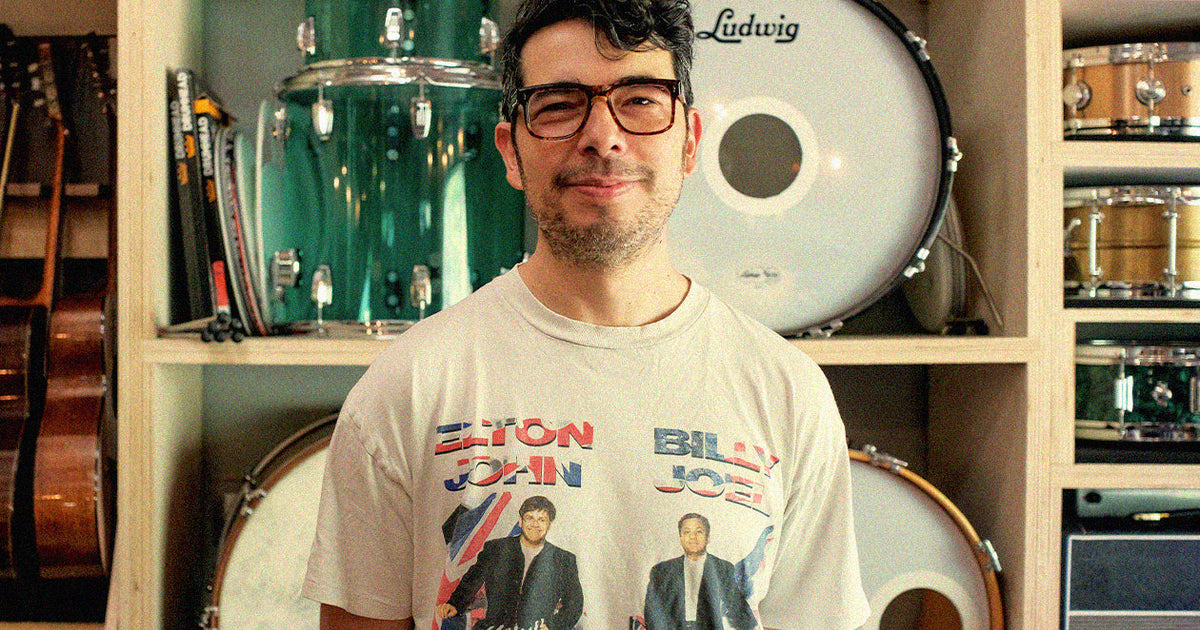
From working as a runner at Capitol Records with studio legends like Al Schmitt to becoming a full-time engineer, de la Garza built his incredible home studio piece by piece. Here, he details his journey from aspiring engineer to Grammy-winning producer and mixer.
Did you ever picture yourself owning a studio like this?
No, I never thought I would have a space like this.
Growing up, I didn’t know anybody who had a studio. I didn’t know anybody who toured in a band. This whole world was completely foreign to me.
There used to be just two pieces of gear in the room — a guitar and a drum set. But little by little, the tools that inspire me have been added to the arsenal. It’s been slow, steady growth to get to this point. And like anything in life, you have to take stock every now and again.
Was there a specific moment when your path veered from musician to producer?
I’ll never forget it. I grew up playing drums in bands, and the first time I went to a proper studio, my mind was blown. I didn’t understand how anything worked, but I loved the process. I assumed you had to have some fancy degree just to work there.
Then one of my old bands made a record with this guy, Val Garay. He’s a legendary producer who worked with Linda Ronstadt and James Taylor. That was the first time I saw someone bring their own rack of gear into a studio. He had his own mic preamps and API 550s in a rack. I was like, “Why are you doing that?”
At that time, everything was new and confusing and exciting. It was the seed that grew to where we are today.
From a Tascam tape recorder and Boss delay pedal, Carlos de la Garza’s home studio has grown piece by piece.
Any fond memories of your early recording setup?
I had a Portastudio 424 and a Boss delay pedal! That equipment opened up a whole new world. Like, “Oh, this is cool! Maybe it doesn’t sound like a record, but it does have a level of production.” That kept the wheels turning.
It made me ask myself: what else can this thing do? What else can I integrate? Maybe if I get a different microphone. Maybe if I try different techniques. A lot of experimentation was unlocked with that first setup.
“The coolest music borrows from the past and mixes it with something new. The goal is using those albums as sparks, not as a blueprint.”
Carlos de la Garza
You talk about nostalgia as an ingredient. As a creative technique, how do you make use of that?
There’s a fine line between borrowing from the past and making something that’s just a complete rip. It’s impossible to do anything completely new. But certain sounds are invariably tied to emotions — they help a song become fully realized. At the end of the day, music is all about emotion.
What does your current Apollo setup look like?
I recently made the switch to Apollo x16s.
Currently, I have 50 ins and outs. It’s been an amazing workflow improvement having all the I/O to integrate my hardware as inserts. And the processing power for more plug-ins is fantastic. I don’t have to use my accelerator cards anymore, and the sound quality is unrivaled.

“When I switched to the newest Apollo x16s, the difference was not subtle,” says de la Garza. “It felt like a breath of fresh air to have everything sound and feel the way I wanted — a literal game changer.”
Walk us through your go-to UAD plug-ins.
The Gray LA-2A is completely indispensable. It’s on pretty much every vocal I do, across every record. It just instantly makes everything sound more forward and brings things into full focus at the center of the stereo spread. I don’t know how else to explain it other than this: it makes things sound like a record.
I also reach for the LA-3A as a starting point on acoustic and electric guitars. It’s solid state, while the LA-2A is tube. So they do a similar kind of gain reduction, but the amplifier circuits sound very different tonally, and that difference is the whole point.
The UA 175B / 176 Tube Compressors have a little more grit. They’re almost like a juiced-up 1176. I use them on vocals that need character, especially when someone has recorded at home in a sterile environment. It’s like a magic bullet for those kinds of recordings.
On the Death Cab record [I Built You a Tower], I used the 175B/176 across the percussion bus because it added a sense of room and life to the direct mics. It also helps even out the dynamics of someone playing a shaker without perfect mic technique.
You mentioned the AMS RMX16 reverb is another one you use on almost every snare.
On the Paramore After Laughter record, pretty much every snare sound has the AMS RMX16. It’s my starting point. When you need something more affected and ’80s-leaning, you just goose it a little higher and it does the thing perfectly. It’s an indispensable plug-in for me.
What about the Vertigo VSM-3? You said you leaned on that for the Paramore record?
I’ve been a long-time subscriber of distortion in my workflow. The Vertigo VSM-3 is one of my favorites. I used it all over the After Laughter record.
In a way, it’s a form of compression because it shaves off some transients. But at the same time, it just makes things feel cool. It’s capable of doing a lot of different kinds of distortion, both subtle and extreme. It’s a little deep, and a little scary at first, but once you wrap your mind around how it works, it’s fantastic.
Paramore’s “Hard Times”, mixed and engineered by Carlos de la Garza.
The Death Cab record has some interesting stereo textures and panning effects. How did you achieve that?
I used the 910 trick — two Eventide 910 Harmonizers panned hard left and right, with one pitched slightly up and one slightly down. You can hear it on the harmonies for “Riptides”. I also reached for the Gray LA-2A as the starting point for every vocal on that record. And the AMS RMX16 on snare — that’s something I do on pretty much every session.
Death Cab for Cutie’s “Riptides” off the album I Built You a Tower, mixed by Carlos de la Garza.
You’ve worn all the hats as a producer and mix engineer across multiple records for Paramore. How has that relationship evolved over the years?
So I got my start at Capitol Records as a runner, and from there I moved into engineering. The first thing I did with Paramore was engineer the self-titled record. Then I engineered and mixed After Laughter, and then I produced This Is Why. So I’ve done every role for them.
To some extent, you really learn an artist on the first record. But the best stuff doesn’t happen until the wall of comfort is broken down. I was able to do that multiple times with Paramore, and they are some of the best people — so funny and so talented. Every one of those records means a lot to me.
“Take something that you feel might be an obstacle in your path, flip it on its head, and make that your superpower.”
Carlos de la Garza
You worked with Joe Newman of Alt-J on his solo project JJerome 87. His music is pretty intimate and cerebral. What was that creative process like?
He would usually come in with just a guitar and vocal idea, and then we’d start cooking. Some synths, some basic guitar layers, and some drum machine programming. Then we’d take it to a proper room like Sunset Sound, add real players like Mark Guiliana, Kyle Crane, Zach Rae, or Sean Hurley to overlay vocals, horns, and strings. It was a multi-layered, maximalist production process, which I loved because you have a full palette of colors to explore.
He thinks cinematically. There’s a song where he wanted it to feel like a ’70s police procedural. We went too far with it at first. It started sounding too much like a throwback. So we had to pull some things back. How do you do a ’70s police procedural in a way that’s modern and cool?
He’s really drawn to the synth world and drum programming. Those are things that Alt-J didn’t really explore. It allowed him to spread his wings in a new direction.
JJerome87’s “Track and Field”, produced by Carlos de la Garza.
You’re working on the Linda Lindas’ new record, and two of them are your daughters! What’s that like?
It started in this very room! We did a benefit show where they performed a handful of cover songs — very simplified versions, because they did not know how to play instruments. I thought it was a one-and-done deal. But playing that show changed their whole perspective on music. They saw what it meant to rehearse together, perform, and feel the crowd. They caught the music bug.
Then they learned how to actually play. Kathleen Hanna reposted a video of them, and they opened for Bikini Kill at the Palladium. Amy Poehler put them in her movie Moxie, and that got them signed to Epitaph. Then they went viral for “Racist, Sexist Boy,” and now they’re signing with Warner Brothers. Hopefully they’ll be releasing their new record by the end of the year.
I would not wish the music industry on anyone, especially my own daughters. But I support their dreams, and getting to be a part of them learning to play and grow as artists has been a dream come true. They’ve really grown tremendously. They bring such great, youthful energy. I’m only the dad of two of them, and those two give me the most grief. But it’s been a great working relationship.
The breakout single “Racist, Sexist Boy” by the Linda Lindas, featuring two of de la Garza’s daughters.
How do you approach choosing new projects to take on?
Sonically, I listen for something that feels authentic, unique, and really catchy. If it has all three of those things, that’s the magic formula. Any one of those things alone is hard to do.
I’ve made the mistake of committing to a whole record and after day two realizing it’s not a good fit. So I make sure we’re mostly aligned in advance in terms of expectations and vision.
Any advice for someone trying to make a go of it in music today?
One of the big takeaways from my own experience is: I never thought I would make any money doing music. But I would probably still be doing it even if I wasn’t making money. When your expectations are that low, it’s easy to exceed them.
But first and foremost, keep following what feels authentic to you. Whether it be a different workflow or learning music theory — take whatever it is that you feel might be a weakness and become really good at that thing. That was a piece of advice I really took to heart.
And of course, be nice to everyone. Bring positivity to any project. Music is incredibly collaborative. If you’re in your bubble and not bringing people in, that’s going to be tough. The people who do really well are great at bringing people into their process, because the end result is often so much better than what you could do on your own.
— UA Staff
Related Articles: