


Tired of weak guitar recordings? Our amp sim buyer’s guide is here to help.
Getting an electric guitar to sound natural in your DAW can be tricky. Whether you choose an in-the-box workflow with plug-ins, or an amp sim pedal into your audio interface, this is the gear you can rely on for incredible tones in 2026.
Capturing a digital emulation of a real guitar amp requires precise modeling. Today, the best amp sim plug-ins and pedals recreate the sound and feel of playing through a real miked-up amp.
What to Look for in an Amp Sim
Accurate amplifier emulation
On guitar amps, the preamp and power amp are responsible for the gain structure, dynamics, and harmonics. This is where a majority of the amp’s tone and character come from.
With UAD amp emulation plug-ins, we model classic guitar amps at the component level — meaning we capture the individual tubes, transformers, resistors, and capacitors. This gives you the most accurate emulation of the original amp, with the feel and touch response under your fingers.
Profiling is another technique used to capture an amp’s sound. By sending a series of test signals and capturing how the amp responds, it’s like taking a single snapshot. The result can sound accurate to the original amp, but often lacks the natural feel and realism.
Real speaker and cabinet models
For a guitar cabinet and speaker, amp sims rely on physical modeling. Engineers measure the frequency response of the speaker and cabinet in a real space to build an emulation of the amp’s acoustic qualities.
Impulse responses (IRs) are the most common method used to capture a guitar speaker and cabinet. But since they only take a static snapshot of the amp, they can lack realism and dynamics.
Our UAD amp emulation plug-ins go further with dynamic speaker modeling. This technique captures every nuance of the speaker and cabinet in immaculate detail — along with the microphones and room sound. This gives you all the sonics of a real amp in your DAW, with the feel and harmonics of playing at volume in a live room.
Best UAD Guitar Amp Plug-Ins
Paradise Guitar Studio
Great for: Any genre
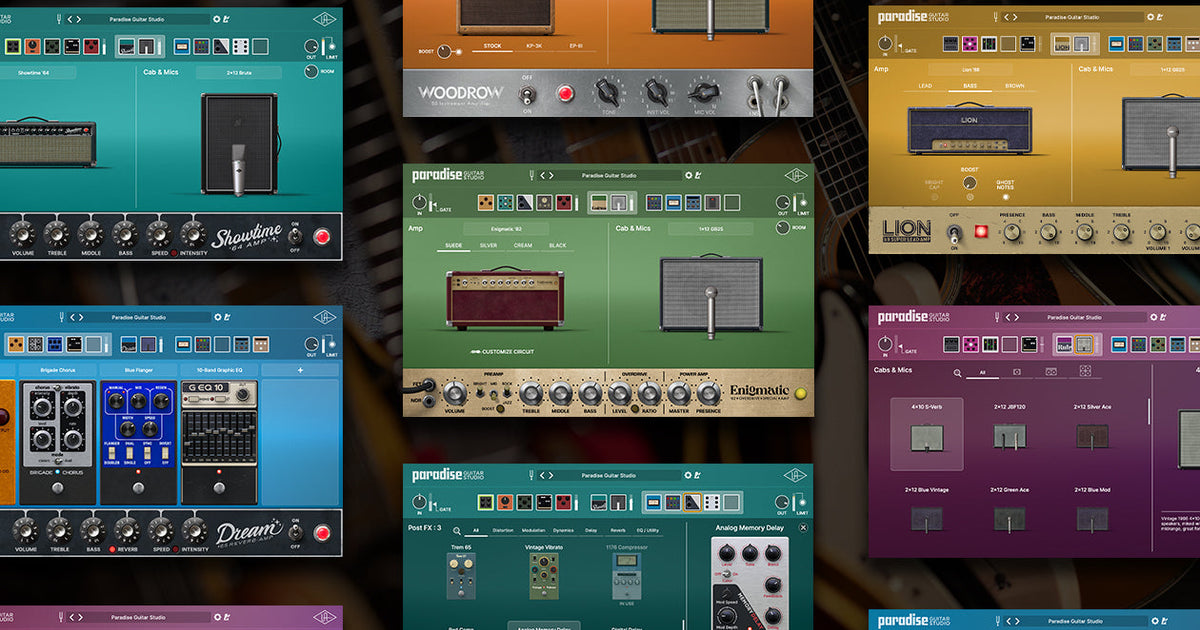
If you’re after versatility and sound quality, Paradise Guitar Studio is hard to beat. It’s a complete guitar recording environment that brings together classic amp models, cabinet and mic pairings, and effects. It covers everything from shimmering cleans to heavy distortion all in a single plug-in.
It doesn’t matter if you’re tracking a folk record or laying down a metal rhythm track — Paradise Guitar Studio has you covered. Plus, with over 300 presets, it’s easy to find the right sound without endless tweaking.

With Paradise, the controls and routing all happen in one plug-in. This means you don’t need to build an entire plug-in chain, and you can discover sounds faster.
UAD Showtime ’64 Tube Amp
Great for: Bold cleans, pedal platform
When pristine clean tone is the priority, the UAD Showtime ’64 Tube Amp sets the bar. Modeled after a legendary American tube amp, this plug-in captures the springy, bell-like clarity and feel that made the original so iconic.
It excels with single-coil guitars in blues, country, and indie contexts, but is equally at home as a foundation for your pedalboard. You can run your favorite overdrives and fuzzes straight into your computer, and UAD Showtime ’64 is the perfect compliment.

The UAD Showtime ‘64 Tube Amp gives you the bold cleans of a classic sixties amplifier used by artists like the Beach Boys, Dick Dale, and Nels Cline.*
Best UAFX Amp Pedals
When you want the sound and feel of iconic tube amps right on your pedalboard, UAFX amp emulator pedals give you a more authentic playing experience than typical amp sim plug-ins. Designed to sit alongside your other stompboxes, they become the “amp” in your rig.
Unlike plug-ins, which are used exclusively inside a DAW, UAFX amp pedals let you shape your sound in real time with the immediacy and responsiveness of a traditional amp setup. Just set them like an amp, and run them into your audio interface to get the same mix-ready tones as their plug-in counterparts.
Lion ’68 Super Lead Amp
Great for: Rock
Lion ’68 is perfect for crunchy rhythm tones and searing leads. When harder-rocking sounds are needed, add a distortion stompbox in front to push it into heavier territory.
Enigmatic ’82 Overdrive Special Amp
Great for: Blues, Rock
Enigmatic ’82 gives you the mythical touch sensitivity and biting overdrive favored by players like Stevie Ray Vaughan and Robben Ford.*
Ruby ’63 Top Boost Amp
Great for: Pop, Indie
Ruby ’63 captures the legendary British jangle that’s defined chart-topping tracks since the early sixties.
Dream ’65 Reverb Amp
Great for: Surf, Country
Dream ’65 delivers the warmth and bell-like cleans of an era-defining American tube amp.

UAFX Amp & Cab Emulator pedals give you the sound of the most famous tube amps ever made, from iconic combos to legendary high-powered heads.
UAD Amp Sims vs Neural DSP and Helix
There’s no shortage of capable amp sims on the market. Here’s how our flagship amp plug-in, Paradise Guitar Studio, stacks up against two popular alternatives.
| Amp Models | Cabinet Modeling | Effects Included | Standalone Mode (No DAW) | |
|
Paradise Guitar Studio |
Curated by Genre | Dynamic Speaker Modeling | Yes | Yes |
|
Neural DSP Archetype |
Artist/Genre-Specific | Static IR | Yes | Yes |
| Line 6 Helix Native | Broad Multi-Brand Library | Static IR | Yes | No |
Finding Your Sound
The best amp sim is the one that gets out of your way and lets you play. Whether you’re building a full virtual rig with Paradise Guitar Studio or finding your personal sound with an amp model like UAD Showtime ’64, our lineup is built to take you where you want to go. Start with the style and genre that fits you best, dial in your tone, and then focus on what matters most — the music!
For a deeper look at setting up your signal chain and getting the most from direct recording, check out our guide to recording guitar direct.
— Austin Lyons
*All trademarks property of their respective owners. Use of artist names does not constitute endorsement of Universal Audio products.
Related Articles: