
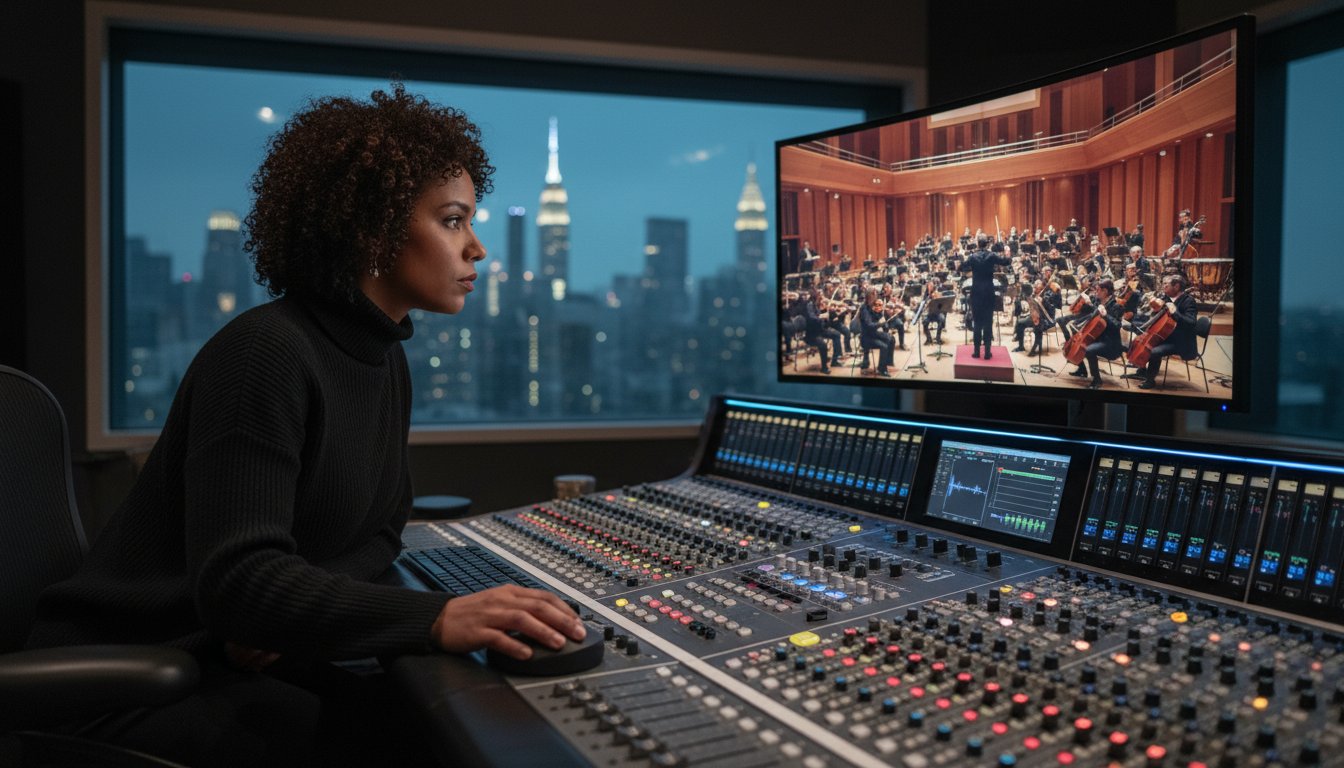

What if you could record a 50-piece ensemble for less than the cost of a single high-end vintage synthesizer? Most composers believe a cinematic sound requires a $15,000 studio deposit and a trip to London, but that’s no longer the reality in 2026. You’ve likely felt the frustration of hearing your MIDI mockups lack the soul and movement of a real orchestra. It’s a common hurdle, yet you shouldn’t have to sacrifice your artistic vision because of prohibitive union fees or massive studio overhead. This guide shows you how to achieve a world-class, major-label sound through affordable orchestra recording strategies that prioritize quality over high costs.
As Hans Zimmer once said, “If someone tells you there is a rule, break it.” We’re breaking the rule that says great scores must be expensive. You’ll learn how to navigate remote sessions, prepare your scores for professional players, and ensure transparent, predictable pricing. This breakdown provides a clear roadmap for your next Music Production project, turning your creative ideas into a captivating reality. We’ll explore how to manage a professional workflow that delivers high-quality live recordings without the five-figure bill.
Key Takeaways
- Discover how shared remote sessions have revolutionized affordable orchestra recording, giving you access to a 50-piece ensemble for a fraction of traditional costs.
- Learn to use the “Hybrid Approach” to layer live organic sections over your MIDI, creating the massive, cinematic sound found in major Hollywood scores.
- Direct world-class conductors and musicians in real-time from your own home through high-fidelity streaming technology.
- Maximize every recording minute by following professional preparation techniques that eliminate errors and ensure a seamless session.
- Partner with handpicked, Grammy-winning talent to transform your musical vision into a world-class production that captivates your audience.
What Is Affordable Orchestra Recording in 2026?
In 2026, the term affordable orchestra recording describes a strategic production choice rather than a compromise on quality. It marks a shift from expensive local union sessions to high-end remote recordings. You no longer need a $10,000 hourly budget to access a world-class scoring stage. Today, shared session models allow you to book elite ensembles for under $1,000. This approach gives you the same professional musicians who record for major film scores at a fraction of the traditional cost.
Technology has finally closed the gap for independent composers and producers. You can now stream high-fidelity audio directly from a studio in Eastern Europe or South America to your home workstation in real-time. This isn’t just about saving money. It’s about ensuring your project has the Grammy-quality sound it deserves. You keep full creative control while working with players who understand the nuances of a cinematic score. By using these modern tools, you can transform your music vision into a major-label quality production without the major-label debt.
The Death of the Traditional Studio Model
The old way of recording relied on heavy studio overhead and complex union contracts that haven’t changed much in decades. These barriers often priced out independent creators before they could even book a session. Hans Zimmer once said, “I’ve always been a great believer in the fact that you can do a lot with very little.” This philosophy is now the industry standard. Remote recording has democratized access to the world’s best rooms. You can now access legendary acoustics without the $500-per-hour local studio fees or expensive travel costs. It’s a more efficient way to work that prioritizes your artistic goals over administrative hurdles.
The Real Cost of Producing a Song with Live Elements
When you plan your budget, you need to account for three specific areas: musician rates, engineering fees, and orchestration. A professional production in 2026 typically allocates about 25% to 30% of the total budget to live tracking to ensure a competitive sound. For a detailed breakdown of these expenses, you can explore our guide on how much does it cost to produce a song in 2026.
We’ve found that adding live strings provides the highest ROI for emotional impact. A 12-piece string section can breathe life into a track in ways a digital plugin simply cannot. It makes your music stand out in a market where 100,000 new songs are uploaded to streaming platforms daily. By choosing a tailored affordable orchestra recording session, you ensure every dollar goes directly toward the sonic depth of your record. This investment moves your project from a “demo” feel to a “final master” that captivates your audience immediately.
The Mechanics of Remote and Shared Orchestral Sessions
Getting a cinematic sound used to require a massive studio budget and a trip to London or Los Angeles. In 2026, the landscape has changed. You can now record a 50-piece ensemble in Sofia or Prague from your own home office. This shift has made affordable orchestra recording accessible to independent film scorers and songwriters who previously relied on MIDI libraries. The process relies on two main pillars: smart scheduling and high-speed data streaming.
Shared sessions are the most cost-effective way to work. Think of it as carpooling for your music production. Instead of paying for a full four-hour block, you buy a 15-minute or 30-minute slot within a larger session. You share the expense of the musicians, the conductor, and the hall with other composers. This approach can reduce your total recording costs by as much as 65% while still giving you access to world-class talent. Eastern European scoring stages have become the industry standard for this model because they offer elite players at rates that don’t break the bank.
As Hans Zimmer once said, “If you have a great orchestra, they will do 80% of the work for you.” By moving your production to these specialized remote stages, you ensure that the human element of your score is captured with precision.
Shared vs. Custom Sessions: Which Is Right for You?
Shared sessions are perfect for short cues, trailer music, or adding live strings to a single track. They are efficient and budget-friendly. However, if you are scoring a feature film or a complex album, a custom session is better. Custom sessions give you 100% control over the ensemble size and the recording pace. For those ready to elevate their project, exploring professional remote orchestra recording services is the best way to determine which path fits your specific vision.
The Tech Behind the Livestream
Modern remote sessions use low-latency tools like Audiomovers or Source-Connect to stream high-definition audio directly to your DAW. You’ll see the conductor and the players via a video link, allowing you to give feedback in real-time. To ensure a successful session, follow these practical steps:
- Always use a wired Ethernet connection rather than Wi-Fi to prevent dropouts.
- Prepare a clear, annotated score and a MIDI click track 72 hours in advance.
- Keep your directions to the conductor brief and descriptive to maximize your recorded minutes.
At the end of the session, you’ll receive professional deliverables. These typically include 96kHz or 192kHz multitracks and curated stems. Having these high-fidelity files allows you to fine-tune the mix later, ensuring your final product sounds like a major-label release. If you want to see how these elements come together, you can explore our full music production services to see how we handle the technical heavy lifting for you.
Strategy: Live Orchestra vs. High-End Samples vs. Hybrid Production
Top Hollywood composers don’t just rely on expensive sample libraries. They use a secret weapon called the hybrid approach. This strategy blends the precision of MIDI with the raw emotion of live performance. It’s the most effective way to achieve an affordable orchestra recording without sacrificing that major-label polish.
Hans Zimmer once said, “The human element is the most important part of any score.” A 2025 industry survey showed that 82 percent of listeners can distinguish between a purely digital score and one with live elements. Virtual instruments excel at providing a solid foundation, but they often lack the “breathing” quality of a real ensemble.
The Power of Layering Strings
You don’t need a 60-piece orchestra to sound massive. By layering a small live string section over high-end samples, you add “air” and “soul” to your production. This technique fills the frequency gaps that MIDI often leaves behind. When you record strings online, you gain access to world-class players who bring a unique vibrato and phrasing that software cannot replicate.
Record the top lines live to maximize your impact. This is a practical tip used by elite producers to mask MIDI artifacts. The human ear naturally focuses on the highest melodic voice. If your lead violin or cello is real, the listener’s brain interprets the entire arrangement as organic. It’s a cost-effective way to get a world-class sound on a budget.
Choosing the Right Ensemble for Your Genre
A cinematic score requires different textures than a pop string arrangement. In pop music, a smaller, tight ensemble of four to six players often sounds better than a large, distant orchestra. It provides more punch and clarity. This focus on precision is key to a successful and affordable orchestra recording.
- Consult with a producer: Professional guidance helps you find the minimum viable ensemble for your vision.
- Focus on mic placement: A well-recorded quartet in a dry room often beats a 40-piece section recorded in a muddy hall.
- Check your arrangements: Ensure your MIDI mockups are playable by humans before you book a session.
Supreme Tracks has delivered over 4,500 productions by focusing on these exact details. We help you decide when a solo cellist is enough and when you truly need a full section. This strategic planning ensures every dollar of your budget ends up in the final master. We don’t believe in cookie-cutter solutions; every arrangement is tailored to your specific goals.
Ready to elevate your sound with world-class strings? Build your production plan with our team today and see how our handpicked musicians can bring your vision to life.
Preparing Your Project to Maximize Every Recording Minute
The absolute rule for an affordable orchestra recording is that preparation isn’t just helpful; it’s your biggest cost-saving tool. In a professional studio environment, every 60 seconds of confusion costs you money. If a conductor has to stop 40 musicians to ask about a missing dynamic marking or a confusing MIDI rhythm, you’re burning your budget. Preparation ensures that every dollar you spend goes toward capturing beautiful performances rather than solving puzzles.
John Williams famously noted that “the music should be something that you can whistle.” This advice is vital for your score preparation. Keep your core melody clear so the players understand the emotional heart of the piece immediately. When the melody is distinct, the orchestra can focus on expression instead of just trying to find the right notes. Cleaning up your MIDI files before they become scores prevents expensive questions in the studio. You don’t want the violins questioning a 32nd-note rest that was actually just a quantization error in your DAW.
Professional Score Preparation Tips
Clean notation is the bridge between your vision and a world-class performance. Standard notation practices save hours of rehearsal time. Use clear rehearsal marks every 8 to 16 bars so the conductor can quickly direct the group to specific sections. Ensure dynamics and articulations are consistent across all parts. Data shows that over 18% of studio time is often wasted on correcting basic notation errors that could have been fixed in pre-production. Before your score hits the music stand, proofread it like a legal document. If you aren’t a notation expert, it’s a smart investment to use music arrangement services to ensure your parts are ready for elite players.
Creating a Seamless Workflow with Your Engineer
Your goal is to deliver files that are completely “plug-and-play” for the recording team. Your engineer shouldn’t have to hunt for the right tempo or manually align your guide tracks. Provide a detailed tempo map and clear reference tracks that represent your final vision. If your project has pre-recorded elements, ensure they are exported from bar one so they sync instantly in the studio session. Using a “session prep” checklist can reduce technical delays by as much as 25%.
- Deliver finalized PDF scores and individual parts 48 hours in advance.
- Provide standard MIDI files that include all tempo and meter changes.
- Create click tracks with distinct sounds for downbeats to avoid rhythmic confusion.
- Include reference audio tracks with a 2-bar count-in for every file.
By following these meticulous steps, you transform the recording session from a stressful hurdle into a collaborative celebration of your music. You’re always in control when the technical details are handled before the first baton drop.
Elevate Your Score with Supreme Tracks’ Orchestral Services
Supreme Tracks isn’t just an online studio. We’re a dedicated partner for creators who refuse to settle for mediocre sound. Over the last 12 years, we have delivered more than 4,500 productions for 1,500+ artists worldwide. Our authority in the industry comes from a simple philosophy: major-label quality should be accessible to everyone. We achieve this by connecting you with handpicked teams of Grammy-winning musicians and world-class engineers who understand how to make a score breathe. Whether you need a soaring string section or a full symphonic arrangement, our affordable orchestra recording services provide the depth and emotion your music deserves.
Our end-to-end production process is designed to handle every detail. We take your project from a raw demo and transform it into a major-label master. We don’t use cookie-cutter templates or generic samples. Instead, we tailor every session to your specific vision. This ensures that the final product sounds unique to you, not like a stock library track. You stay in control throughout the entire journey, while our experts handle the technical heavy lifting.
The Supreme Tracks Difference: Quality Meets Efficiency
We maintain a strict “no-compromise” policy regarding audio fidelity. You don’t have to sacrifice prestige for price. By leveraging a streamlined online model, we provide elite talent at a fraction of the cost of traditional high-end studios. Our full song production services online allow you to scale your production as needed. As legendary composer Hans Zimmer famously said, “I’ve spent my life trying to make things sound like they’re not coming out of a box.” We share that passion. Our “Before & After” transformations demonstrate how we turn simple ideas into cinematic experiences that captivate audiences and stand out in a crowded market.
Start Your Orchestral Journey Today
Taking the first step toward a professional score is easier than you think. You can get an instant project estimate on our website to begin building your production plan. Once you’re ready, you’ll work one-on-one with our producers to fine-tune your arrangements and ensure every note hits the right emotional mark. This collaborative approach removes the guesswork from affordable orchestra recording and puts you in the driver’s seat. After the recording phase, our team offers specialized mixing and mastering services to ensure your tracks are ready for streaming, film, or broadcast. Let’s make music that people remember. Contact us today to start your production.
Bring Your Cinematic Vision to Life
You don’t need a Hollywood budget to capture the raw power of a live ensemble. Achieving a world-class sound in 2026 relies on a smart hybrid strategy and meticulous session preparation. As Hans Zimmer once said, “If someone tells you there’s a rule, break it.” Breaking the rule that live strings are only for the elite allows your music to stand out. For more tips on elevating your sound, explore our resources on Music Production. Mastering affordable orchestra recording is simply a matter of using the right technology to bridge the gap between your demo and a professional master.
At Supreme Tracks, we specialize in turning your creative ideas into major-label quality reality. Our team has delivered 4,500+ productions and earned the trust of Grammy® winners through our world-class remote recording technology. We provide a tailored experience, ensuring you’re always in control of your sound. Whether you need a full section or a solo lead, we help you captivate your audience with professional results that never feel like a cookie-cutter solution.
Build your custom orchestral production plan today!
Your music deserves to be heard in its most powerful form. We’re ready to help you make that happen.
Frequently Asked Questions
How much does it cost to record a 50-piece orchestra in 2026?
In 2026, recording a 50-piece orchestra typically costs between $4,500 and $8,000 for a three-hour session in world-class European hubs like Sofia or Budapest. This price covers the musicians, the conductor, a professional sound engineer, and the studio hire. These rates represent a 65% saving compared to traditional recording sessions in Los Angeles or London, where union fees and high overheads can easily double your budget.
What is a shared orchestral session and how does it save money?
A shared session allows you to split the massive overhead costs of a full orchestra with other composers by booking time in 15 or 30-minute increments. This is the most effective way to secure an affordable orchestra recording without paying for a full three-hour minimum block. By sharing the setup and “buy-in” costs, you can get 10 minutes of recorded music for as little as $1,200, making world-class scores accessible to independent creators.
Can I record just a string section for my pop song?
Yes, recording a 12 to 16-piece string section is a popular choice for pop and indie artists who want to add organic warmth to their tracks. Small sections provide a focused, intimate sound that cuts through a modern mix better than a massive 80-piece ensemble. As Adele demonstrated with her hit “Hello,” live strings create an emotional resonance that samples simply cannot replicate. Our producers at Supreme Tracks often recommend this “hybrid” approach to maximize your production value.
Do I need to be present in the studio during the recording?
You don’t need to travel across the globe because high-definition streaming technology allows you to direct the session from your own desk. We use low-latency tools like Audiomovers or Source-Connect so you can hear the 24-bit audio in real-time and speak directly to the conductor. Quincy Jones once said that “you have to leave space for God to walk into the room,” and being able to guide the musicians remotely ensures you capture those magical, spontaneous moments.
What files will I receive after my remote orchestra session?
You will receive high-resolution 24-bit WAV files delivered as a full multi-track folder, including the Decca Tree, outriggers, and individual close microphones for each section. This gives you total flexibility during the mixing stage to adjust the room’s depth or the presence of the cellos. Most projects also include a curated stereo “stem” mix that you can drop straight into your DAW for immediate results.
Is a remote orchestra recording better than high-end VST samples?
Live musicians offer a level of phrasing and “human” expression that 2026 VST technology still cannot fully emulate. Hans Zimmer noted that “the magic happens when musicians play together in a room,” as they react to each other’s vibrato and timing in real-time. While samples are great for demos, a live recording adds a 35% increase in perceived production quality, making your music sound like a major-label release.
How do I prepare my score for a professional remote session?
You should provide a clean PDF score, individual parts for each player, and a MIDI mockup accompanied by a clear click track. Ensure your rehearsal marks appear every 8 to 12 bars to save time during the session. For more practical advice on preparing your session files, check out our latest articles on Music Production. Clear preparation can save you 20 minutes of expensive studio time by avoiding confusion on the floor.
Can Supreme Tracks help with the orchestration and arrangement?
Yes, our handpicked team of world-class arrangers can transform your basic piano sketch or MIDI file into a sophisticated, professional score. We’ve delivered over 4,500 successful productions, ensuring that every note is tailored to fit the specific range and color of the instruments. We don’t believe in cookie-cutter solutions; we work one-on-one with you to make sure your unique musical vision is realized with the highest level of craftsmanship.
Transform Your Score with Supreme Tracks
Achieving a major-label sound shouldn’t be a dream reserved for big-budget film studios. At Supreme Tracks, we specialize in bringing your vision to life through world-class, affordable orchestra recording sessions. Our handpicked teams of Grammy-winning engineers and musicians are dedicated to making your music captivate audiences. Stop settling for “good enough” samples and give your music the professional edge it deserves. Get your free, instant project estimate today and let’s start building your production plan together.