


Why LUFS Exists
LUFS exists because peak meters kinda lie. 👀
Two tracks can peak at the same level and feel wildly different in loudness.
One feels calm. The other feels aggressive.
LUFS measures how loud audio feels to humans over time, not just how high the waveform goes.
If you understand LUFS, loudness stops being confusing — and starts being predictable.
Quick Summary
👉 LUFS measures perceived loudness over time. Integrated LUFS shows overall loudness, Short-Term shows loudness over a few seconds, and Momentary shows instant loudness. Together, they explain how music and voice actually feel to listeners.
LUFS stands for Loudness Units relative to Full Scale.
It is a loudness standard designed to match human hearing, not electrical level.
LUFS answers the question:
“How loud does this actually feel?”
Key idea:
Example:
-
–23 LUFS → quiet
-
–14 LUFS → loud
-
–9 LUFS → very loud
Different meters answer different questions.
Peak Level
VU
SPL
-
Measures sound pressure in a room
-
Used in acoustics and calibration
-
Not used for file delivery
LUFS
Simple takeaway:
-
Peak = safety
-
VU = feel
-
LUFS = reality
What Is a Decibel? dBFS, dBV, dBu and dBSPL Explained in Simple Terms
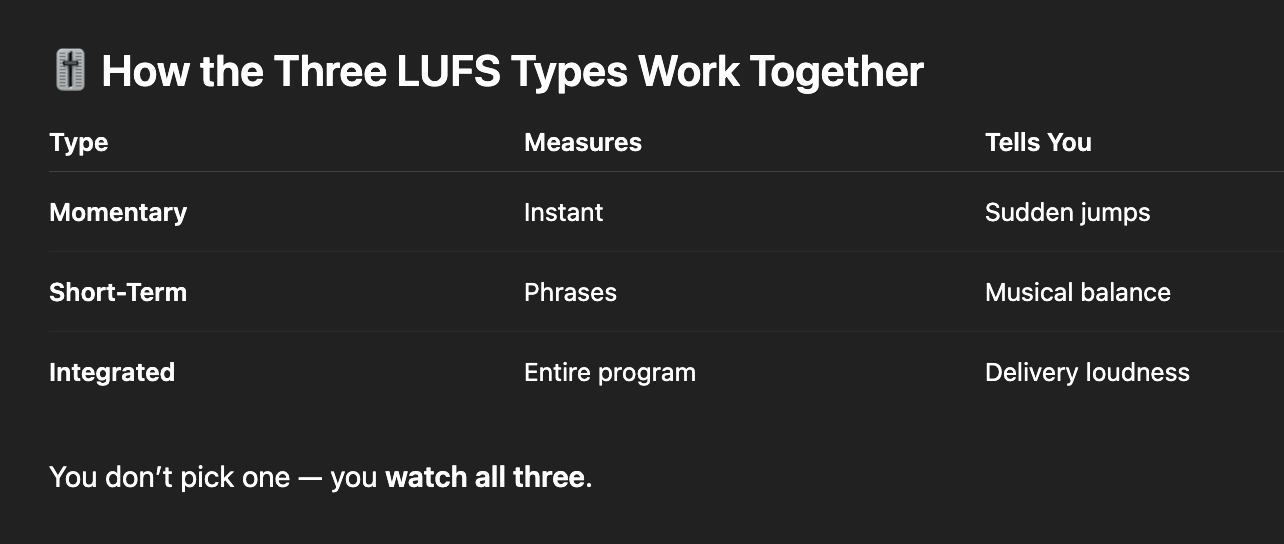
Momentary LUFS measures loudness over ~400 milliseconds.
It shows what’s happening right now.
Best used for:
Momentary LUFS moves fast — like a speedometer.
⭐️ Start by downloading all of my FREE Music Production Guides ⭐️ It took me years to learn this stuff!
Short-Term LUFS measures loudness over ~3 seconds.
This is where music and speech live.
Best used for:
-
verses vs choruses
-
dialogue consistency
-
chorus impact
-
dynamic contrast
-
podcast voice balance
If a chorus doesn’t feel bigger, short-term LUFS usually explains why.
Power vs Force in Mixing and Mastering Audio🎚️
Integrated LUFS measures loudness across the entire program.
This is the number platforms care about.
Best used for:
Integrated LUFS ignores short spikes and focuses on overall experience.
Music (Streaming)
-
Singles: –14 to –16 LUFS Integrated
-
Albums: normalize loudest song, keep relationships
-
Peaks typically below –1 dBTP
YouTube (Music & Video)
Podcasts
-
–16 LUFS Integrated (stereo)
-
–19 LUFS Integrated (mono)
-
Very consistent short-term levels
Audiobooks
Broadcast / TV (North America)
-
–24 LUFS Integrated
-
Very strict compliance
 ⭐️ Download my Free Guide The Magic EQ Settings that work on EVERYTHING!
Q: Should I mix to LUFS from the start?
A: No. Mix for balance first. Check LUFS near the end.
Q: Why does my track sound quieter even at the same LUFS?
A: Dynamics, arrangement, and frequency balance matter.
Q: Does louder always mean better?
A: No. Platforms normalize loudness anyway.
Q: What LUFS meter should I trust most?
A: Integrated for delivery. Short-term for musical decisions.
LUFS isn’t about loudness wars.
It’s about translation.
Peak tells you if it breaks.
LUFS tells you how it feels.
When you understand LUFS, you stop guessing — and your music and voice sound consistent everywhere they’re played.

⭐️ Download my Free Magic Delay settings Guide ⭐️

⭐️ Download my Free Magic Reverb settings Guide ⭐️
#protools #daw #homestudio #recordingschool #recording #musicproduction
Also read:
How to Start Your Own Online Business Teaching Music

Hey, I’m Futch – Music Production Coach and Ableton Certified Trainer

Learn how to make your first song and beat in Ableton Live with my
FREE 90-minute Ableton Live course
I’ve been teaching audio engineering and music production for 35 years.⭐️
Check out my new online music production program: Music Production Ninja…