


You Feel It… But You Can’t Hear It
“The lowest note is often the most important…
and the easiest to lose.”
You solo the bass.
It sounds huge.
Deep.
Powerful.
Then you hit play on the full mix…
And it disappears.
Not gone.
Just buried.
Bass isn’t just about low frequencies.
It’s about being heard.
Quick Summary
👉 Bass disappears when it clashes with other elements (especially the kick), lacks midrange presence, or isn’t supported by arrangement and harmonics. The solution is better arrangement, EQ separation, sidechaining, and adding harmonic content.
Before EQ.
Before plugins.
Start here.
If your bass and other instruments are playing in the same range at the same time…
They compete.
Common Problems
- bass and kick hitting together constantly
- dense arrangements with too many low instruments
- bass parts that don’t leave space
The Fix
- simplify the bassline
- create rhythmic contrast with the kick
- leave space in the arrangement
The cleanest mix starts with the right notes.
DAW Mixing: Why Is My Mix Muddy? 🔊
Not all bass sounds are created equal.
Some are:
- too sub-heavy
- too dull
- too soft in the mids
What Works Better
- bass tones with midrange presence
- slightly driven or amped sounds
- tones that translate on small speakers
If the sound doesn’t cut, no amount of mixing will fix it.
Bass and kick live in similar frequency ranges.
If they overlap, they cancel each other out.
The Strategy
Give each its own space.
Example
- Kick → focus on punch (around 50–100 Hz)
- Bass → focus slightly above or below
Additional Moves
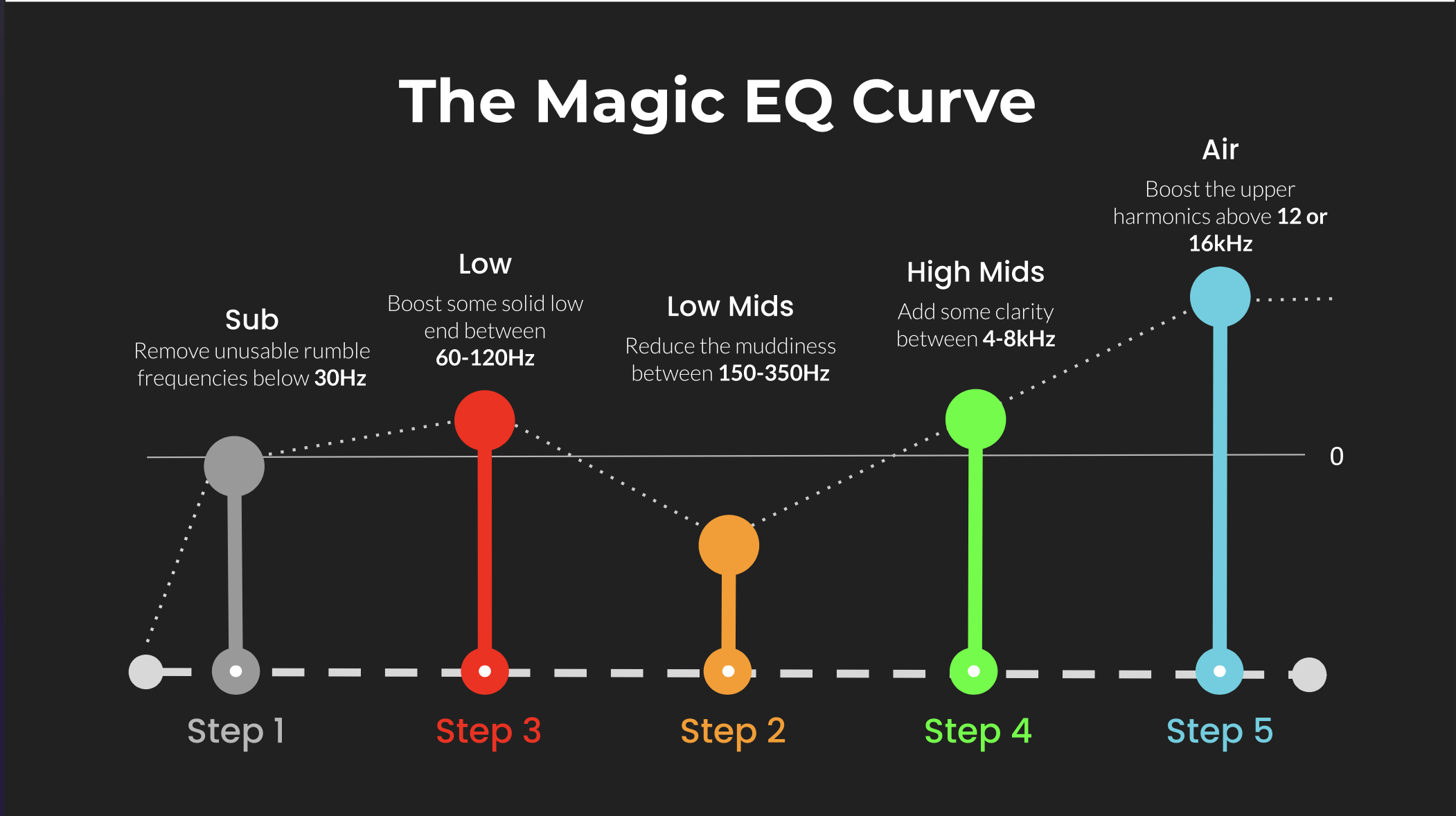
- cut unnecessary low end from other instruments
- clean up low-mids (150–300 Hz)
- shape clarity instead of boosting everything
Separation creates clarity.
Download my Free Magic EQ Guide that workd for everything!
Sometimes EQ isn’t enough.
That’s where sidechain compression comes in.
How It Works
A compressor on the bass is triggered by the kick.
Every time the kick hits:
- the bass ducks slightly
- the kick cuts through
- the mix feels tighter
The Result
- more punch
- more clarity
- better groove
The bass steps back so the kick can step forward.
⭐️ Download my Free Music Production Guides or take my free Ableton Live Course ⭐️
Here’s the secret:
Most speakers can’t reproduce deep sub frequencies well.
So how do you hear bass on small systems?
Harmonics.
What Are Harmonics?
Frequencies above the fundamental note.
They make the bass audible, not just felt.
The Fix
- boost upper harmonics
- use subtle distortion or enhancement
- emphasize frequencies around 700 Hz – 2 kHz
If you can hear the harmonics, you perceive the low end.
Saturation adds:
- harmonic content
- texture
- midrange presence
Why It Works
It makes the bass:
- more audible on small speakers
- more present in the mix
- easier to hear without increasing volume
Use It Subtly
- light saturation → clarity
- heavy saturation → distortion
Saturation translates bass across systems.
3 Ways to Process Audio in Your DAW: Series, Parallel & Group
Sometimes the bass isn’t disappearing.
You just can’t hear it accurately.
Common Issues
- headphones with weak low end
- speakers exaggerating bass
- untreated rooms
The Result
Bad decisions.
Too much bass… or not enough.
If you can’t hear it, you can’t balance it.
If your bass disappears, check this:
- arrangement too dense
- bass tone lacks midrange
- kick and bass overlapping
- no sidechain control
- no harmonic content
- poor monitoring
Fix these first.
Q: Why can I hear my bass on headphones but not speakers?
A: Likely too much sub and not enough harmonics.
Q: Should I boost bass frequencies?
A: Not always — focus on clarity and separation.
Q: Is sidechain compression necessary?
A: Not always, but very effective in modern mixes.
Q: Can saturation replace EQ?
A: No — but it enhances what EQ shapes.
Bass isn’t just about depth.
It’s about presence.
Arrangement.
Tone.
Separation.
Harmonics.
If the bass has a place, you’ll hear it.
If it doesn’t…
It disappears.
 ⭐️ Download my Free Magic EQ settings Guide ⭐️

⭐️ Download my Free Magic Reverb settings Guide ⭐️
#protools #daw #homestudio #recordingschool #recording #musicproduction
Also read:
How to Start Your Own Online Business Teaching Music

Hey, I’m Futch – Music Production Coach and Ableton Certified Trainer

Learn how to make your first song and beat in Ableton Live with my
FREE 90-minute Ableton Live course
I’ve been teaching audio engineering and music production for 35 years.⭐️
Check out my new online music production program: Music Production Ninja…