

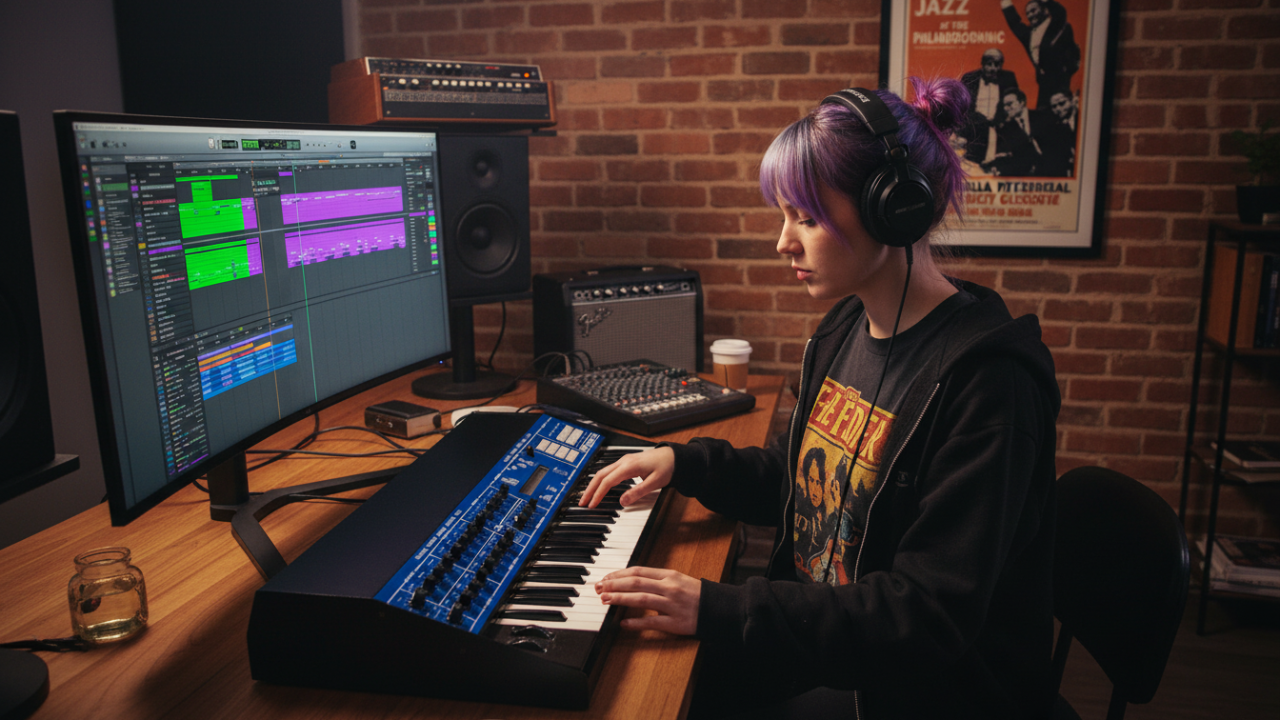

The Blue Portal Into the Digital Future
Before the digital age arrived…
before FM took over…
before sampling became mainstream…
there was the PPG Wave 2 — a glowing blue spaceship of a synthesizer that sounded like the future trying to break into the present.
It wasn’t analog.
It wasn’t digital.
It was something in between — a new dimension of sound.
The PPG Wave 2 didn’t just change electronic music.
It changed what synthesis could be.
Quick Summary:
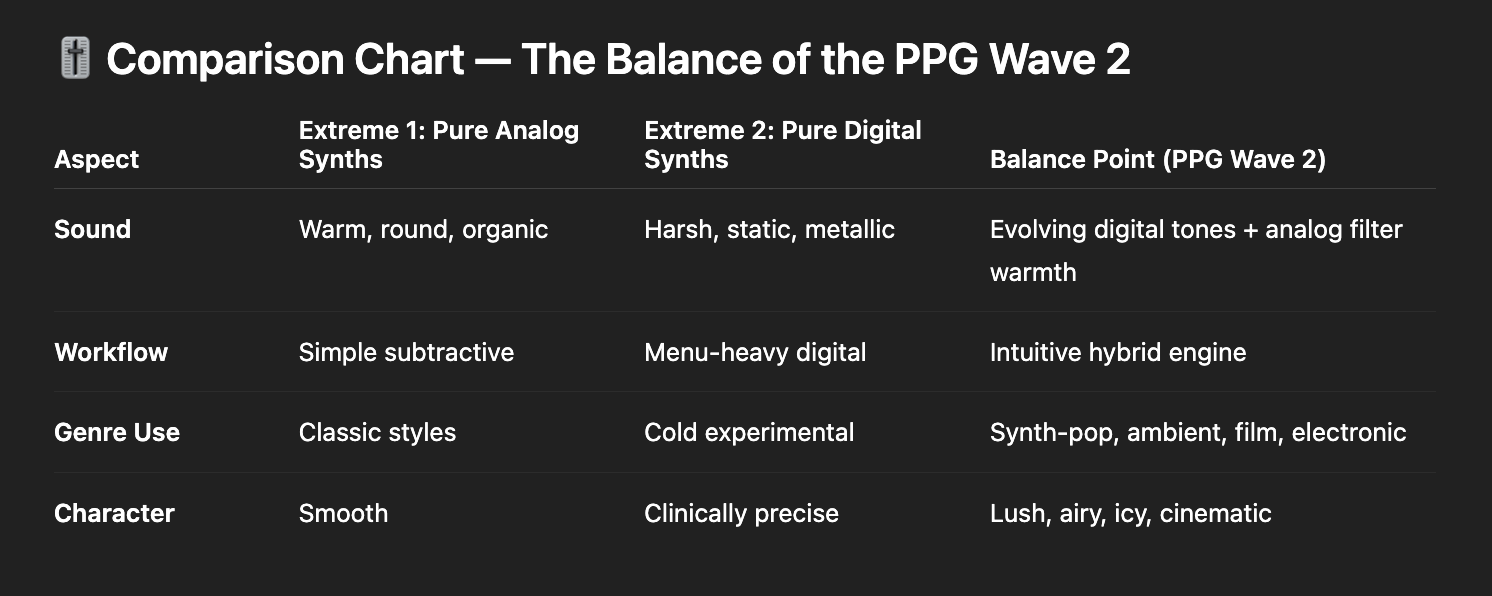
👉 Released in 1981, the PPG Wave 2 is a hybrid wavetable synthesizer combining digital oscillators with analog filters. Its shimmering, evolving tones defined new wave, synth-pop, industrial, electronica, and film scoring.
Question: How did the PPG Wave 2 begin?
German designer Wolfgang Palm wasn’t satisfied with the limitations of analog subtractive synthesis.
He wanted evolving waveforms.
He wanted motion.
He wanted digital complexity with analog emotion.
So in 1981, he released the PPG Wave 2, a synthesizer that combined:
This wasn’t an update to existing technology.
It was a philosophical leap.
🎯 Core Innovations
-
Wavetable synthesis — cycle through waveforms in motion.
-
Hybrid design — digital oscillators + analog filters.
-
Characterful Curtis filter — smooth, warm, essential.
-
Bright, glassy digital tone — unheard-of at the time.
-
A bold new UI aesthetic — ocean-blue, futuristic, unmistakable.
“The PPG Wave sounded like analog dreaming of digital.”
🧩 Balance Point
Between analog soul and digital imagination.
It didn’t replace analog — it expanded it.
🔑 Key Takeaway
The PPG Wave 2 invented modern wavetable synthesis — and reshaped the future of electronic sound.
Synth Legends: The Moog Minimoog 🎛️
Question: Why does the PPG Wave 2 sound so otherworldly?
Because its oscillators could move.
Not just detune.
Not just filter.
Move through tables of waveforms in real time.
This created sounds that felt like:
-
evolving glass
-
shimmering metal
-
digital choirs
-
icy pads
-
hybrid bells
-
alien textures
-
warm-yet-hollow leads
It was beautifully contradictory — the perfect blend of volatility and clarity.
🎯 Core Sound Traits
-
Evolving wave motion — a swirling, shifting tone.
-
Bright digital harmonics — distinctly non-analog.
-
Analog filter warmth — smoothing the digital edge.
-
Icy pads & choirs — the signature PPG atmosphere.
-
Hybrid bells & metallic hits — a soundtrack composer’s dream.
“The PPG Wave 2 is what happens when electricity starts painting with light.”
🧩 Balance Point
Between sharp digital clarity and warm analog filtering.
Both modern and timeless.
🔑 Key Takeaway
The PPG Wave’s originality lies in its evolving, shape-shifting digital voice tempered by analog warmth.
⭐️ Start by downloading all of my FREE Music Production Guides ⭐️ It took me years to learn this stuff!
The PPG Wave 2 became the synth for artists who wanted futuristic emotion.
It wasn’t built for radio pop.
It was built for sonic landscapes.
Synth Legends: The Roland Juno-106 🌈
🎤 New Wave & Synth-Pop — The Shimmering ’80s Glow
The PPG Wave helped define the “blue neon” sound of ’80s synth-pop.
Key artists
-
Tears for Fears
-
Thomas Dolby
-
Depeche Mode
-
Thompson Twins
-
Eurythmics
Its sound sat perfectly between warmth and cold.
“Shout” – Tears for Fears (Bass line and melody stabs)
🎬 Film Scoring — The Cinematic Prophet
Film composers embraced the PPG for its dramatic, evolving textures.
Key composers
-
Hans Zimmer (early career)
-
John Carpenter (later works)
-
Harold Faltermeyer
-
Brad Fiedel – The Terminator (PGG-influenced tones)
It became a soundtrack instrument long before soft synths existed.
🎛️ Industrial, Electronica & Techno — The Deep Edge
The PPG Wave’s metallic and hybrid tones made it a favorite of experimental and electronic producers.
Key artists
-
Front 242
-
Orbital
-
The Chemical Brothers
-
Leftfield
Its sound was aggressive, icy, intelligent.
Beatmaking Legends: 6 Classic Turntables, Drum Machines, and Samplers 🎶
🎹 Modern Influence — The Birthplace of Wavetables
Without the PPG Wave 2, there would be no:
This is ground-zero for them all.
🧩 Balance Point
Between cinematic atmosphere and digital bite.
A rare synth capable of both emotion and edge.
🔑 Key Takeaway
The PPG Wave 2 is the ancestor of every modern wavetable synth.
Q: When was the PPG Wave 2 released?
A: 1981.
Q: What is wavetable synthesis?
A: A method where oscillators scan through changing waveforms, creating evolving and harmonic-rich tones.
Q: What makes the PPG Wave unique?
A: Its hybrid engine: digital oscillators + analog filters.
Q: Who used the PPG Wave?
A: Tears for Fears, Depeche Mode, Hans Zimmer, Thomas Dolby, and many electronic & industrial pioneers.
 ⭐️ Download my Free Guide The Magic EQ Settings that work on EVERYTHING!
The PPG Wave 2 wasn’t just another synthesizer.
It was a portal —
the moment synthesis stepped into a new dimension of tone.
It gave artists:
-
evolving harmonic motion
-
shimmering digital textures
-
analog filtering as emotional glue
-
a clean break into a futuristic sound world
“The PPG Wave didn’t predict the future —
it invented it.”

⭐️ Download my Free Magic Delay settings Guide ⭐️

⭐️ Download my Free Magic Reverb settings Guide ⭐️
#protools #daw #homestudio #recordingschool #recording #musicproduction
Also read:
How to Start Your Own Online Business Teaching Music
Hey, I’m Futch – Music Production Coach and Ableton Certified Trainer

Learn how to make your first song and beat in Ableton Live with my
FREE 90-minute Ableton Live course
I’ve been teaching audio engineering and music production for 35 years.⭐️
Check out my new online music production program: Music Production Ninja…