

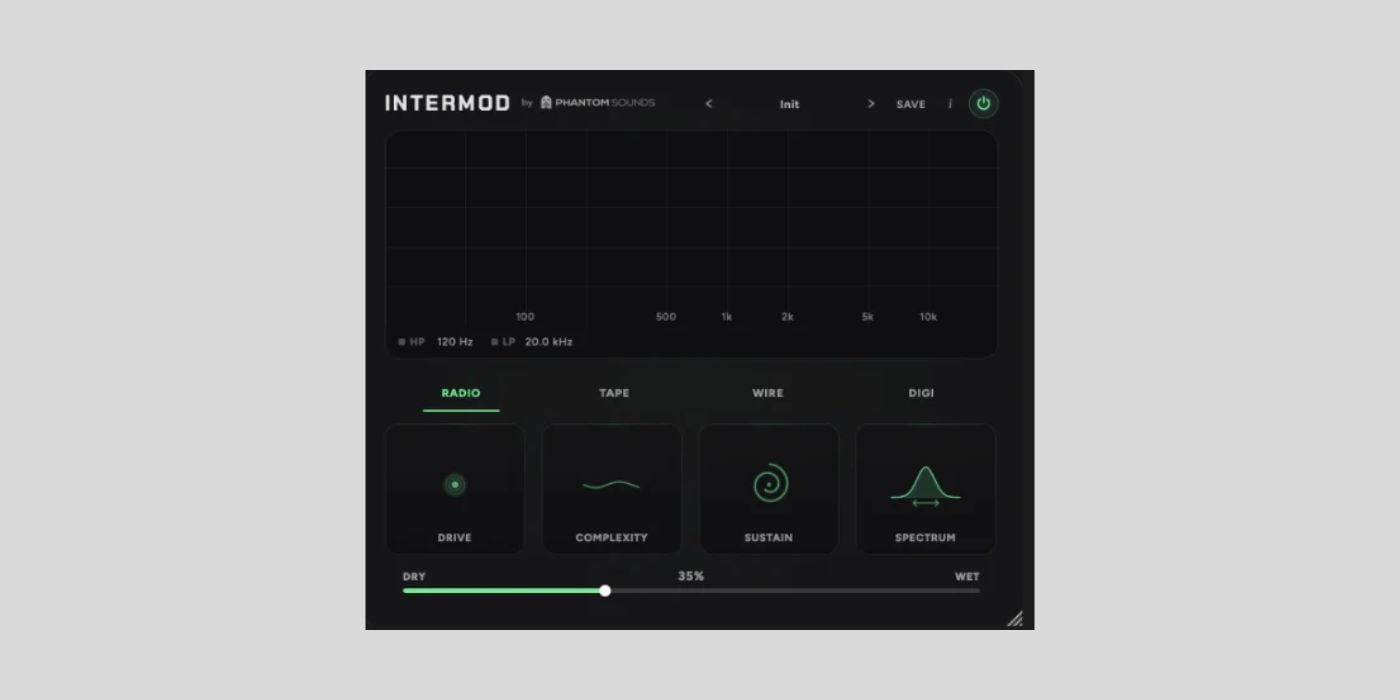

Intermod is a new audio plugin from Phantom Sounds, the developer behind Orbit (spatial reverb) and 56K (digital decay).
Intermod offers something a little different; it’s a self-intermodulation effect that multiplies the strongest components in your signal against each other.
In doing so, it creates phantom frequencies derived from the original audio.
Because these phantom frequencies are derived from the original audio, each input produces a unique character profile.
Intermod offers four source modes: Radio, Tape, Wire, and Digital.
You then have four adjustable parameters: Drive, Complexity, Sustain, and Spectrum.
I’ve had a little play around with Intermod, and it’s pretty easy to get into otherworldly territory with the effect.
This is especially true with the Radio and Wire modes if you push the Drive and Sustain fairly hard.
It’s interesting; you can take shorter sounds, and Intermod creates a constant, almost pulsing, tail. Even if you are in otherworldly or ethereal territory, a low Complexity setting keeps the movement fairly stable, which works well for prolonged sequences.
If you want the movement to be a little wilder, you can bump up the Complexity.
You also have a Dry/Wet slider to control the effect amount.
The plugin features a nice frequency display, and just underneath, you’ll find HP and LP filter settings, providing another level of tone shaping.
One of the things I like about Intermod is the thoughtfulness of the presets.
Since it’s quite easy and tempting to create wilder effects, you might expect that the presets would lean heavily in that direction.
But I was glad to see a nice mix of subtle and aggressive effects, compiled specifically for various instruments, including:
- Bass
- Drums
- Guitar
- Piano
- Synth
- Drums
- Vocals
- SFX
- Strings
If we learned anything from Orbit, the last plugin we covered from this developer, it’s that Phantom Sounds tries to take a less typical approach than expected, and that’s a good thing when we have so many plugins to choose from.
Intermod is more of the same; it’s not overly complicated and offers something a little different, making it an interesting tool for sound design.
Last Updated on April 16, 2026 by Tomislav Zlatic.