


Developer Kobito has made its ChordGenius free for a limited time.
The thing that makes ChordGenius a little different from typical MIDI chord generators is that it’s much more of a performative tool.
Many MIDI chord generators focus purely on creating chord progressions that you can drag into your project, and that’s great. But if you want something that adds a performance element, ChordGenius could be for you.
The most basic way to describe it would be that it’s something like a chord mode you’d find on a keyboard that allows you to trigger chords from a single note, but it’s more sophisticated than most.
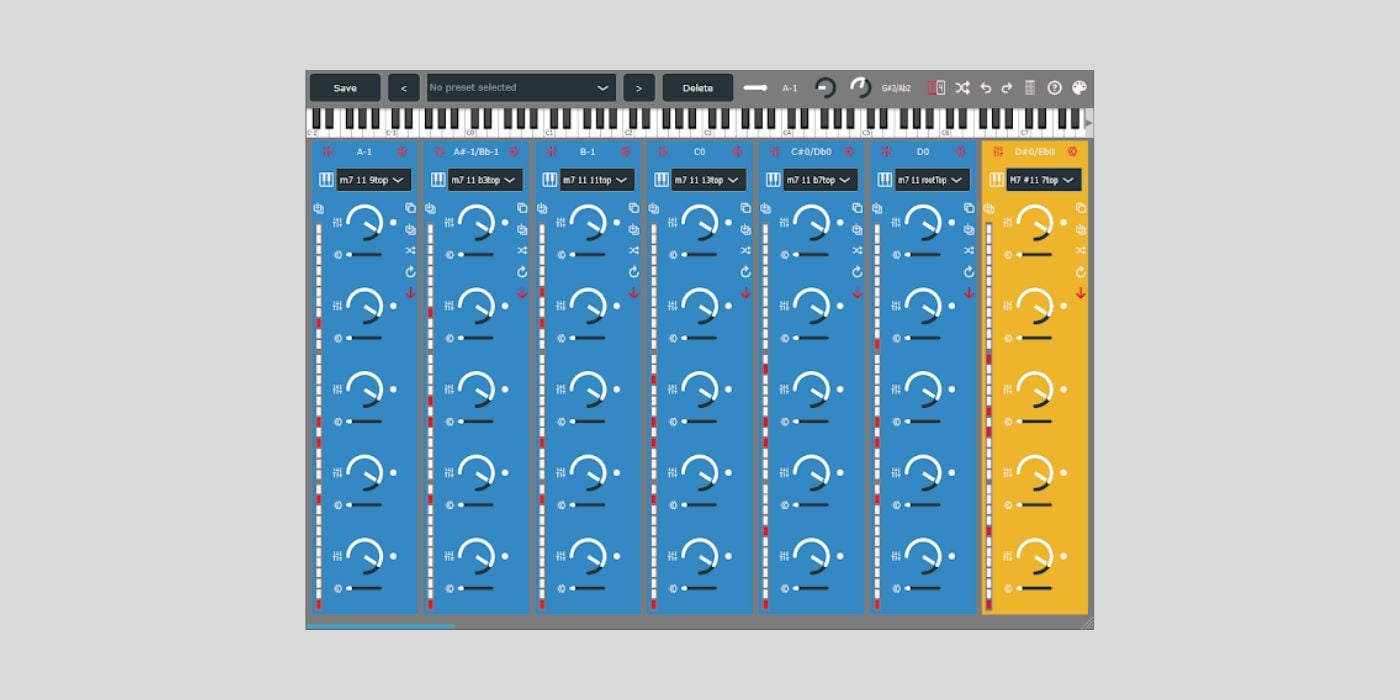
ChordGenius works by playing two notes, a Control Note and a Pivot.
The Control Note is how you select a chord quality (maj9, 7#9, etc.), and each strip on the interface represents a specific control note and chord quality.
For example, C1 might trigger a maj7#11.
Each strip on the interface also displays which note will sit atop the triggered chord voicing (root on top, 7th on top, and so on).
The Pivot note is the note that sits at the top of the voicing and determines the chord generated.
For example, if your chord quality is a Maj9 and the GUI indicates the root as the top note, playing a C as your pivot note creates a Cmaj9.
But, if the GUI indicates the 9th as the top note, playing that same C as the pivot would generate a Bbmaj9 chord.
With that out of the way, you don’t need to be a theory wizard or even know what to expect when you hit a pivot note; much of the fun is in finding happy accidents.

You can manually change the chord quality of any control note to build little performance patches, placing all the desired chords close together.
You have an extensive list of chord types to choose from, including minor(major7) chords, which are perfect for far more than ending international spy movie themes.
You can also humanise chords, add random delay and velocity settings per note, or completely randomise the voicing.
ChordGenius is fun, but what I like most is that it throws up lots of crunchy voicings with half steps in the middle, which are perfect for neo-soul, jazz funk, and more.
Last Updated on June 19, 2026 by Tomislav Zlatic.