



Every Sound Has a Shape
“Music is the arithmetic of sounds as optics is the geometry of light.”
— Claude Debussy
Every sound contains frequencies.
Low frequencies give music weight.
Mid frequencies give it identity.
High frequencies give it detail.
An equalizer lets you reshape that balance.
You can remove rumble.
Add warmth.
Reduce muddiness.
Bring a vocal forward.
Soften harshness.
Add air.
But EQ becomes much easier when you stop seeing the frequency spectrum as thousands of unrelated numbers.
Instead…
Think of it as seven musical regions:
- Sub
- Low
- Low Mid
- Mid
- High Mid
- High
- Air
Each region contributes something different.
And every EQ decision changes the balance between them.
Download my free guide: The Magic EQ Settings
Quick Summary
👉 A parametric EQ controls three main things: Frequency selects the area you want to change, Gain boosts or cuts that area, and Q or Bandwidth controls how wide or narrow the change will be. The frequency spectrum can be divided into seven practical bands: Sub, Low, Low Mid, Mid, High Mid, High, and Air.
EQ stands for equalization.
It allows you to change the balance of frequencies inside a sound.
Imagine a photograph.
You could adjust:
- Shadows
- Midtones
- Highlights
- Contrast
- Brightness
You are not replacing the image.
You are changing how its details are balanced.
EQ does something similar with sound.
It can make a recording feel:
- Bigger
- Smaller
- Warmer
- Brighter
- Darker
- Clearer
- Closer
- Farther away
EQ does not create a new performance.
It changes which parts of the performance receive attention.
EQ Explained Like Sculpting Stone 🗿
A parametric equalizer gives you detailed control over individual frequency bands.
Most DAW EQs include several adjustable nodes or bands.
Each one usually controls three main parameters:
- Frequency
- Gain
- Q or Bandwidth
These three controls form the foundation of parametric EQ.
Frequency chooses the part of the sound you want to affect.
It is measured in:
For example:
- 60 Hz is low bass
- 500 Hz is in the lower midrange
- 3 kHz is in the upper midrange
- 12 kHz is in the high-frequency range
Moving the frequency control left targets lower sounds.
Moving it right targets higher sounds.
Frequency asks: Where is the problem?
Gain determines how much you boost or cut the selected frequency.
It is measured in decibels.
A positive gain value boosts the frequency.
A negative gain value cuts it.
For example:
- +3 dB adds emphasis
- −3 dB reduces emphasis
- −12 dB creates a much deeper cut
Small adjustments can make a large difference.
Especially when several EQ bands are working together.
Gain asks: How much should this area change?
Q determines how wide or narrow the EQ adjustment will be.
A high Q creates a narrow band.
A low Q creates a wide band.
Narrow Q
Useful for:
- Resonances
- Ringing frequencies
- Electrical hum
- Whistles
- Specific harsh notes
A narrow band behaves like a scalpel.
Wide Q
Useful for:
- General tone shaping
- Adding warmth
- Brightening a vocal
- Reducing broad muddiness
- Shaping an entire mix
A wide band behaves more like a paintbrush.
Q asks: How much of the surrounding sound should change too?
Equalizer Types: What Kind of EQ Are You Using in Your DAW? 🎛️
Every parametric EQ decision can be reduced to three questions:
Where?
Frequency.
How much?
Gain.
How wide?
Q or Bandwidth.
That is the entire system.
The controls may look technical.
But the idea is simple.
When you boost one frequency range…
It can make another range seem quieter.
When you remove low mids…
The highs may appear clearer.
When you reduce harsh upper mids…
The sound may suddenly feel warmer.
This means EQ is not only about changing one frequency.
It is about changing the relationship between all frequencies.
EQ is the art of contrast.
The boundaries between frequency bands are not exact.
Different engineers may divide them slightly differently.
A bass guitar, vocal, piano, and cymbal can all occupy several bands at once.
The following ranges are practical starting points.
They are not laws.
Approximate Range
20 Hz–60 Hz
The Sub band is the deepest part of the audible spectrum.
You may feel it as much as you hear it.
It provides:
- Depth
- Power
- Physical impact
- Low-end extension
Common sources include:
- Sub-bass synthesizers
- Kick-drum fundamentals
- Bass drops
- Low electronic effects
- The deepest notes of a bass instrument
Too Much Sub
The mix may sound:
- Uncontrolled
- Heavy
- Rumbly
- Distorted
- Quiet after mastering
Excessive sub energy can consume headroom without being obvious on small speakers.
Too Little Sub
The mix may feel:
- Small
- Thin
- Weak
- Physically disconnected
But not every song needs strong sub-bass.
Acoustic, folk, punk, and vintage recordings may sound better without extreme low-frequency extension.
Common EQ Moves
- Use a high-pass filter to remove unnecessary rumble.
- Control extreme lows on instruments that do not need them.
- Shape the relationship between the kick and bass.
- Check the result on headphones and full-range monitors.
Sub is the foundation beneath the floor.
You may not always hear it clearly…
But you notice when it moves.
Approximate Range
60 Hz–250 Hz
The Low band provides the main weight and body of many instruments.
It contains much of the power of:
- Kick drums
- Bass guitars
- Floor toms
- Pianos
- Guitars
- Lower vocal fundamentals
Too Much Low End
The mix may sound:
- Boomy
- Thick
- Slow
- Overpowering
- Undefined
Too Little Low End
The mix may sound:
- Weak
- Thin
- Cold
- Unconvincing
Common EQ Moves
- Add weight to a kick drum.
- Reduce boom in an acoustic guitar.
- Create separation between kick and bass.
- Remove unnecessary lows from vocals and cymbals.
- Add body to a thin instrument.
The Low band gives the music weight.
Sub is the sensation beneath the sound.
Low is the body of the sound itself.
Approximate Range
250 Hz–500 Hz
The Low Mid band contains warmth…
But it is also where muddiness often collects.
Many instruments produce energy here:
- Vocals
- Guitars
- Pianos
- Toms
- Synthesizers
- Room microphones
- Reverbs
One instrument in this range may sound warm.
Twenty instruments in this range may sound cloudy.
Too Much Low Mid
The mix may sound:
- Muddy
- Boxy
- Congested
- Distant
- Small
Too Little Low Mid
The mix may sound:
- Hollow
- Weak
- Artificial
- Overly bright
- Lacking warmth
Common EQ Moves
- Reduce muddiness from guitars or keyboards.
- Remove boxiness from drums.
- Create space around a vocal.
- Add warmth to a thin recording.
- Control excessive room tone.
The Low Mid band is where warmth becomes mud.
The difference is context.
Approximate Range
500 Hz–2 kHz
The Mid band contains much of the recognizable identity of a sound.
It helps us identify:
- The words of a vocal
- The notes of a guitar
- The tone of a snare
- The character of a piano
- The shape of a synthesizer
The mids are not always glamorous.
But they are essential.
Too Much Midrange
The sound may feel:
- Nasal
- Honky
- Aggressive
- Boxed-in
- Telephone-like
Too Little Midrange
The sound may feel:
- Empty
- Distant
- Weak
- Disconnected
- Impressive alone but invisible in the mix
This is a common problem with heavily scooped instruments.
They may sound enormous in solo…
Then disappear when the full arrangement plays.
Common EQ Moves
- Reduce nasal vocal frequencies.
- Add note definition to bass.
- Shape the character of guitars.
- Bring an instrument forward.
- Reduce honkiness in drums or rooms.
The mids tell you what the sound is.
The lows create size.
The highs create detail.
The mids carry identity.
Approximate Range
2 kHz–6 kHz
The High Mid band controls presence, attack, clarity, and intelligibility.
It helps us hear:
- Vocal consonants
- Pick attack
- Snare crack
- Kick beater
- Guitar bite
- Percussion transients
This range can make a sound cut through the mix.
It can also make the mix painful.
Too Much High Mid
The mix may sound:
- Harsh
- Aggressive
- Fatiguing
- Sharp
- Painful
Too Little High Mid
The mix may sound:
- Dull
- Soft
- Distant
- Unclear
- Lacking definition
Common EQ Moves
- Increase vocal presence.
- Add attack to drums.
- Add definition to guitars.
- Reduce harshness.
- Soften aggressive cymbals.
- Control piercing resonances.
The High Mid band determines how close the sound feels.
Add too much…
And it feels like the instrument is shouting into your face.
Remove too much…
And it moves to the back of the room.
Approximate Range
6 kHz–12 kHz
The High band contains brightness, detail, and crispness.
It includes much of the energy from:
- Cymbals
- Hi-hats
- Vocal consonants
- Acoustic guitar strings
- Percussion
- Noise and hiss
Too Much High End
The sound may become:
- Bright
- Brittle
- Hissy
- Sharp
- Sibilant
Too Little High End
The sound may become:
- Dark
- Dull
- Covered
- Old
- Lacking detail
Common EQ Moves
- Brighten a dark vocal.
- Reduce cymbal harshness.
- Control sibilance.
- Add clarity to an acoustic guitar.
- Soften noisy or brittle recordings.
High frequencies reveal the surface of a sound.
They are the edges.
The texture.
The fine detail.
Approximate Range
12 kHz–20 kHz
The Air band is the highest part of the audible spectrum.
It often feels less like a specific pitch…
And more like openness.
It can add:
- Breath
- Space
- Polish
- Openness
- Expensive-sounding brightness
Too Much Air
The sound may become:
- Hissy
- Artificial
- Thin
- Overly processed
- Fatiguing
Too Little Air
The sound may feel:
- Closed
- Dark
- Dull
- Lifeless
Common EQ Moves
- Add a gentle high shelf to a vocal.
- Open the top of a mix.
- Add polish to overheads.
- Reduce hiss from noisy recordings.
- Darken a source that feels too modern or bright.
Air is not the spotlight.
It is the space around the spotlight.
Balance in Mixing: Subtractive vs. Additive EQ ⚖️
⭐️ Download my Free Music Production Guides or take my free Ableton Live Course ⭐️
| Frequency Band | Approximate Range | Main Quality |
|---|---|---|
| Sub | 20–60 Hz | Depth and physical power |
| Low | 60–250 Hz | Weight and body |
| Low Mid | 250–500 Hz | Warmth or mud |
| Mid | 500 Hz–2 kHz | Identity and character |
| High Mid | 2–6 kHz | Presence and attack |
| High | 6–12 kHz | Brightness and detail |
| Air | 12–20 kHz | Openness and polish |
These ranges overlap.
That is normal.
Sound does not divide itself into perfectly labelled boxes.
The bands are simply a map.
Most parametric equalizers include several filter types.
Each one solves a different problem.
A bell filter boosts or cuts frequencies around a selected centre point.
You control:
It is the main tool for shaping:
- Mids
- Resonances
- Tone
- Instrument separation
It is called a bell because the curve resembles the shape of a bell.
A low shelf boosts or cuts everything below the selected frequency.
Use it to:
- Add overall weight
- Reduce excessive bass
- Warm a sound
- Thin a sound
A shelf is often more natural than a narrow bell when changing the general tonal balance.
A high shelf boosts or cuts everything above the selected frequency.
Use it to:
- Add brightness
- Add air
- Darken harsh recordings
- Reduce excessive top end
A gentle high shelf is common on vocals, overheads, and complete mixes.
A high-pass filter allows high frequencies to pass…
While reducing frequencies below the cutoff point.
It is also called a:
Use it to remove:
- Rumble
- Handling noise
- Plosives
- Unnecessary sub frequencies
- Low-frequency buildup
The Common Mistake
Do not automatically high-pass every instrument.
Low-frequency information can contribute:
- Warmth
- Depth
- Natural body
- Room tone
Remove what does not help.
Keep what supports the music.
A low-pass filter allows low frequencies to pass…
While reducing frequencies above the cutoff point.
It is also called a:
Use it to:
- Darken a sound
- Remove hiss
- Push something backward
- Reduce unnecessary high-frequency content
- Create a filtered effect
How To Create Space and Clarity in Mixes With EQ and Panning 🎚️
A sound can be beautiful alone…
And wrong inside the song.
A guitar may sound thin in solo because you removed low mids.
But inside the full mix…
That cut may create space for the vocal and bass.
A vocal may sound slightly bright alone.
But inside the arrangement…
That brightness may be what makes the words understandable.
Do not EQ the instrument.
EQ the relationship between the instrument and the song.
Use solo to locate problems.
Use the full mix to make decisions.
Subtractive EQ means cutting frequencies.
It is useful for removing:
- Mud
- Resonances
- Harshness
- Boxiness
- Rumble
- Frequency masking
For example:
If a vocal feels muddy…
You might reduce some Low Mid energy.
If a guitar feels harsh…
You might reduce part of the High Mid band.
Why Cut First?
Sometimes the frequency you want is already present.
It is simply being hidden by something else.
Instead of boosting the good frequency…
Reduce the competing one.
Before adding more, ask what can be removed.
Additive EQ means boosting frequencies.
Use it to add:
- Weight
- Warmth
- Presence
- Brightness
- Air
- Character
Boosting is not wrong.
The goal is simply to know why you are doing it.
A wide, gentle boost often sounds more natural than an extreme narrow boost.
A common way to locate an unwanted frequency is:
- Create a bell band.
- Use a relatively narrow Q.
- Boost the band temporarily.
- Sweep through the frequency spectrum.
- Listen for the problem becoming exaggerated.
- Stop when you find it.
- Change the boost into a cut.
- Adjust the Q and gain until it sounds natural.
This can help locate:
- Ringing
- Nasal tones
- Boxiness
- Harshness
- Resonance
Use Sweeping Carefully
If you boost a narrow frequency enough…
Almost everything will sound terrible.
The goal is not to find an ugly frequency.
The goal is to find a frequency that was already distracting before you boosted it.
Different genres use the seven frequency bands differently.
Electronic Music
Often emphasizes:
- Deep Sub
- Controlled Low end
- Bright Highs
- Polished Air
The relationship between kick and bass is critical.
Rock
Often emphasizes:
- Strong Low end
- Powerful Low Mids
- Aggressive High Mids
- Cymbal brightness
Too many guitars in the Low Mid and Mid bands can create congestion.
Hip-Hop
Often emphasizes:
- Sub-bass
- Kick weight
- Vocal presence
- Crisp Highs
The low end may carry much of the emotional impact.
Jazz
Often preserves:
- Natural Low Mids
- Instrumental Midrange
- Realistic transients
- Controlled Air
Extreme EQ may make the instruments feel less natural.
Pop
Often uses:
- Controlled Sub
- Clear Low end
- Reduced mud
- Strong vocal presence
- Bright, polished Highs and Air
Clarity is usually more important than any one instrument sounding huge by itself.
The same frequency can be useful on one track…
And unnecessary on another.
Kick Drum
May use:
- Sub for depth
- Low for weight
- Low Mid for body
- High Mid for beater attack
Bass
May use:
- Sub for extension
- Low for power
- Midrange for note definition
- High Mid for string or pick attack
Vocal
May use:
- Low for body
- Low Mid for warmth
- Mid for identity
- High Mid for intelligibility
- High for detail
- Air for openness
Electric Guitar
May use:
- Low Mid for body
- Midrange for tone
- High Mid for bite
- High frequencies for pick and amplifier texture
The deepest lows are often unnecessary.
Cymbals
May use:
- High Mid for attack
- High for brightness
- Air for openness
But cymbals can also produce harshness throughout the High Mid range.
Choose a complete mix.
Place a parametric EQ on the master channel.
Do not make permanent changes.
Create a wide bell boost and slowly move through each region.
Listen for what becomes exaggerated.
Sub
What becomes physical?
Low
What becomes heavy?
Low Mid
What becomes warm or muddy?
Mid
What becomes recognizable or nasal?
High Mid
What becomes clear or harsh?
High
What becomes bright or brittle?
Air
What becomes open or hissy?
Then bypass the EQ.
The goal is not to improve the song.
The goal is to train your ears.
A spectrum analyzer can show you where energy exists.
It cannot tell you whether that energy serves the song.
A large peak may be:
- A problem
- A musical note
- The sound’s identity
- A deliberate resonance
- The entire reason the instrument feels exciting
Look at the analyzer after you hear something.
Not instead of hearing it.
The analyzer shows energy.
Your ears decide meaning.
A balanced mix does not need to look flat.
Different songs require different shapes.
A dance track may have powerful Sub energy.
A folk song may contain almost none.
A punk recording may have aggressive High Mids.
A jazz recording may sound softer and warmer.
The goal is not to make every song look the same.
The goal is to make each song communicate clearly.
Having said that, start with these Magic EQ Settings that work on everything!
What are the seven frequency bands of EQ?
The seven practical bands are Sub, Low, Low Mid, Mid, High Mid, High, and Air.
What are the three main controls on a parametric EQ?
The three main controls are Frequency, Gain, and Q or Bandwidth.
What does Q mean on an EQ?
Q controls how narrow or wide an EQ adjustment is. Higher Q values affect a narrower range, while lower Q values affect a wider range.
What frequencies create muddiness?
Muddiness frequently builds in the Low Mid range, approximately 250–500 Hz, although the exact area depends on the instruments and arrangement.
What frequencies create harshness?
Harshness often appears in the High Mid region, approximately 2–6 kHz. Brightness above this range can also become brittle or sibilant.
What frequencies add air?
Air is commonly associated with frequencies above approximately 12 kHz.
Should I cut or boost first?
Subtractive EQ is often a useful starting point because removing unwanted energy may reveal the sound you already have. Boost when the sound genuinely needs more of a useful quality.
Should I EQ every track?
No. If a track already fits the arrangement, it may not need EQ.
Should I EQ in solo?
Use solo to locate a problem, but make the final decision while listening to the full mix.
Is a high-pass filter the same as a low-cut filter?
Yes. Both names describe a filter that reduces low frequencies while allowing higher frequencies to pass.
A parametric EQ may show hundreds of frequencies.
But you do not need to memorize every number.
Begin with seven regions.
Sub.
Low.
Low Mid.
Mid.
High Mid.
High.
Air.
Learn what each one contributes.
Then use the three controls:
Frequency chooses the location.
Gain chooses the amount.
Q chooses the width.
The seven bands give you the map.
Frequency, Gain, and Q give you the controls.
But the song gives you the destination.
Do not EQ because the graph looks wrong.
Do not cut because a chart told you to.
Listen.
Identify what the music needs.
Then make the smallest move that helps it say more.
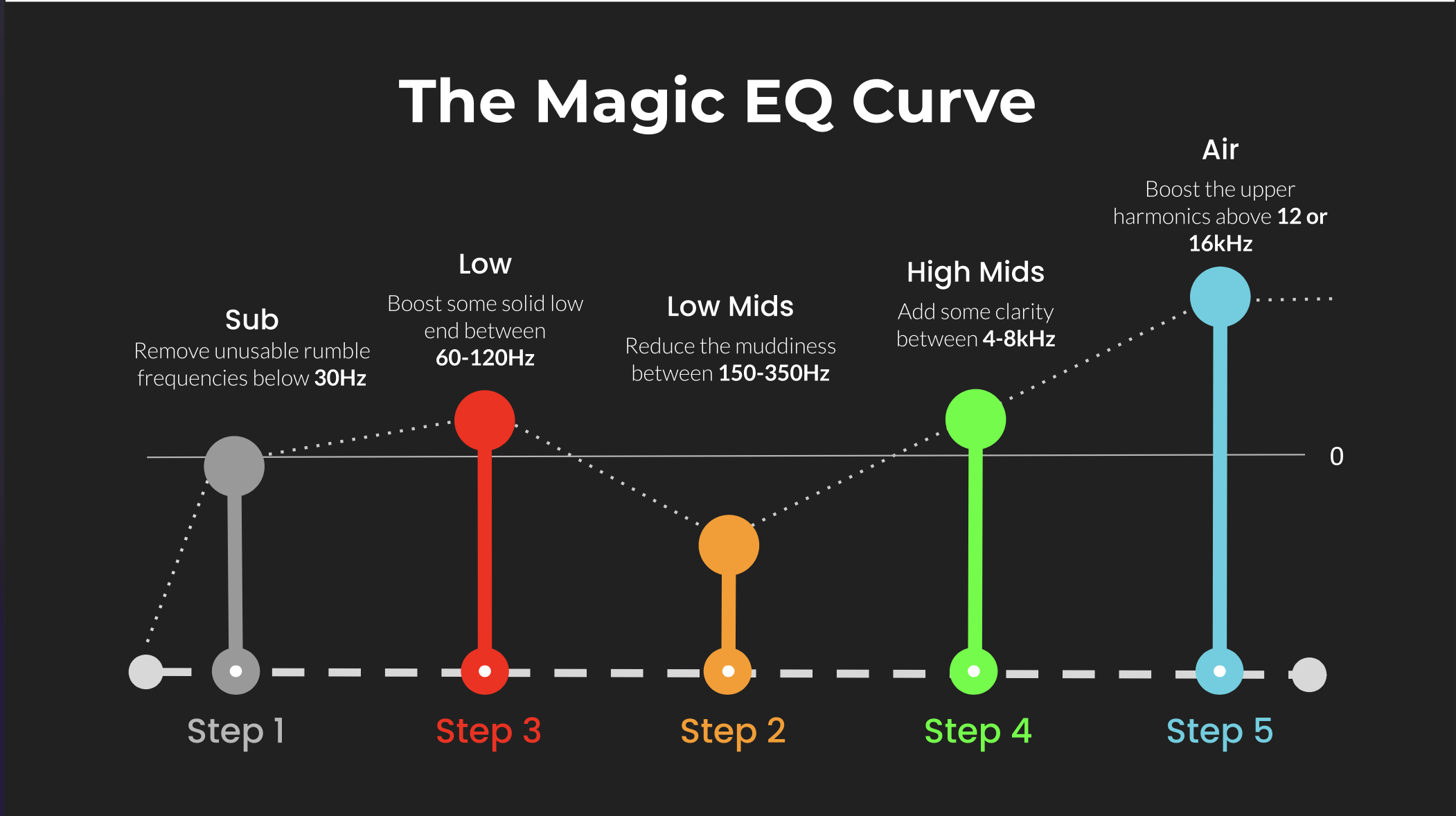 ⭐️ Download my Free Magic EQ settings Guide ⭐️

⭐️ Download my Free Magic Reverb settings Guide ⭐️
#protools #daw #homestudio #recordingschool #recording #musicproduction
Also read:
How to Start Your Own Online Business Teaching Music
Hey, I’m Futch – Music Production Coach and Ableton Certified Trainer

Learn how to make your first song and beat in Ableton Live with my
FREE 90-minute Ableton Live course
I’ve been teaching audio engineering and music production for 35 years.⭐️
Check out my new online music production program: Music Production Ninja…