

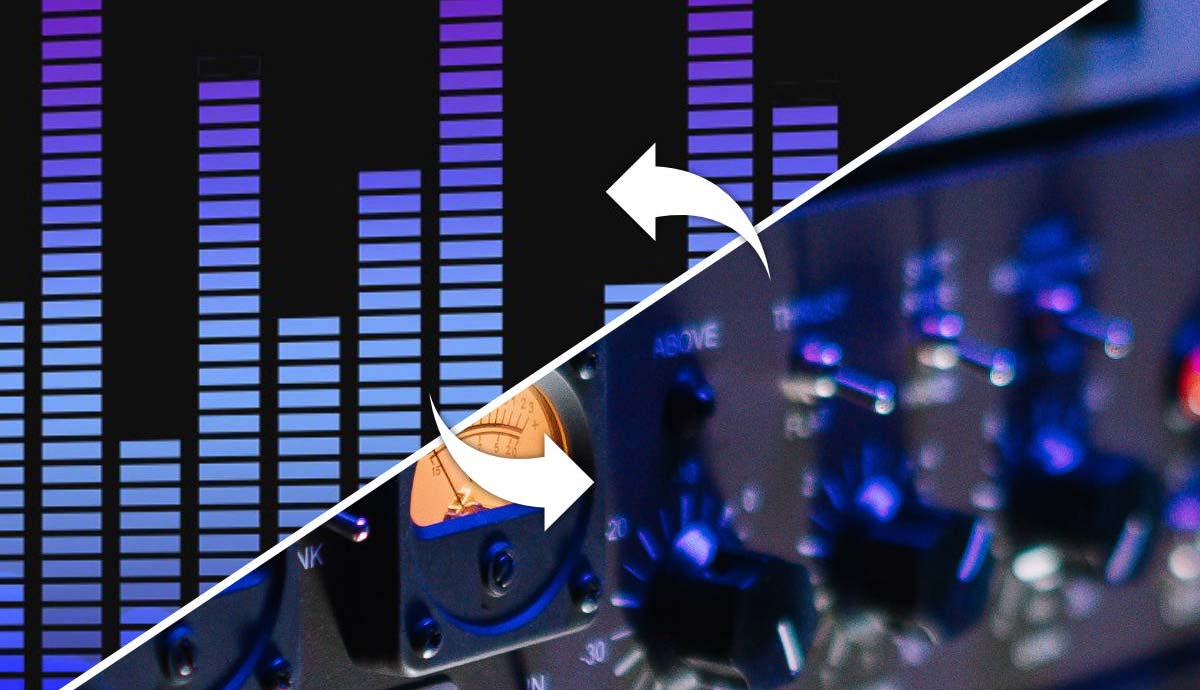

There’s no doubt about it; compression and EQ are absolutely essential tools for any audio engineer. Learning how to use each of them correctly is crucial, but learning how to use them together is just as important.
Why? Simply because switching the order of the two can produce drastically different results. On top of that, it’s not really a case of “set-and-forget” where one particular order works for all instruments either.
Understanding compression and EQ
If you’re reading this, it’s likely that you already have an understanding of what both compression and EQ do. If you don’t, here’s a quick overview to ensure we’re all on the same page.
What is compression?
Compression is an effect used to control – or compress – the dynamic range of an audio signal. In other words, the difference between the loudest and quietest parts of a piece of audio.
Studio VCA audio compressor in Logic Pro.
Compression works as a kind of automated volume knob, turning down parts that are too loud and turning up quiet parts according to your settings.
Some applications of compression include:
- Evening out volume peaks and dips
- Thickening instruments by giving them a ‘fatter’ sound
- Helping instruments sit better in a mix placement
For a more in-depth take on the subject, check out this deep dive into audio compression.
What is EQ?
EQ (equalization) is the process of boosting or cutting certain frequencies of an audio signal. There are 2 ways EQ is predominantly used in mixing:

Channel Equalizer in Logic Pro
Corrective EQ
This is generally how EQ before compression is used. Corrective EQ is used to “clean up” an audio signal with things like high-passing, removing harsh or resonant frequencies before it reaches the compressor.
Shaping EQ
Shaping EQ is what is generally used after compression. This is used to sculpt the final audio signal and determine how it sits in the mix among the other instruments.
The main uses of EQ include:
- Taming or removing problem frequencies
- Balancing instruments in a mix
- Creative effects (e.g. making the audio signal sound like a radio)
To learn more about EQ with this simple guide to using equalizers.
OK, so now we have a basic idea of what the tools do. Before diving in, however, it’s best to think about what you are trying to achieve first.
What are the problems that you are trying to solve?
Compression and EQ are problem-solving tools. To make the most out of them, you need to determine what kind of issues you need to address. Consider things like:
- Are you about to record and want a cleaner recording, or are you processing recorded audio?
- Is the problem a frequency issue, or a dynamic (i.e. volume) issue?
- Is the issue with a single instrument or a mix?
Listen to the audio a few times, and take note of what you want to adjust or correct (more often than not, there will be multiple issues to address). Make the more noticeable problems a priority to tackle first – this will help us decide on the order.
Why the order matters
As I stated earlier, the order of compression and eq will give distinctively different results in terms of tone and coloration. It’s important to understand how the two interact to get the best outcome for the track.
EQ > compression (pre-EQ)
EQ before compression has a far more dramatic effect than the other way around. In fact, that’s an understatement: Pre-EQ will completely dictate how the compressor behaves, whereas post-EQ (i.e.EQ after compression) won’t be affected by the compressor at all.
If you were to alter a pre-EQ setting (let’s say significantly boosting a particular frequency), the compressor will then actually cut the rest of the frequencies way more than the selected frequency is boosted!

This is why EQ before compression is mainly used in a corrective context. Any undesired frequencies are going to be exaggerated by the compressor, one way or another. Taming unwanted frequencies with pre-EQ can actually help in getting the compressor to play nice.
Example: Recording acoustic guitar
If you’ve ever tried recording an acoustic guitar, you’ll know that it can be particularly notorious for producing low, boomy frequencies.
These low frequencies can then cause the compressor to react unpredictably to higher notes and strums. Once it’s recorded like this, no amount of post-EQ is going to be able to fix the volume fluctuations.
Pre-EQ, on the other hand, can be used to tame those lower frequencies before reaching the compressor, resulting in a natural, even sound.
Compression > EQ (post-EQ)
It’s usually rare, but there are some situations where you just don’t need pre-EQ! You may be happy with the frequency spectrum of a recording; it’s balanced, natural-sounding, and pleasing to the ear. If so, why mess with it?
Then there are some instruments, like bass guitars, that actually often benefit from using compression prior to EQ. This is because the compression can actually help define the tone of the instrument. In fact, using pre-EQ to boost lower frequencies on a bass guitar can actually cause a loss of mid to high frequencies when the compressor reacts.
The main benefit of EQ after compression is that it allows you to shape the final image of the audio signal. It assists the instrument to sit well in a mix (which would be all the more difficult with compression pumping away at the end of the signal chain!)
The secret sauce: pre-EQ > compression > post-EQ
For 90% of applications, many audio engineers (myself included) swear by this method, as it gives the ultimate control:
- Corrective pre-EQ. Tidy up the signal feeding into the compressor so that the compressor doesn’t end up reacting to unwanted frequencies.
- Compression. The compressor will behave a lot more predictably and respond how you want it to thanks to corrective EQ.
- Shaping post-EQ. Sculpt the final compressed image. Boosts will sound much cleaner and fit nicely in the mix.
Conclusion
As with just about everything when it comes to audio engineering, there are no hard-and-fast rules. Regardless of which method you decide to employ, don’t fall into the trap of using it all the time; there’s a time and place for each of the methods listed above, it’s up to you to develop an ear for what works best in each scenario.
About the Author
 Ric Lora is a long-time music producer/home recording enthusiast based out of Sydney, Australia. With over 30 years on (and off) stage, in (and out) of the studio, he has used this experience to develop a creative approach focused on developing uniqueness rather than following trends.
He is the founder of proaudiohq.com, a growing music production, and recording blog currently aimed at helping aspiring producers learn the ropes and finding their feet.