
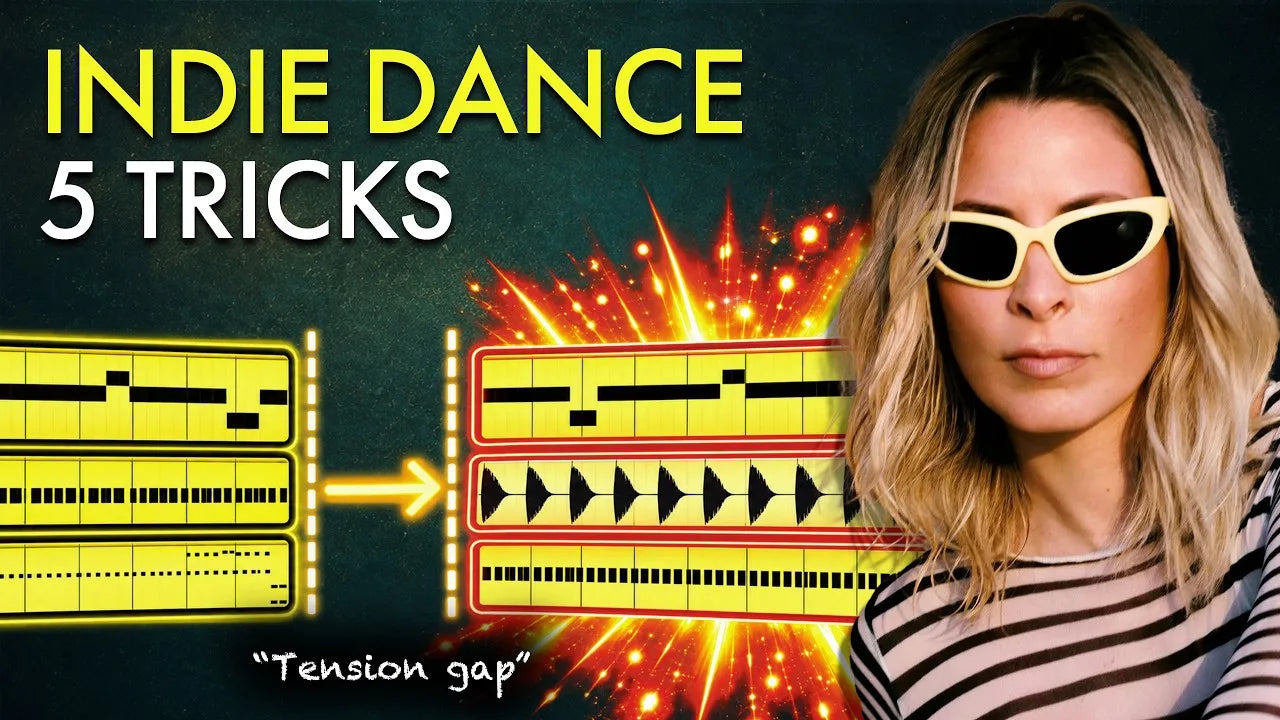

We pulled apart tracks in the style of Brunello, BLOND:ISH and Notre Dame and found five indie dance production tips: simple drums, a stripped back bassline drop, a gritty digital lead, a buildup that fills the whole spectrum, and a hypnotic vocal loop.
Every example comes from the Ableton projects in the Indie Dance sound pack Surge, so you can open the same sessions and check every setting yourself.
1. Keep your indie dance drums simple

The drums are the backbone, not the show. In the Brunello style track the plain groove gives the bassline room to be the interesting part. In the Notre Dame style track the harmonies play the show.
Key settings:
- Few elements and few fills, just enough to mark the bar
- Pick one element to carry the complexity: bassline, chords or plucks
2. The bassline drop: back to the essentials

Indie dance lives on powerful bassline drops. Build tension first, then cut the drop down to almost nothing but the bass, kicks and simple drums. The bass splits into two layers with different jobs, and the surprise is which one grooves.
Key settings:
- Mid layer = the roller, a steady driving pattern that fills the midrange
- Sub layer = the groover, sparse notes with space between them
- A sub note right on the one of the drop for maximum impact
- Few other elements in the drop, the bass carries the moment
3. Gritty digital leads for contrast

Everything before the drop is deep and rolling, then a bright, gnarly digital lead cuts straight through it. That contrast is the point. It enters right out of the silence before the drop and comes back every few sections so the track keeps its edge.
Key settings:
- Square wave in Serum 2, the source of the energy
- No filter at all, keep every harmonic
- Phase distortion with a sine as the modulator for extra grit
- Hyper/Dimension plus reverb for width and space
- Low cut to clear the bass range
- Saturator on Digital Clip: +12 dB drive, -12 dB output. Loud and controlled at the same time
4. Adding energy and intensity to the buildup

A strong buildup works because every layer covers a different part of the frequency spectrum and has its own job. Stack them and the tension climbs from the low mids to the top end. Then comes the move most producers skip: a short gap of silence right before the drop, which is what makes the digital lead hit so hard.
Key settings:
- Atmo 1: deep and wide, but plucky
- Atmo 2: mostly noise, fills the top end
- Riser 1: a long square wave note with LFO 2 on the fine tune, for a laser gunshot feel
- Pluck, Riser 2 and a reversed vocal stacked on top
- A short gap of silence right before the drop
5. Looped vocals with heavy processing

Take one vocal phrase and loop it across the whole track, mantra style. Brunello does this on “Ghost Dance” and “Science Fiction”. It is trippy and hypnotic, but because it is a human voice, the listener stays engaged.
Key settings:
- Multiband Dynamics and EQ to shape the phrase
- Delays for space, pushed harder towards the drop so the break gets trippier
- Two versions of one vocal: the full take plays once as the payoff, usually in the drop
- A short snippet from that take carries the rest of the arrangement
- Automate the delays over time to keep the loop moving
Build it yourself
Everything above comes from Indie Dance – Surge: 10 fully produced Ableton projects, 415+ samples, and 60 Serum 2 presets with matching MIDI. Open the sessions, solo the bass layers, the buildup stack and the vocal chain, and rebuild them in your own track.
Watch the full breakdown

Reference tracks
Typical reference tracks for this style are:
- Brunello – Ghost Dance
- Brunello – Iluzja
- Blond:ish, Darco, Broken Hill – GOAT
- Nico de Andrea – I’m Here
- Max Styler – Inferno
- Hugel, Mydoz – Pull Up
- Romain Dary – Really That Simple
- Andruss – Active
- Jon.K – Moet
- Notre Dame – No Rules