
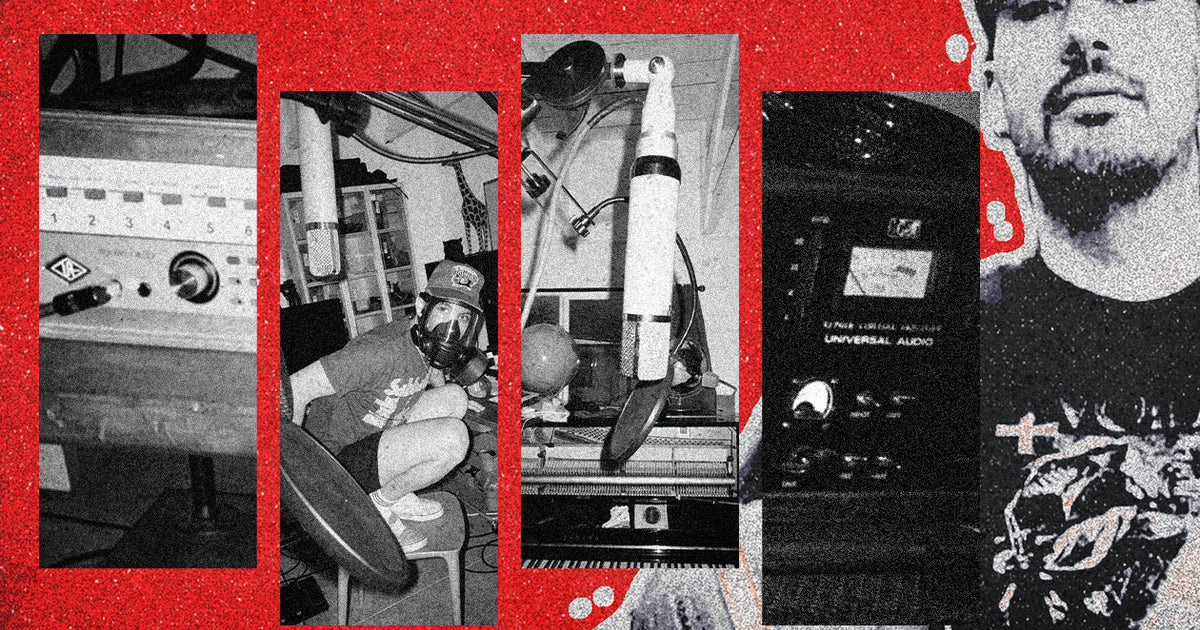

The LA producer with credits including Roe Kapara and Arkells showcases his favorite Apollo workflows.
He got into music to start a Back to the Future tribute band. Twenty-three years later, Ryan Spraker’s credits span Roe Kapara, Arkells, Killer Mike, and Skip Marley.
He learned to make records the traditional way, on a Neve console and two-inch tape at Boston’s Q Division Studios. But these days his rig relies on a U47 mic, various vintage synths and keyboards, a pair of ATC SCM25s monitors, and an Apollo x8p audio interface.
Ryan Spraker walked Universal Audio through his LA studio to talk about the gear he relies on, including the Apollo x8p at the heart of his rig.
Give us the tour! What’s actually earning its keep in here?
A vintage tube 47, good monitors, and reasonable instruments. That’s about it. I’ve tried so many other things, and those are far and away the biggest tools. I came to that conclusion because the Apollo interface gives me flexibility. So I don’t need much else.
So did you used to have a lot more gear than this?
I used to have loads of old gear. Calrec PQ15s, Inward Connections Vac Rac, a Fulltone TTE tape echo, the 1176. There’s an Inward Connections sidecar right here with two 610-style preamps, two Pultec modules and a Vac Rac compressor under it. The Pultecs have this 20 Hz that feels like a remaster. Ridiculously good low end.
I’d have a full analog master bus, through a passive summing mixer into the Vac Rac. And then someone would say, “Can you change this?” Even a recall that small is a nightmare. Recall and speed pushed me off the hardware, so it stays powered off and I’m “in the box”.
There’s a real 1176 in the room. But you’re using the plug-in?
This is shameful, but yes. I was doing vocals earlier and I’m just re-instantiating the blackface 1176 plug-in down the line. It’s still sitting right there. I feel bad about it. But the Apollo and UAD plug-ins just work.
“I take my Neumann U47, plug it into the back of the Apollo, and it just sounds awesome.”
Ryan Spraker (Roe Kapara, Arkells)
How did you discover Apollo interfaces?
I hit up my friend Frank and said, “I need an interface.” He said, “There’s a new one that just came out, it’s supposed to be great — go get it.” And I did. I’m pretty sure I got it the first week it came out.
That was the original Apollo FireWire, and it’s still going strong. Someone kicked the rotary encoder years ago, but whatever. It worked. It’s over there!
You’ve since moved to the Apollo x8p Gen 2. Can you hear a difference?
Instantly. Conversion is not an easy thing to hear, even for me. But that was noticeable. Mostly on playback, which might just be how I’m set up. If I’m in $50 headphones I’m not noticing anything. On playback over the ATCs, it’s much, much more hi-fi.

While his signal chain is simple, Spraker’s performance-first approach yields records that are organic and full of character.
Are you tracking through Unison plug-ins?
Usually I put the preamp on after, to be honest. I track clean. There’s probably some flow thing I got used to and just kept doing.
The Unison stuff is great, but printing means you have to be totally sure. And you have to make sure the person you’re working with is sure. These days, nobody is sure of anything. So I keep it flexible. Even if I monitor with plug-ins on, I’ll print it clean and copy the channel.
Any exceptions to that rule?
Every now and again I’ll wreck something on purpose. If I need a really disgusting sound I’ll dime the 610 Unison preamp. But for the most part, no.
What’s one feature on the Apollo that you can’t live without?
The DI on the front. Just plugging straight into the front panel — that’s it. I usually go in clean and figure it out later.
Give us your top UAD plug-ins. What are they used on and why?
The 1176 on everything except drums. I like drums a little sturdier, a little more solid, so the 1176 doesn’t tend to be my move there. Everything else, it’s on.
The SSL G Bus Compressor is on the mix bus without fail. At some point you added the sidechain high-pass filter — thank goodness for that! I don’t know if it’s chicken or egg, whether we’ve just heard so many mixes crammed through those things that we associate the sound with finished records. It’s friendly, it’s aggressive, it’s tight. It makes things hit hard. It makes things feel finished.
I love Neve (the 1084 especially), I love API, I love SSL. But the G Bus seems to work with everything.
“Feel Sexy” by Roe Kapara. Produced by Ryan Spraker.
What about the Sonnox Oxford Inflator? You mentioned it earlier.
Incredibly helpful. It’s so bold and in-your-face. And again — we’ve all heard a million records through that one. I still can’t figure out what it does. It’s not a limiter… I don’t know. But it does something… magic.
You have a real tape echo in the room. But you still reach for the EP-34 UAD plug-in?
The EP-34 is unbelievable. I swear, it sounds better than some room reverbs. I’ll use it as a short space with a light repeat, or really mess with the feedback and let it do these cascading echo things I can Vari-Fi down afterward.
I was running the EP-34 into Ocean Way Studios on a horn section earlier today. Ocean Way for horns is a constant for me.
What’s your favorite trick or technique with UAD plug-ins?
I use plug-ins the same way I’d use a chain in a studio, just like I learnt in Q-Division. Whatever your signal path would be in the room, try that. If something’s going to be loud and I think it can take 14 dB of reduction on an 1176, great, I’ll do that. I’m not going to do that on an LA-2A, because it’s going to squash and I’m going to be annoyed. I try to think about it in terms of real-world application as much as possible.
“My tip with plug-ins? Take them off. Turn them down. Do less. You can overdo it real fast.”
Ryan Spraker (Roe Kapara, Arkells)
That’s the through line with the older emulations too — the Neve 1084, Studer A800, and Ampex ATR-102.
I’m so familiar with the sound of a Neve 1084. It was in the console at Q-Division. It’s one of my favorites. And short of being in a studio that has one, the UAD version has been a staple for a long time. Same with the A800 and the ATR-102. That was exactly how I learned to make records in Boston, Neve console to two-inch tape.
A friend of mine co-owns the old Elliott Smith studio up in Van Nuys, and they have the Trident A-Range that UA spec’d out for the plug-in. We were talking about it the other day. You pull it up and it’s not easy to tell the difference.

While he maintains a less-is-more approach with plug-ins, Spraker depends on a few UAD staples like the Ampex ATR-102, 1176 Limiter, Paradise Guitar Studio, and Ocean Way Studios room emulation.
You came up around a lot of that hardware.
I used to be in a building with Mike Elizondo and Chris Lord-Alge, and one of the engineers there did the math one day. He was pretty sure that building had ten percent of all the Universal Audio Blue Stripes ever made in it.
So when I got deeper into UAD I was going, “Oh, they have a Blue Stripe. Oh, they have the Rev A. Oh, Fairchild — I know how to use that.” It didn’t occur to me that most people had never seen one.
Would you have found your way into this world without Apollo interfaces?
Honestly, no. My journey into music would have been much more difficult if I hadn’t stumbled into the Apollo. I have younger clients and friends asking why something isn’t sounding right, and it’s like, what you’re doing here in the computer would be completely insane in the real world. Apollo and UAD plug-ins let me carry my studio knowledge over. I’d have been lost otherwise.
You don’t need the hardware to capture the spirit of something. I’ve done sessions in rooms like Sun. I know what that feels like. The lived experience is the part you can’t download — the gear is just how you get there.
Your mixes have a really wide stereo image. Is that you or your mix engineer?
Probably him. I push for my friend Patrick Dicenso in Boston, who was an intern at Q Division when I was learning there and is now one of the best mixers I know. We have most of the same plug-ins, so he mixes out of a Dropbox and I can open the session here and make changes with the artist in the room. It’s been a godsend.
Left to my own devices I’m pretty LCR (left-center-right). I want things hard panned. Which is how my favorite punk records were mixed. It’s more rudimentary. It’s how I understand it.
“UAD gave me the ability to translate what I knew about studios into working digitally. Without that, I’d have been lost.”
Ryan Spraker (Roe Kapara, Arkells)
How would you sum up your approach to production?
Just like be humble. Be nice, be kind, be open, be excited. Because shit gets frustrating, right?
Sometimes you just have to take a walk…
Yeah, take a fucking walk. Move your body. Go outside. Play some basketball.
So what’s next for you?
I’m finishing an album for Roe Kapara on Epitaph, an alt artist with a big voice that runs the gamut from fingerstyle to Pixies. And hopefully late fall or early next year my band Fast Friends will have a record out, which has everything on it from ’90s dance music to British Oi!.
And if anyone wants to meet me and say what’s up, you can find playing traditional bluegrass banjo around Los Angeles.
— Tom Waterman / UA Staff
Gear Mentioned
Apollo x8p
1176 Classic Limiter Collection
UA 610 Tube Preamp & EQ Collection
SSL 4000 G Bus Compressor
Neve 1084 Preamp & EQ
Sonnox Oxford Inflator
EP-34 Tape Echo
Ocean Way Studios Deluxe
Teletronix LA-2A Leveler Collection
Studer A800 Multichannel Tape Recorder
Ampex ATR-102 Mastering Tape Recorder
Paradise Guitar Studio
Fairchild Tube Limiter Collection
Related Articles
Why the Pros Use Apollo
Will Yip on Redefining Punk Rock with Turnstile
Vintage Analog Hardware vs. Apollo & Unison Plug-Ins
Daniel Nigro on Producing Olivia Rodrigo and Chappell Roan
How Apollo’s Unison Technology Changes the Way You Record