

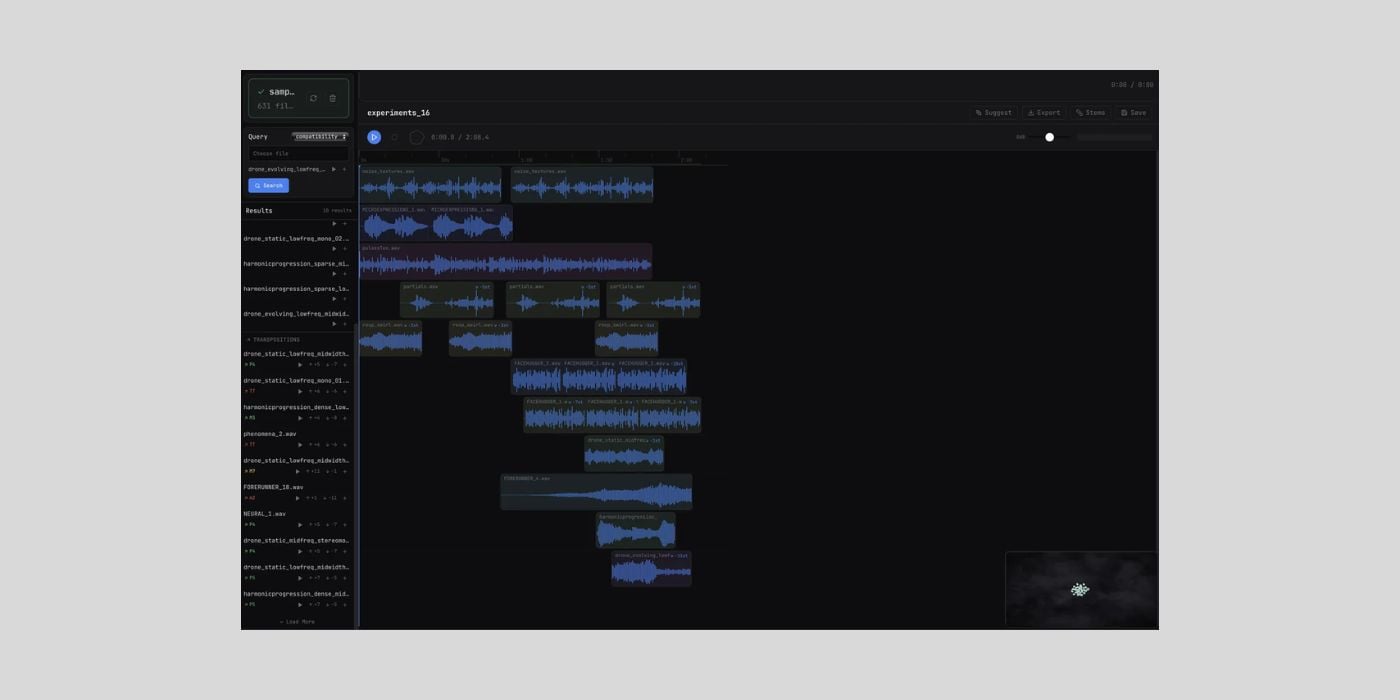

Composer and software engineer Austin Rockman has released Reflector, a free open-source interactive audio workstation for sample discovery.
Austin contacted me about the project, and I liked the idea even before testing it. Machine learning gets thrown into a lot of music tools now, but I find it interesting when it helps us interact with audio differently rather than simply generate more audio.
Reflector is built for browsing your own sample library by harmonic relationship. In simple terms, you point it at a folder of sounds, it analyzes the material locally, and then you can search for samples that either combine well with a query or resemble it.
That makes it different from a regular sample manager. If you have one sample you like, Reflector can help find other sounds in your library that may work with it harmonically. It can also suggest transpositions when a sample might fit better after being pitch-shifted.
The more interesting part is that Reflector does not stop at one static search. It has a DAW-like timeline where you can place samples, build a rough arrangement, and then ask Reflector for suggestions based on what is already happening in the session.
Austin describes it as the stage before the DAW. It is not there to replace your main music software. It is more of an idea-building space where you throw sounds together, explore what belongs, and then export the result as a WAV file or stems when you are ready to continue elsewhere.
Reflector is currently aimed at tonal and textural material, such as pads, keys, strings, synths, guitars, vocals, field recordings with a tonal center, and sound design that carries harmony. It does not analyze rhythm, so it is not a beat-matching tool.
There is also a Galaxy view that maps saved sessions in a 3D space, showing which arrangements share harmonic relationships. That part sounds especially useful if you have a large sample library or a lot of unfinished sketches and want to rediscover connections between them.
The privacy and training side is worth mentioning, too. Reflector runs locally, your audio and usage data stay on your machine, and the system was trained entirely on synthetic audio rather than copyrighted recordings. Austin also confirmed that Reflector will remain free, with the weights, model code, and training pipeline open source.
As always with experimental software from a solo developer, expect some rough edges. But this feels like the right kind of machine learning tool for musicians: not a shortcut around creativity, but a different way to navigate your own sounds.
Reflector is currently available as a free signed macOS application. The manual notes that it is distributed outside the App Store, so macOS may ask you to right-click the app and choose Open the first time you launch it.
Download: Reflector (FREE)
Deal of the day 🔥: Get the VATRA mix finisher plugin by Flame Sound!
More:
Last Updated on August 9, 2026 by Tomislav Zlatic.