

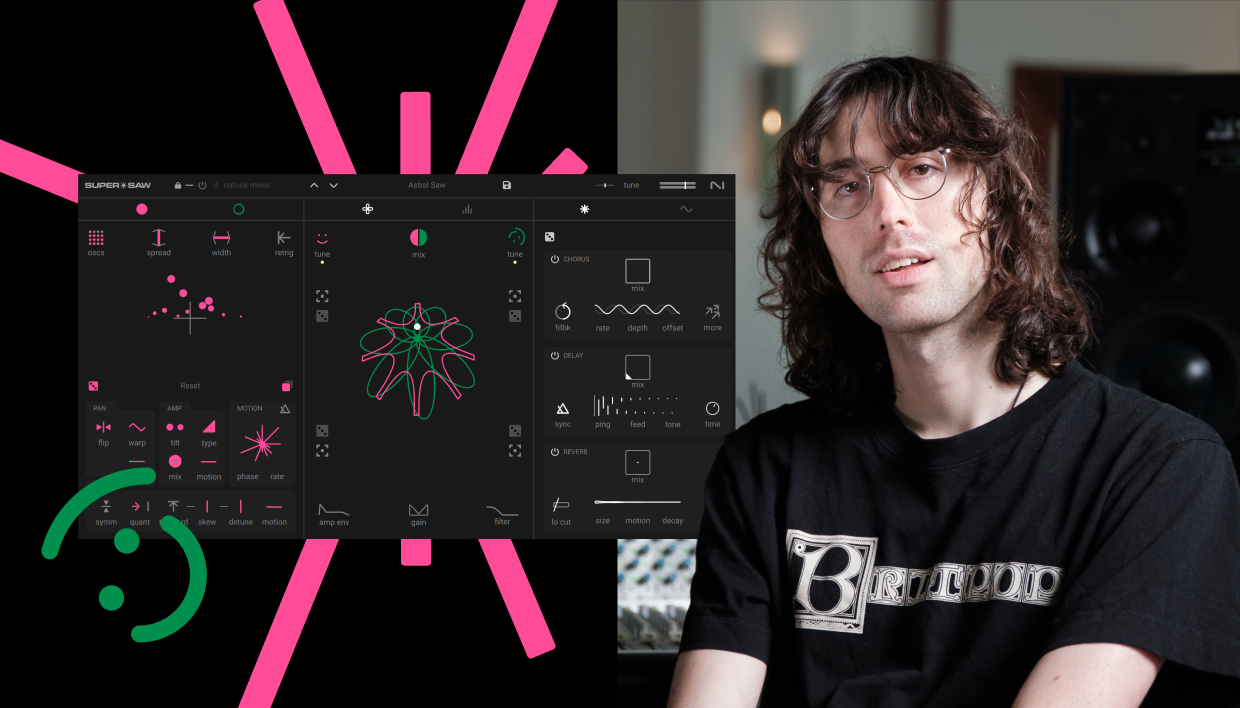

“I find it hard to describe my own sound because I’m really constantly trying to break it,” Cook says. “That’s what makes music interesting to me… a lot of the experimentation I’m doing in my own music is really to keep myself interested… I’m trying to just, you know, stay engaged. In a way, that’s what I really love about making music on computers. So really anything could happen very, very quickly.”
This tension between the precise and the chaotic is exactly what makes the sawtooth wave such a perfect canvas. A simple sawtooth wave is sharp, aggressive, and harmonically rich. But when you stack them, they morph into something massive.
“In my mind, the supersaw is really a 90s invention because it’s about moving from a sort of analog synth to proper digital virtual analog instruments that can suddenly load way, way more oscillators than you normally, you know, be limited to. And we can make something that is much thicker and weirder and sort of more digital and ultimately raver. It’s essentially just stacking this saw wave.”
Across Cook’s catalog, you can hear this exact technique at play. On his track “Superstar,” the arrangement transitions from a delicate piano ballad into towering, detuned supersaw layers. On 7G, tracks like “Mad Max” push stacked saw waves so far that they stop sounding like chords entirely.
“The supersaws get so thick that they’re essentially percussion,” Cook explains. “At that point, it stops even really being audible as a chord, and you just hear it as this block of sound.”