

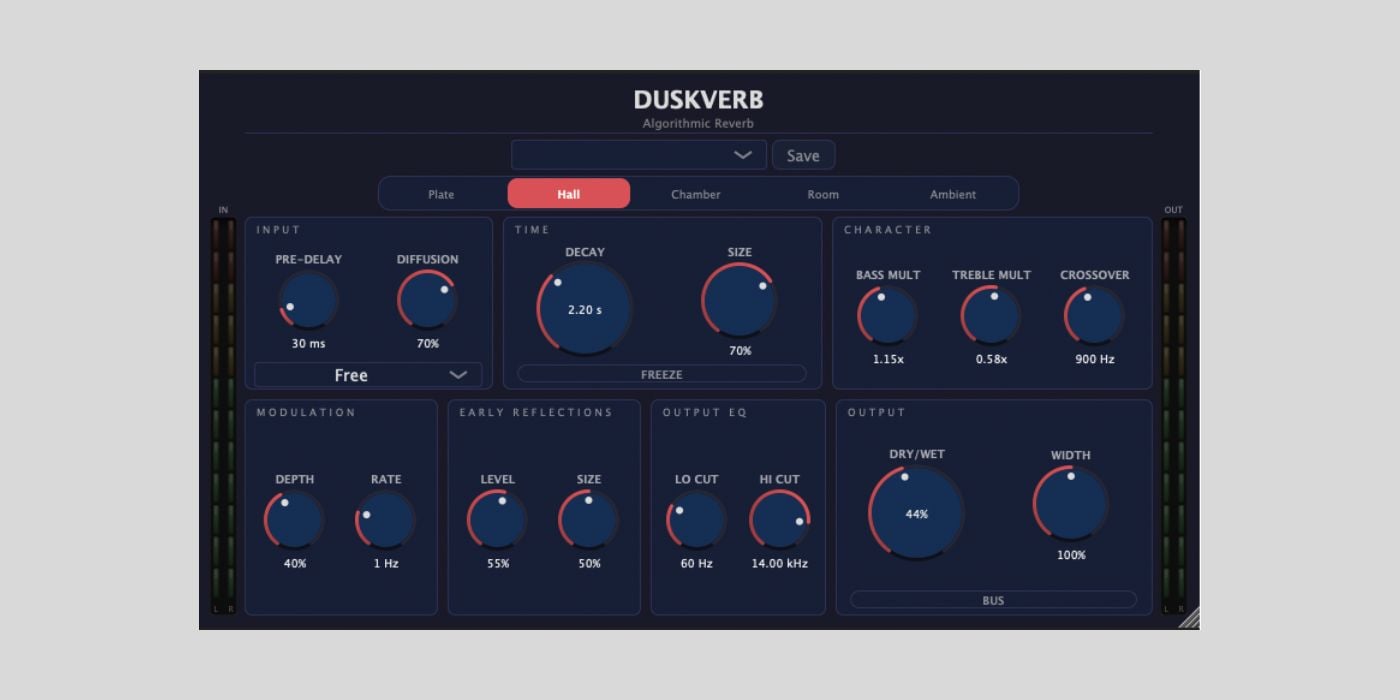

Dusk Audio has released DuskVerb, a free algorithmic reverb currently in pre-release, available for Windows, macOS, and Linux.
Before we check out DuskVerb in more detail, I have to briefly share my two cents on the topic of vibe-coded plugins.
The surge in free plugins over the past several months has been hard to miss. We never covered this many new freebies in January or February before.
And, obviously, it’s not hard to guess that a lot of it comes down to AI-assisted development (aka vibe coding). And that seems bad, right?
But vibe coding covers a wide spectrum.
It can mean someone with no audio engineering background building a plugin entirely through AI tools. It can also mean a skilled DSP developer using AI to speed up their workflow while bringing real technical depth to the algorithms. Or someone with strong coding skills who only relied on AI for the interface design side of things.
So what I’m trying to say here is that, in my opinion, vibe-coded plugins aren’t necessarily bad.
I have to draw a parallel here with the days of SynthMaker and SynthEdit (old tools for rapid development of VST plugins for non-coders). Plugins made with those tools were often regarded as “less worthy.”
But at the same time, without those tools, we wouldn’t have plugins by Variety of Sound (SynthMaker/FlowStone used for interfaces), the old legendary freebies like Superwave P8 or Elektrostudio Tapeotronic (SynthEdit), and many more fantastic plugins.
So, I believe that there’s a line between a good and a bad plugin made with the help of AI, just like any other tool. At the end of the day, it boils down to whether the plugin itself sounds and works well.
Anyway, I’m saying all of this because DuskVerb was made with the help of AI.
I’ve started to develop a feel for recognizing AI-assisted interfaces, and DuskVerb instantly had that look to me. And it turned out I was correct – the developer’s website notes it was built with AI assistance.
But to my ears, the plugin sounds good, and the relatively deep feature set suggests this was built by someone who knows reverb design well.
Let’s (finally) take a closer look at it. Let me know what you think about it in the comments.
DuskVerb uses a 16-channel Hadamard feedback delay network with Dattorro-inspired diffusion stages for the tails. The early reflections are physically modeled with air absorption, which means smaller algorithm settings actually produce a convincing sense of physical space.
Each of the five algorithms has a unique sound. My favorite during the test was Ambient, which goes on for a super long time and feels ethereal with heavy modulation. It sounds great on drones and cinematic effects.
Controls are organized into clear sections. Decay runs from 0.2s up to 30s, Pre-Delay supports tempo sync, and Size lets you scale the virtual room.

The Character section covers Diffusion, Bass Multiply, Treble Multiply, and a Crossover frequency for independent low and high decay control.
The Output section includes a Mix knob, Width up to 200%, Lo Cut and Hi Cut filters, and a Bus Mode for send setups. Also, the Freeze function sustains the current tail indefinitely, which is awesome for ambient and cinematic work.
DuskVerb comes with 25 factory presets across nine categories, including vocals, drums, guitar, keys, ambient, and special effects. You can also save custom user presets.
You can download it directly from the developer’s website without registering.
DuskVerb v0.3.0 is available for macOS 10.13 and higher (VST3 and AU), Windows 10 and higher (VST3), and Linux with glibc 2.31+ (VST3 and LV2). Sample rates from 44.1kHz to 192kHz are supported.
Download: DuskVerb by Dusk Audio (FREE)
Deal of the day 🔥: LOWEST PRICE EVER – 67% OFF Roland D-50!
More:
Last Updated on March 2, 2026 by Tomislav Zlatic.