Pythagoras was an ancient Greek philosopher in Ionia, modern-day Turkey.
He spent 22 years in Egypt and 12 years in Babylon, modern-day Iraq, and his 34 years spent abroad in his early adulthood were the time in which he learned geography and music.
No Pythagorean writings survived antiquity, if there ever were any, as he was primarily an oral teacher, so everything we know about him today comes to us via different writers with first- and second-hand accounts.
Writers of the Middle Ages and Renaissance credited Pythagoras with having “discovered” or at least first characterized perfect intervals.
As the story goes, Pythagoras was strolling by a blacksmith shop in ancient Greece one day in the 6th century BCE when he heard perfect octaves ringing out from the shop as hammers sized in a ratio of 2:1 struck the anvils.
We know now that this could not have been exactly how things went down, as it would have had to be the anvils in the 2:1 ratio in order to resonate at an octave, not the hammers.
A more likely origin for Pythagoras’s theorizing about harmonic ratios would be plucked strings of various lengths.
A pitch and the octave above it can be found by plucking a string and then dividing the string in half (by fretting the 12th fret on a guitar or bass, for example) and plucking it again.
Plucking a string and then shortening it so that 2/3 the original string length is able to resonate before plucking it again (fretting the 7th fret on a guitar or bass) yields the pitch a perfect fifth above the original.
Repeating this process but allowing 3/4 of the original string length to resonate (fretting the fifth fret) yields a perfect 4th.
The ratios involved in forming these harmonic ratios are such that their differences in each case (2-1 for the octave, 3-2 for the fifth, and 4-3 for the fourth) is 1, making these “superparticular” ratios, mathematically speaking.
Both the sound and the mathematical simplicity of these harmonic ratios leads music theorists and musicians to refer to the harmonic intervals that they form as perfect intervals.
Is Pythagoras The Father Of Music?
While Pythagoras did play the lyre and was an early proponent of the healing quality or music, perhaps suggesting he was a predecessor to modern-day music therapists, he did not invent music.
At best, Pythagoras could be listed among the fathers of music theory based on the impact the Pythagoras music ratios had on naming harmonic intervals.
However, as discussed in the article linked above, theorists were writing theoretically about music long before Pythagoras walked by a blacksmith shop (or experimented with plucked strings).
Pythagorean Tuning
If you are like me and have spent most of your musical life in A=440 Hz tuning, then it might come as a shock to you, as it did for me, to learn that there are other forms of tuning, one of which being Pythagorean temperament.
I highly recommend reading through it for a comprehensive understanding of all of the controversy around tuning systems.
For our purposes here, though, Pythagorean temperament is of greatest importance to the discussion at hand.
How To Tune In Pythagorean Temperament
While we most commonly use a system of equivalent semitones today, Pythagoras theorized a system of tuning in which all intervals were based on the 3:2 ratio, or the perfect fifth.
Up until the early 16th century, at which point this system lost favor which musicians, Pythagorean tuning involved beginning at a given pitch, we’ll use D as an example, and measuring fifths in each direction until each pitch was covered based on octave and enharmonic equivalence.
Essentially, this would yield E-flat – B-flat – F – C – G – D – A – E – B – F-sharp – C-sharp – G-sharp.
While tuning fifths, the pitches in between the fifths could be matched to their octave equivalents using the 2:1 ratio of the octave.
For example, because D4 resonates at 288 Hz, A4, when tuned exactly a perfect fifth up from D4, would resonate at 288 x 1.5 (the ratio 3:2), or 432 Hz.
After multiplying 432 x 1.5 to find E5, which resonates at 648 Hz, one would divide it by 2 to find the frequency of E4, one octave lower.
That frequency is 324 Hz. This process continues until every key is tuned using solely fifths and octaves.
A problem arises when tuning to perfect fifths and relying on octave equivalence, though.
Essentially, for the system to work perfectly, the D that is exactly 12 fifths higher than D1 would have to be the same as the D that is 7 octaves higher than D1.
In other words, 1.5 raised to the 12th power would have to be equivalent to 2 raised to the 7th power (2 being the octave ratio and 1.5 being the fifth ratio).
Alas, 1.5^12=129.746, while 2^7=128.
This small difference, known as the Pythagorean Comma, results in poorly tuned thirds and the fifth formed by the pitches across the circle of fifths from the fundamental tuning pitch going so far out of tune that they are known as the “wolf fifth” of that key.
In D, for example, the “wolf fifth” is G-sharp/A-flat to D-sharp/E-flat.
By the time these pitches are reached in moving by fifths from the fundamental of D, they are so far out of tune that they form a distorted fifth.
This flaw in the tuning system limits musical harmony in the Pythagorean temperament to a narrow range of keys and harmonies.
The tuning system of today, equal temperament, improves on Pythagorean tuning by tuning each octave perfectly at the 2:1 ratio and tuning semitones within the octave equally so as to approximate the ratios for each interval.
In this way, each interval in each key is equally playable, but none of them are quite perfect except for the octaves.
Music Of The Spheres
Pythagoras has something of a mythical legacy. As I mentioned before, we have none of his writings, so everything we know about him comes to us from other philosophers, like Ovid.
Ovid writes about him as if he were somewhere between a man and a god, with the ability to tap into a higher form of consciousness.
In Book 15 of Metamorphoses, Ovid shares that Pythagoras can supposedly hear his friends in the noises of animals, supposedly his reasoning for a vegetarian diet.
Pythagoras developed something of a cult of followers while living in Southern Italy.
This cult might have been nothing more than a school, or it might have been more in line with the cults in the news today–insufficient written evidence exists to indicate one or the other.
At any rate, adherents of Pythagoreanism believed that, since objects that move make sound and since spherical celestial bodies (planets) move, there must be sound to their movement.
Johannes Kepler, a mathematician, astronomer, and astrologer working over 2000 years after Pythagoras, developed the concept a bit further by tracking the actual movements of the planets around the Sun.
He then characterized their trajectories via ratios to set them up with scales akin to the Pythagoras music scale established in Pythagorean temperament.
Kepler went so far as to compose some music using his observational measurements and the theorizing of Pythagoras in music, but, unfortunately, it did not sound very good.
Kepler determined that this music might be more in the taste of the fiery beings living on the Sun since God wouldn’t be interested in such strangely-tuned music.
Is There Any Truth In The Music Of The Spheres?
While the absence of a medium between the planets and the earth means we can’t really hear what is happening in space, scientists have measured electromagnetic pulses and other resonances at frequencies that we can hear.
When Dr. Michio Kaku says the sound in this recording is “amplified” by 57 octaves, he means it is transposed or shifted up 57 octaves so that it can be perceived as sound by human ears.
What these types of recordings have in common is that some sort of resonance information is coded into sound, but would not be perceptible as sound otherwise.
The ratios of planetary or lunar orbits that formed the foundation of the original thinking of Pythagoras in music of heavenly bodies may match the ratios in musical harmonies, the commonality is in the ratio itself, and not the sound.
Pythagorean Theorem In Music
Music and mathematics share a great deal of overlap.
From the way that we talk and write about music, to the way we organize it in terms of its vertical (pitch) and horizontal (time) dimensions, to the ratios that result in harmonic intervals.
Sometimes musicians go so far as to factor mathematics into their creative process purposely.
Part of the reason I was so excited to write this article is that it reminded me of a little EP I put together shortly before moving to New York City, so that I would have something to share with anybody who might be interested in playing music together.
I was reading Euclid’s Window by Leonard Mlodinow at the time, a well-written book on the history of geometry, and from the stories of the mathematicians, I was inspired to name the album Three Chords (a bit of geometrical/musical double entendre).
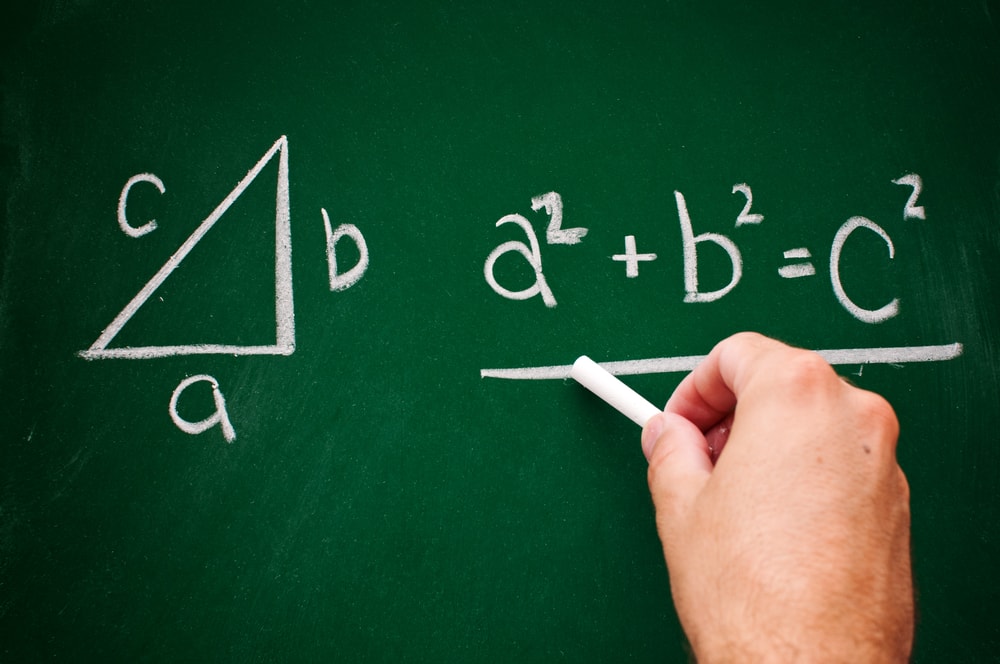
I recorded the tracks at 3:00, 4:00, and 5:00 exactly, and name them A, B, and C, like the two right-angle sides and hypotenuse of a right triangle.
I have since gone on to do much better composition and recording work, with this being a thing I thre together in the basement of my parents’ house with a laptop, audacity, a Fender acoustasonic junior, and the cheapest MXL condensor mic I could find on sale, but I got a kick out of listening to it for the first time in years.
Wrapping Up
I am inclined to agree with Pythagoras that numbers and geometry are beautiful things.
When the numbers of music work out nicely so that the look and the sound of the music convey a simple elegance, I find it especially moving.
That said, I find the evidence of imperfection just as compelling.
The Pythagorean Comma that presents itself as a by-product of Pythagorean tuning to sink the entire tuning system of Pythagorean tuning anytime you try to compose too far from your original key or mix in too many imperfect consonances is a gentle reminder that nothing is perfect.
The fact that the solution to Pythagorean tuning we have managed to stick with distributes a little imperfection evenly across across the octave has a certain humor to it.
Likewise, as beautiful and perfect as it would be for the planets, sun, and moons to make music together, there is no medium for sound to travel through in most of space, so we will just have to be content with making our own music.