

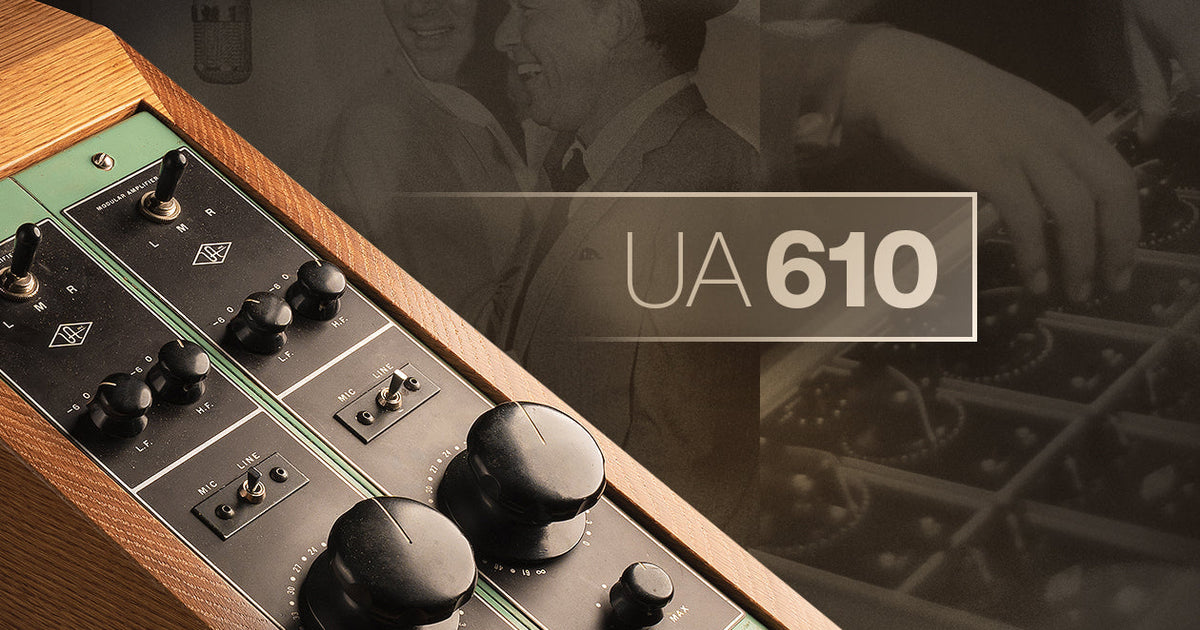

How a custom tube mixing desk transformed audio recording, and continues to inspire music creators today.
Few pieces of audio equipment can claim a lineage as culturally significant as the 610 console. Introduced in 1960 by Universal Audio founder Bill Putnam Sr., it was the first of its kind — a purpose-built tool that reflected radical ideas about sound, control, and craftsmanship.
From Frank Sinatra and Ray Charles to Neil Young and Van Halen, the 610 mic preamp modules have left their fingerprint upon some of the greatest recordings of our time. We traced the origins of this hallowed equipment to uncover why it continues to inspire modern music creators.
Get the UA 610 Tube Preamp & EQ Collection FREE for a limited time!
Recording Before the 610 Console
In the 1930s and ’40s, recording studios were often extensions of radio facilities. This meant equipment was designed primarily for speech, instead of musical tone. Equalization was rare, gain staging was often fixed, and engineers relied on mic placement and room acoustics to shape sound.
Before purpose-built recording consoles existed, engineers used modified broadcast mixers. And early recording chains were primitive: a microphone fed a simple preamp, which fed a recorder. This left few opportunities for tone shaping or creative routing.
As multitrack recording began to emerge in the 1950s, record producers and engineers needed more control. They could no longer simply document performances — they needed to sculpt them.
The gap between creative ambition and technology had widened. The world needed something new.
With the 610 modular console, Bill Putnam Sr. introduced a new paradigm for studio control and sound design.
Designing a Custom Studio Desk
By the late 1950s, Bill Putnam Sr. had already earned his reputation as a pioneer of modern recording. With his work at Universal and United Recording, he introduced techniques like overdubbing, artificial reverb, channel equalization, and purpose-built studio electronics. These concepts now form the backbone of any modern recording studio. But for their time, they were nothing short of revolutionary.
The 610 console was Putnam’s answer to new demands in multitrack recording. It’s modular, multi-channel design meant that each console could be tailored to a particular studio or space. And the tube channel strips at the heart of the 610 encouraged broad tone shaping and creative control.
While it wasn’t a simple piece of gear, the 610 answered a simple question: could recording equipment become an instrument in itself?
Unlike earlier broadcasting desks, the 610 was designed specifically for recording. Engineers could drive the input stages for harmonic color to shape tone on the way in. This concept of “printing a sound” underpins the workflow of top recording engineers to this day. And it all began with the 610.
The 610 answered the question: could recording equipment become an instrument?
Capturing Icons of the Golden Era
The 610 quickly became synonymous with some of the greatest recordings of the 20th century. At United and Western Studios in Hollywood, it shaped the sound of artists like Frank Sinatra, Nat King Cole, Ray Charles, and Dean Martin. But its success had as much to do with the power it imparted upon studio engineers as the artist and performance.
“The 610 gave record producers and engineers control,” explains Will Shanks, Sr. Product Designer at UA. “It went beyond being a part of the signal chain. It allowed vocals to be placed in the mix without losing their natural warmth and timbre.”
And the console didn’t just serve vocalists. As rock and pop groups pushed into more complex, multitracked arrangements during the 1960s, the 610 provided the sonic glue that held it all together. The Beach Boys famously tracked their dense vocal harmonies and adventurous instrumentations at United/Western, while artists like Neil Young and The Rolling Stones gravitated to studios equipped with UA consoles.
“I’ve never heard anything that didn’t sound amazing going through 610 consoles.”
Mark Linett (The Beach Boys, Brian Wilson, Los Lobos)

The Beach Boys used the same recording environment to build their dense, layered harmonies, pushing multitrack recording to new creative extremes.

While the 610 wasn’t transparent in the modern sense, it flattered sources with its rich tube saturation, helping to define what recorded music sounded like for generations to come.
The 610 Finds a New Fanbase
As recording technology shifted toward solid-state consoles and eventually digital workstations, many of the original 610 desks were retired. But their sound and reputation never disappeared. In the modern age of computer-based recording, it has become a coveted aesthetic to harken a time when creating music wasn’t tethered to such complex processes.
Modern artists continue to seek out the 610’s unmistakable tube character for vocals, guitars, or drums. Arcade Fire have famously recorded through vintage 610 consoles, both for the incredible sound that they impart, but also the freedom of expression that they offer in the recording process.
“At some point, engineers had designed all the color out of circuits… Then everyone asked ‘Where did the tone go?’”
Will Shanks, Sr. Product Designer at UA
For engineers and artists, the appeal of the 610 remains much the same as it was in 1960. It makes recordings feel “finished” earlier in the process. It encourages bold tracking decisions and creative commitment. It rewards performances that lean into the emotion of the moment, rather than deferring decisions to the mix.
“The 610 was designed when tone wasn’t something you added later. It was built in from the start,” says Shanks. In an era defined by infinite ‘undo’ — the philosophy of committing to sounds from the outset is almost rebellious, but deeply musical.

Even after falling out of fashion with the rise of digital recording methods, surviving 610 consoles have become cherished artifacts, preserved for their history and prized for their unmistakable tube sound.
Bringing the 610 into the Box
In 2014, Universal Audio introduced the first authentic plug-in recreations of the classic 610-A and 610-B tube channel strips, making them available to a new generation of producers working entirely in the digital domain.
Rather than simply modeling overall frequency response, UA engineers focused on recreating the coveted channel strips in their entirety — including tube gain stages and transformers, and the all-important circuit-level intricacies that make the original hardware so expressive.

The original UA 610 Tube Preamp & EQ plug-ins allowed music producers working with Apollo to access the rich harmonics of the original console in perfect end-to-end detail.
Classic Sound Goes Worldwide
From the earliest days of big band recording to modern in-the-box workflows, the legacy of the 610 console shines bright.
Beyond a single technological achievement, the 610 represents a decades-long philosophy: great tools empower great performances. And that belief now extends to music creators around the world.
Today, the 610 UAD plug-ins are available natively. This means you can experience authentic vintage tube tone right in your DAW, on virtually any system. In this way, the 610 continues to do what it always has — quietly shaping the sound of great performances, wherever they happen.
— McCoy Tyler
Related Articles: