

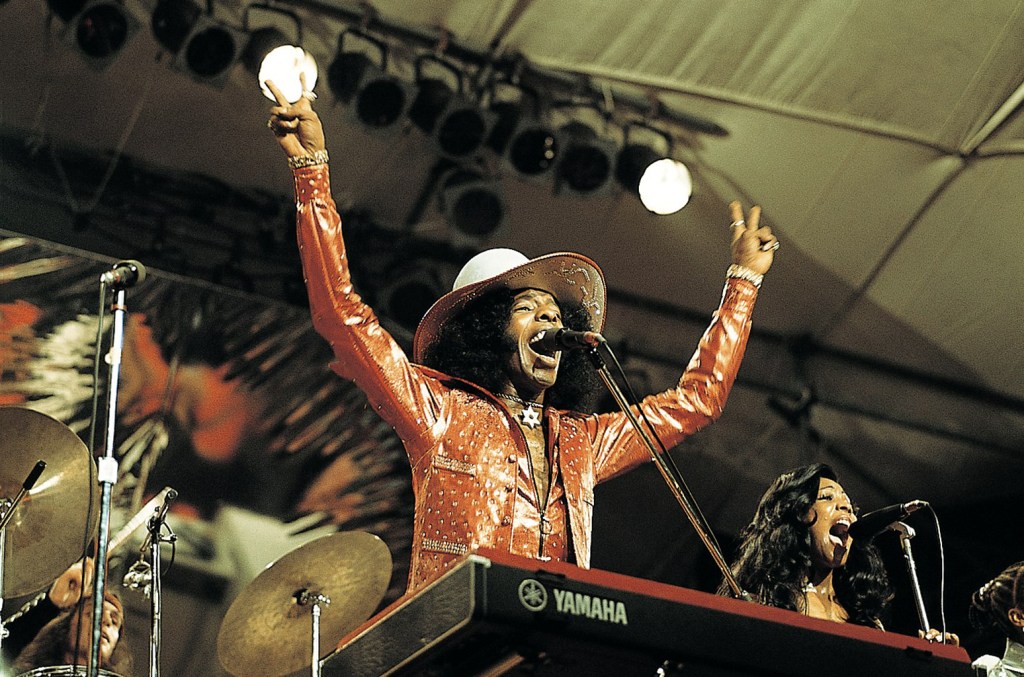

Forever No. 1 is a Billboard series that pays special tribute to the recently deceased artists who achieved the highest honor our charts have to offer — a Billboard Hot 100 No. 1 single — by taking an extended look back at the chart-topping songs that made them part of this exclusive club. Here, we honor Sly Stone, who died on Monday (June 9) at age 82, by looking at the second of Sly & the Family Stone’s three Hot 100-toppers: the disillusioned party staple “Thank You Falettin Me Be Mice Elf Agin.”
Explore
Explore
See latest videos, charts and news
See latest videos, charts and news
It should have been the victory lap. Sly & the Family Stone’s 1969 was one for the absolute ages, kicking off with the band topping the Hot 100 for the first time with “Everyday People” that February, continuing through the release of its commercially successful and highly acclaimed Stand! album that May, hitting a new gear with the standalone single “Hot Fun in the Summertime” in July and perhaps peaking with a legendary set at the iconic Woodstock festival in August. By year’s end, the Family Stone was unquestionably one of the biggest and most important acts in American pop music — and with the December release of the playfully and gratefully titled single “Thank You Falettin Me Be Mice Elf Agin” (as a double A-side alongside the sweeter but less spectacular “Everybody Is a Star”), you’d think the band was simply putting a nice bow on their ’60s run and looking forward to an equally thriving ’70s.
Well, yes and no, but mostly no. The song had the chorus you might have suspected from such a single — and perhaps more importantly, it had the commercial success — but the tone was very different than Sly & The Family Stone’s prior singalongs. Previous classics like “Dance to the Music,” “Everyday People” and “Sing a Simple Song” — all of which are name-checked, with no shortage of irony, in one of the song’s later verses — communicated a communal spirit above all else, of a band with a mixed-gender and mixed-race lineup and no proper lead singer, because the party was equally welcome to all. But by the time of “Thank You,” the party had gotten a little weird and dark, and throughout the song you can hear most of the band members actively looking for the exit.
As Sly & The Family Stone was racking up the accolades and accomplishments during its career year, the band itself was starting to fall apart. Members were becoming alienated from one another, and bandleader Sly Stone in particular was dealing with all kinds of internal and external pressures, which led to health issues and a retreat from the spotlight, and both exorbitant spending and heavy drug use to cope with all of it. “During that period, [he] had enormous pressures on him to align himself with the voices of despair and nihilism,” former manager David Kapralik said of Sly Stone’s turn-of-the-decade turmoil in Fred Bronson’s The Billboard Book of Number 1 Hits. “The poor kid was torn apart.”
You wouldn’t quite ascribe despair or nihilism to the lyrics to “Thank You” — and certainly not to the groove, elevated by Larry Franklin’s innovative slap-bass hook, which pops like air bubbles rising to the surface. But the rest of the Family Stone does feel somewhat submerged: The horns are tentative and a little slurred, the guitar is jagged and scraping, the drums can’t quite carry the weight. While the opening bounce of “Thank You” is buoyant enough to suggest good times, the panic sets in by the time of the song’s famous post-chorus breakdown section, which sounds like the whole band gasping for air.
And the vocals, once punchy and emphatic in early Family Stone singles, are now clipped and indistinct, multiple band members seemingly shouting over one another, rather than cooperatively taking turns as they once did. What’s more, the mix practically swallows them whole as the song goes on: By the time of the song’s final verse, they’re barely audible, with lyrics you can only discern on an extremely close listen. It’s the sound of a band that feels like it’s not being properly heard anyway — so why even bother making it easy for you?
Forever No. 1: Sly & The Family Stone, “Everyday People”
Sly Stone’s lyrics certainly suggest as much. The first verse features him running from a gun-toting devil, while the second seems to find him at an industry party — and he sounds much more freaked out by the latter, protesting, “Thank you for the party/ But I could never stay/ Many things on my mind/ Words in the way.” The last point about words getting in the way is driven home by the third verse, in which he and the band quote many of the their most famous anthems with dispassionate dismissiveness, only really seeming to mean it on the final one, when their declaration of “Papa’s still singing/ You can make it if you try,” feels like they’re quoting a loved one trying to pull them out of their despondency. And the final verse ends — somewhat inaudibly — with the troubled “where do we go from here?” thought: “Dyin’ young is hard to take/ Sellin’ out is harder.”
So how did this song with the sub-aquatic groove and the claustrophobic lyrics still become a No. 1 hit? Well, of course it helps to be anchored by such a mighty chorus. There’s no murmuring or sonic burying being done once you get to the song’s refrain — just the whole band shouting out the title like they mean it, like they really do still want to take you higher. It’s a strong hook and a powerful sentiment, which understandably had the impact of drowning out most of the subtler, less clearly audible signs throughout the rest of the record that all was not right in Stoneland. (As for the modegreened stylization of the title, Stone wrote in his autobiography — also titled after the song — that “mice elf” was meant to suggest “small humble things that were reminders of how big the rest of the world was. You had to stand up straight to be seen at all… And there were forces working against standing up straight. I tried to get to them in the lyrics.”)
And whether you did get Sly’s intent in the lyrics or just loved belting along to that chorus, you still would have no problem getting down to “Thank You.” As off-kilter and occasionally disconcerting as the song’s groove is, it is never less than 100% funky: arguably even more so than the band’s poppier early hits, which sometimes sanded off the grit that traditionally characterizes the best funk records. In fact, along with other grimier late-’60s hits like the Isley Brothers’ “It’s Your Thing” and Charles Wright and the 103rd Street Rhythm Band’s “Do Your Thing,” “Thank You” pointed the way more to where funk would go in the next decade, with rougher textures, fatter bass lines, and lower-pitched grooves that suggested something at least slightly sinister going on underneath the surface.
Billboard
Really, it made perfect sense that despite coming out at the end of the ’60s, “Thank You” ended up being one of the first No. 1 hits of the ’70s. The double-A-side debuted on the first Hot 100 of 1970, dated January 3, and replaced Shocking Blue’s “Venus” atop the listing six weeks later, ruling for both the February 14 and 21 charts. Though the song would ultimately give way to Simon & Garfunkel’s quintessentially soothing “Bridge Over Troubled Water,” the rise of “Thank You” did portend some angrier, darker No. 1s to come; the entirety of Three Dog Night’s “Mama Told Me Not to Come,” which topped the listing five months later, feels like it takes place at the party from the second verse of “Thank You.”
In the decades following “Thank You,” the song has endured as one of Sly & the Family Stone’s most beloved, and has both been inducted into the Grammy Hall of Fame and named by the Rock and Roll Hall of Fame as one of the 500 Songs That Shaped Rock. It has also been covered by everyone from Gladys Knight and the Pips to Van Morrison to Soundgarden, and sampled prominently by dozens of artists — most notably by Janet Jackson, who used the breakdown section as the backbone to her similarly iconic turn-of-a-decade Hot 100 smash, 1989’s No. 2-peaking “Rhythm Nation.”

But the most telling redo of “Thank You” was from Sly & The Family Stone itself, who refashioned the song as “Thank You for Talking to Me Africa,” the closer to its classic 1971 LP There’s a Riot Goin’ On. The new version, which borrowed musical elements from “Africa Talks to You ‘The Asphalt Jungle’” from the album’s A-side, slowed the original song down to a lurch, quieted the chorus to a near-whisper, and even flattened out the bass pops to a repetitive burble. The funk still remained — always would with the Family Stone — but the party was officially over.
Tomorrow, we revisit the final of Sly & the Family Stone’s three Hot 100 No. 1s, the joyous-but-broken-down lead single from There’s a Riot Goin’ On.