

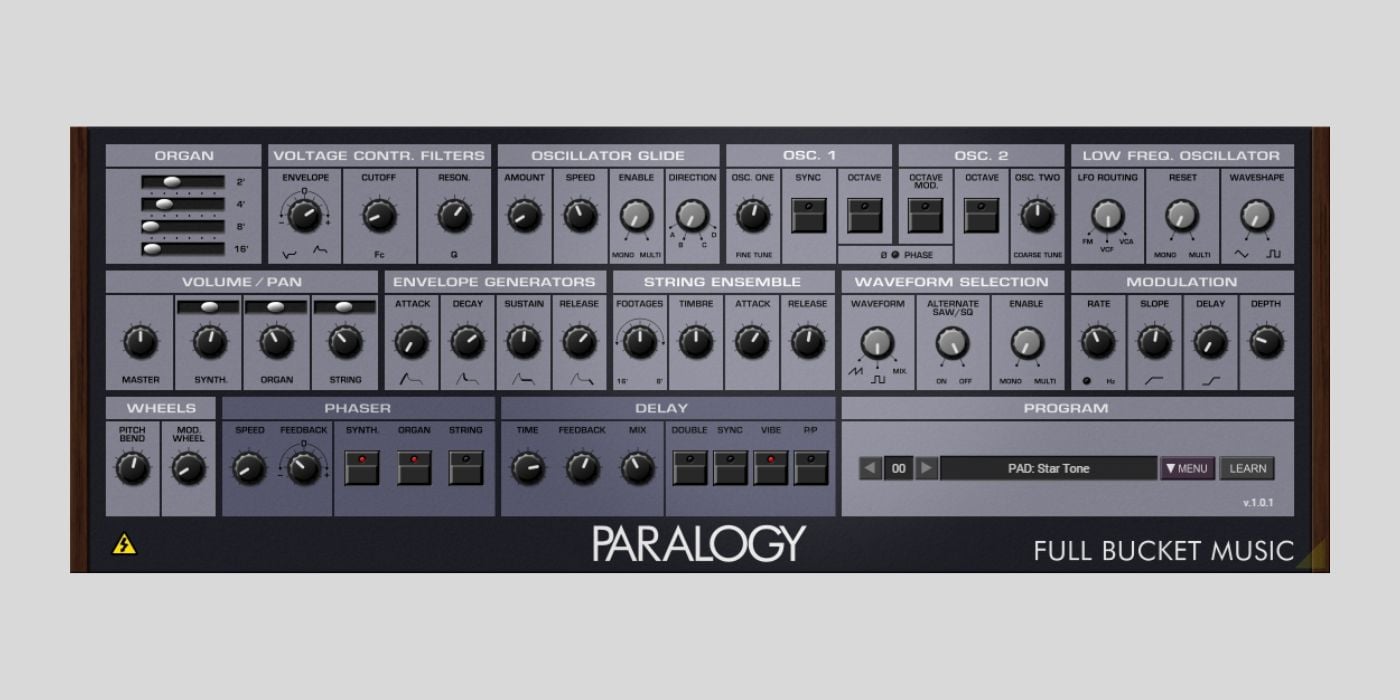

Full Bucket Music has released Paralogy, a free paraphonic synth plugin inspired by the Crumar Trilogy.
2026 is off to a very good start in the free plugin world. After plugin giveaways from Universal Audio, Waves Audio, and Canvas Audio, one of my favorite indie developers, Full Bucket Music, has released another free instrument.
Paralogy is a software recreation of the paraphonic Crumar Trilogy and Stratus keyboards from the early 1980s. Instead of modern polyphonic voice allocation, these instruments used a very unusual paraphonic architecture, which feels quite limited by today’s standards.
That said, I’ve often found limitations like these are actually a benefit for us music producers. Having unlimited features can lead to choice paralysis, whereas instruments with a unique or limited workflow can actually feel inspiring.
Paralogy faithfully recreates Crumar Trilogy’s paraphonic behavior in software so you can try it without spending your hard-earned money on a dusty old synth.
Paralogy combines three sound-generating sections: Organ, Synthesizer, and String Ensemble. All tone generation is based on divide-down oscillators, a design borrowed from vintage organs.
This means every key has a dedicated tone signal, generated as a square wave and shared across octaves, which gives the instrument its distinctive phase-locked character.
The synth section uses two oscillators with independent tuning and octave controls. Detuning creates natural beating, while a unique sync mode locks both oscillators to the same clock source.
Unlike classic hard sync, this can introduce subtle phase shifts that change the tone unpredictably, just like the original hardware. Full Bucket Music even added a tweak parameter to stabilize the phase when needed.
One of the most interesting parts of Paralogy, though, is how paraphony affects envelopes and modulation. The synth section has six voices, each with its own filter, amplifier, and ADSR envelope, but notes are hard-wired to voices by pitch class. If two notes share a voice, triggering one will retrigger the envelope for both, which can lead to unexpected but musical results.
The String Ensemble section is based entirely on the second oscillator and uses classic ensemble chorus circuitry with multiple modulated delays. It behaves like vintage string machines, with a single-triggered envelope that starts on the first key press and ends when the last key is released.
This makes long releases possible, but only if you’re careful with how you lift your fingers .
Paralogy also includes a flexible LFO, MIDI learn for all parameters, and built-in phaser and delay effects inspired by classic analog hardware. The phaser is loosely based on the Electro-Harmonix Small Stone, while the delay models bucket brigade designs common in the 1970s .
Paralogy runs on Windows and macOS and is available in VST2, VST3, CLAP, AU, and AAX formats, making it easy to integrate into almost any modern DAW.
Download: Paralogy
Deal of the day 🔥: Get the UA Moog Minimoog for only $29 + FREE gift!
More:
Last Updated on January 18, 2026 by Tomislav Zlatic.