


Blueprint: Wurli from Fracture Sounds is the 26th and latest addition to the stellar series, and it’s something of a return to the project’s genesis for Fracture Sounds.
This time, Fracture Sounds has sampled a classic Wurlitzer, the backbone of countless hit songs.
Check out Ray Charles What I’d Say and Steely Dan’s Dirty Work for some beautiful and contrasting use of the Wurli sound.
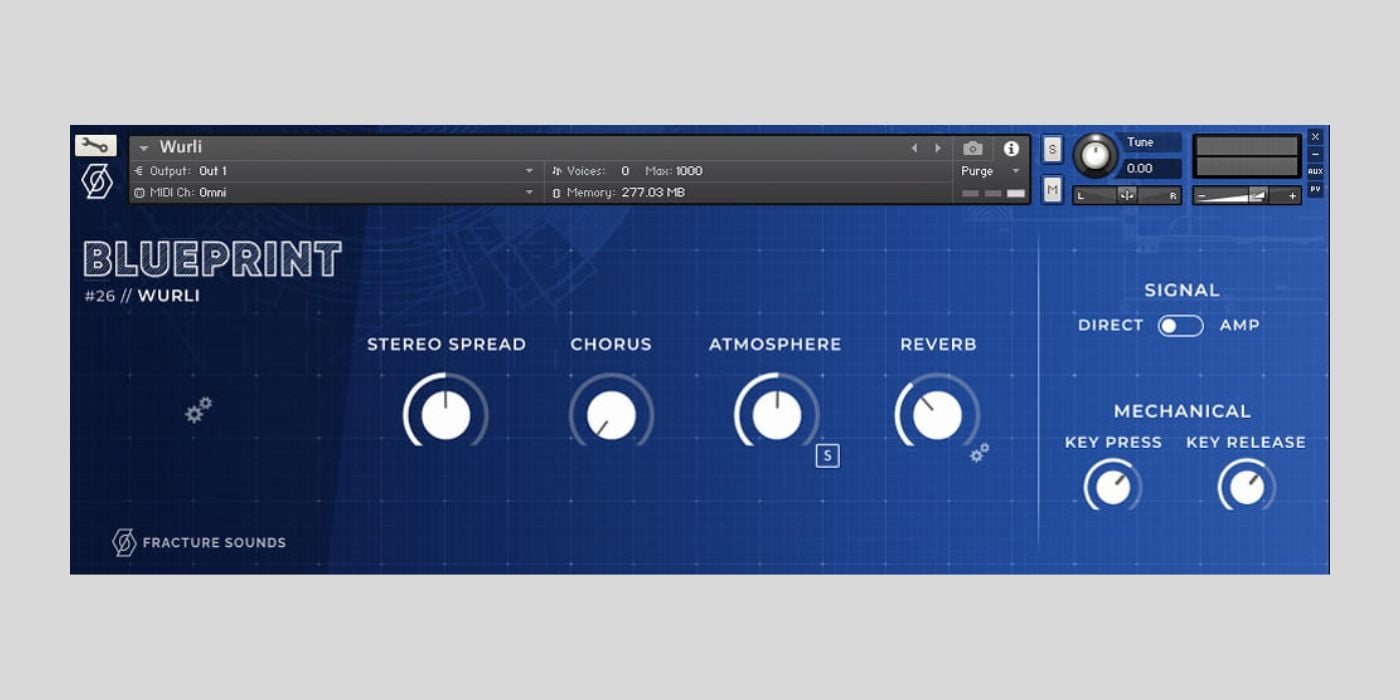
Like Electric Keys, Wurli has a typically simple interface.
From left to right, we have Stereo Spread, Chorus, Atmosphere, and Reverb.
In most cases, I don’t play with the Stereo Spread much; I prefer it pretty neutral.
I don’t use the Chorus too often either, but not because I don’t love it; it’s just a really distinct sound.
Supertramp and many others made the Wurli with chorus an era-defining sound in the late 1970s. You can also crank out Billy Joel’s Just The Way You Are with a little chorus, even if he used a Fender Rhodes on the original.
I tend to prefer the Wurli sound as pure as possible, and if I stray further away from that, I love the Atmospheres included because they are so different.
I think of them less as altering the Wurli and more as something entirely new, which makes these Blueprint instruments more versatile than expected. The thing I like most about the Atmosphere layers is that you can solo them, and some sound fantastic on their own.
The Reverb control offers several types, including Room, Hall, and Shimmer.
Moving onto the right side of the interface, you have a Direct/Amp switch. When the Wurli sounds too clean, it becomes a little passive, in my opinion, so I prefer the grittier Amp setting.
But I love that you have the option, because in the right context, you might need that cleaner tone.
You can then adjust the mechanical noise levels from the key press and release controls. It’s easy to overdo it with these controls, but leaving enough of that thump in the mix highlights the Wurli’s percussive nature.
Lastly, you can adjust the Sample Start time and Velocity Response.
Sample Start is an interesting control; it’s tempting to reduce latency for the smoothest and most responsive performance. However, when you play old electric pianos, they make you work hard, and that adds to the personality; I prefer to leave some of that in the mix.
As always, I highly recommend checking out the rest of the Blueprint series if you haven’t already.
More:
Last Updated on February 11, 2026 by Tomislav Zlatic.