

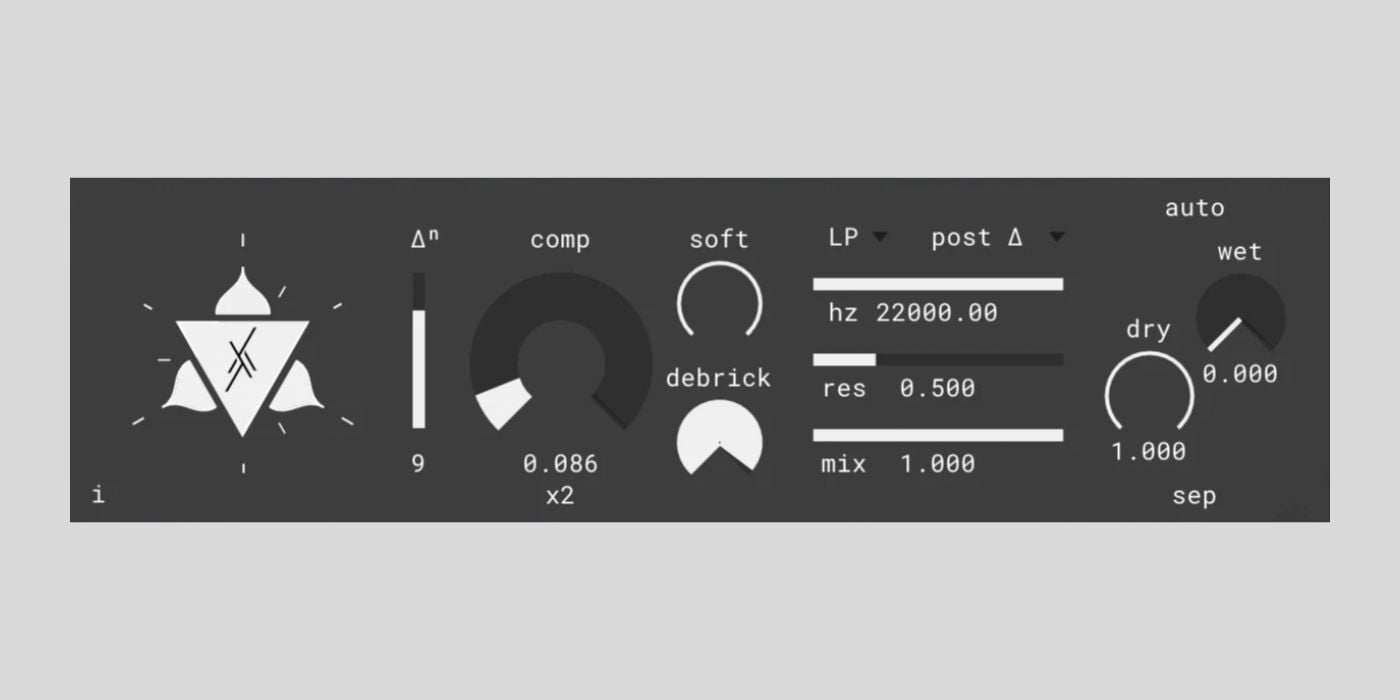

Sand is the latest release from Hvoya Audio, a sound design tool for macOS and Windows that compands the derivative of the original signal.
It expands the quietest signals and adds some soft limiting to the loud signals, adding grit and texture.
Working on the derivative rather than the original signal yields some interesting side effects.
In addition to creating that overdriven, gritty texture, the compander acts like something of a high-pass filter, pulling out elements of your sound that you might not otherwise hear, with a maximum amplification of around 140 dB.
The resizable GUI is pretty straightforward.
The main control is the Compander amount, and underneath that dial, you’ll find a button to adjust the number of companding stages.
To the left of the main Compander dial, you can change the derivative order from -1 to 15. If you set it to 0, the compander will impact the original signal.
Moving along, we have Soft and Debrick: Soft smoothes some of the gritty texture (or adds it, going the other way), and Debrick is like a failsafe, if you overcompress the signal.
Sand also features a multi-mode filter (LP, BP, and HP) with adjustable position in the signal path.
Interestingly, you can switch between a combined Dry/Wet mix or dedicated controls for each.
If you hover over any control, you should see a short description of that parameter, although that doesn’t seem to be working on my end.
Sand is a simple but interesting tool, available in AU, VST, and VST3 formats for macOS and Windows.
Mac users will be prompted with the typical “unknown developer” message, which you can resolve in System Settings (Privacy & Security).
If you haven’t checked it out yet, it’s worth a look, and there’s more great stuff on that list.
More:
Last Updated on February 18, 2026 by Tomislav Zlatic.