

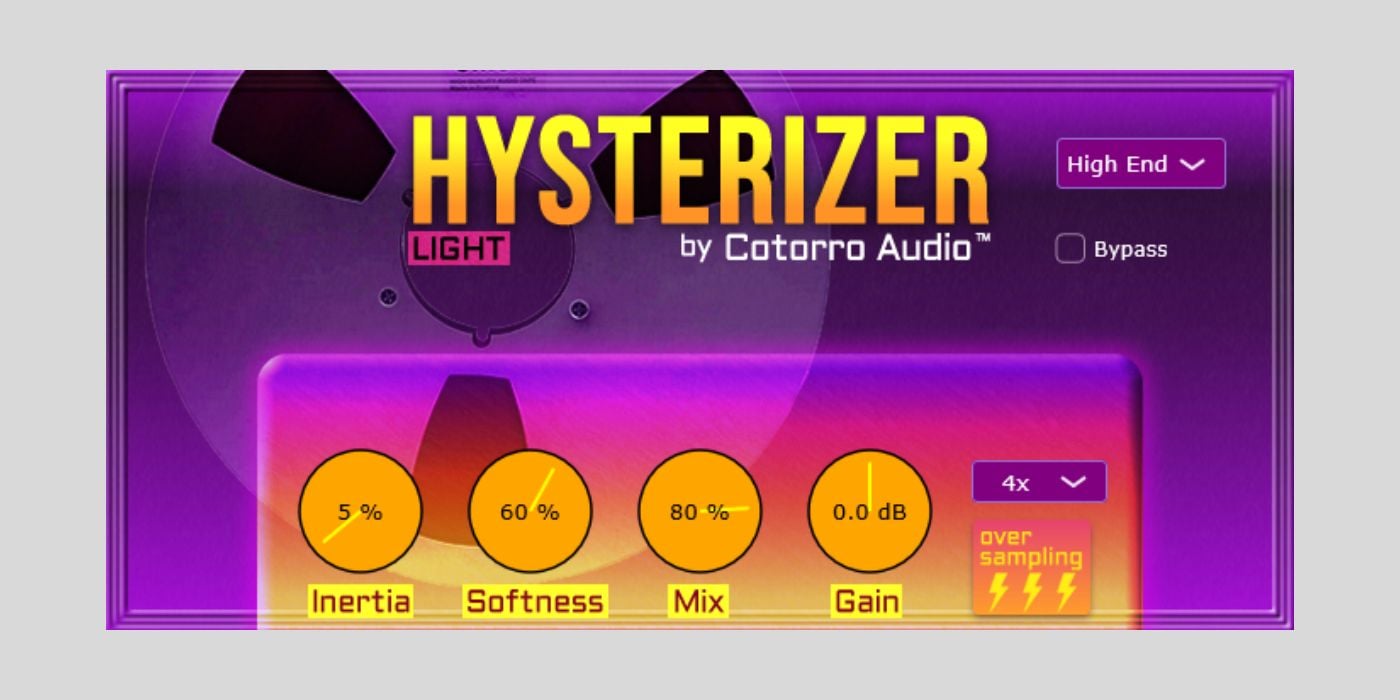

Developer Cotorro Audio has released Hysterizer Light, a free tape hysteresis effect for Windows.
Typically, when we talk about plugins that emulate magnetic tape recorders or their inherent effects, we don’t go much deeper than referencing vibe, warmth, and glue, and that’s enough in most cases.
We’re all familiar with the instant nostalgia that a good tape emulation adds, and when we’re reaching for those plugins, it’s often a character-defining choice.
When a plugin called Hysterizer emerges, offering digital implementation of hysteresis, we should probably review the basics of hysteresis.
Hysteresis is a concept often discussed in the context of noise gates, which have separate thresholds for opening and closing. In short, the separate close threshold prevents the gate from chattering and allows tails to play out more smoothly and naturally.
In this case, tape hysteresis refers to a lagging/softening effect that occurs because magnetic tape reacts much more slowly than anything we snap to a digital grid.
That slower reaction means the attack is more gradual, peaks are softer, and the release is slower.
Like the noise gate scenario, tape hysteresis creates a much smoother sound that often feels more cohesive or glued.
Hysterizer Light has four controls: Inertia, Softness, Mix, and Gain.
But, Inertia is the one that really sets the tone, or the feel, more appropriately.
Inertia defines the resistance to react; higher levels mean transients have to push harder to get through, and lower levels deliver a speedier response.
The free plugin offers 2X and 4X oversampling, but the paid version (Hysterizer Elite $24.99) provides 8X oversampling.
Hysterizer Light is available as a VST3 plugin for Windows; the developer’s website offers an instant download with the option to pay what you like.
Mac users like me will miss out on this one, but Cotorro Audio suggests multiple use cases for Windows users, such as:
- Adjusting the snap of snares and kicks
- Controlling plosives in vocals
- Smoothing transients
- Enhancing micro-dynamics for better groove
I like the groove thought: while the lag of tape hysteresis isn’t as obvious as streaming in the dial-up internet days, it does change the feel.
Without getting into the more characterful effects of tape, like saturation, wow, and flutter, etc., that subtle lag can make a simple groove feel more human and less rigid.
Please let us know what you think of Hysterizer Light in the comments!
More:
Last Updated on January 14, 2026 by Tomislav Zlatic.