

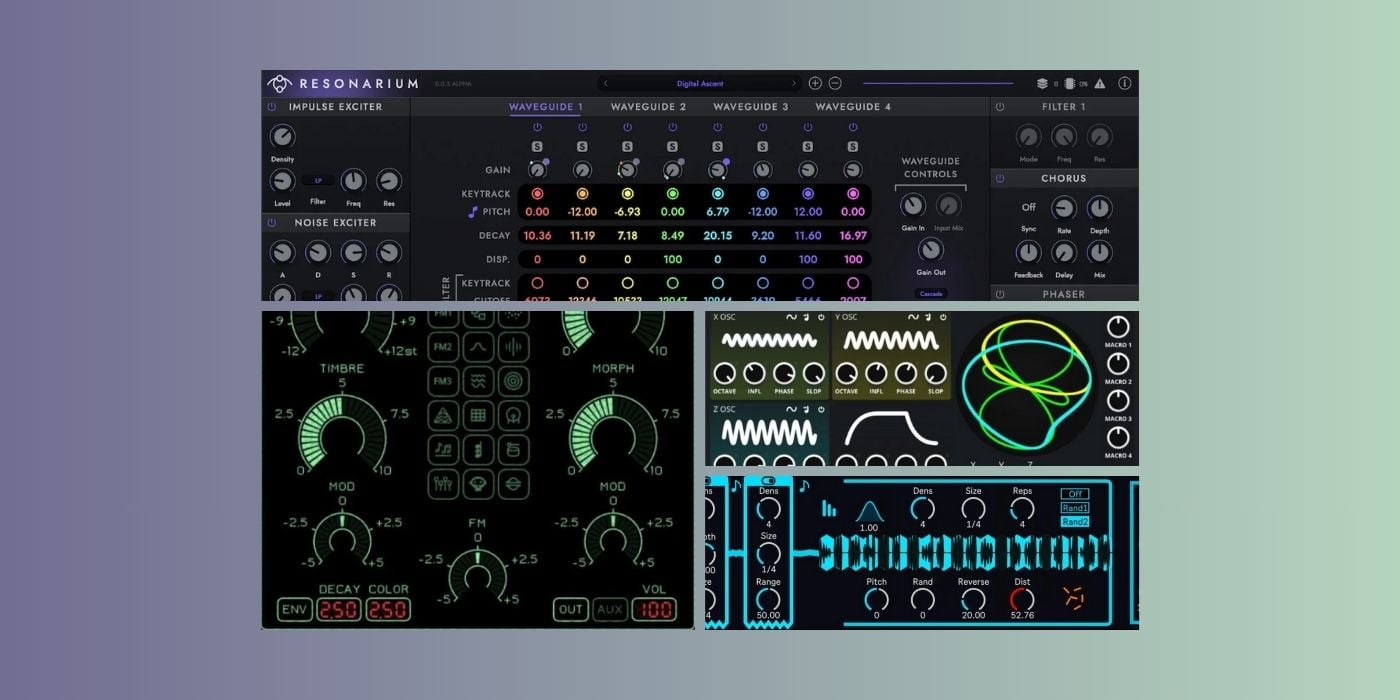

So far, 2025 has been one of the most generous years I’ve seen for free plugins. I’ve been covering freebies for well over a decade now, and every year, free plugins get a little better and more polished.
That abundance comes with a downside, though.
We’re starting to see a lot of the same plugin ideas repeated: another vintage compressor, another Juno-style chorus (we featured two in the same month!), another analog-style synth, another plate reverb with slightly different knobs.
None of that is bad, and many of these plugins are genuinely good, but it does make things feel a bit stale.
So I wanted to put together a list of free plugins released in 2025 that do something a little differently. These aren’t necessarily the “best” plugins of the year, and they’re not meant to replace your everyday tools.
Instead, they’re meant to inspire and help you find new ways to shape the audio in your DAW.
Some explore unfamiliar synthesis methods, others rethink modulation or delay in odd ways, and a few are simply weird (in the best possible sense).
SoundThread UI (CDP) – GUI for an infamous sound design tool
SoundThread isn’t a plugin in the traditional sense, but I couldn’t leave it out. It’s a free, node-based graphical interface for the Composers Desktop Project (CDP), which has been a legendary but notoriously inaccessible sound design toolkit since the 1980s.
CDP has famously been used by Aphex Twin, but for most people (✌️), the command-line workflow is a dealbreaker. SoundThread fixes that by turning CDP into a visual environment where you connect processes like blocks and cables.
You load an audio file, chain together CDP processes, and export the result as a new file. It feels more like a modular synth or a modern DAW patchbay rather than a piece of ancient academic software. There’s still a learning curve, and setup takes some effort, but SoundThread makes CDP usable in a way it wasn’t before.
But why even bother? It’s a fantastic sound design playground, and probably the single best tool on this list if you want to sculpt audio in unusual ways. But it’s super addictive once you get into it. Consider yourself warned!
Flechtwerk – Unusual synth with a 90s video game look
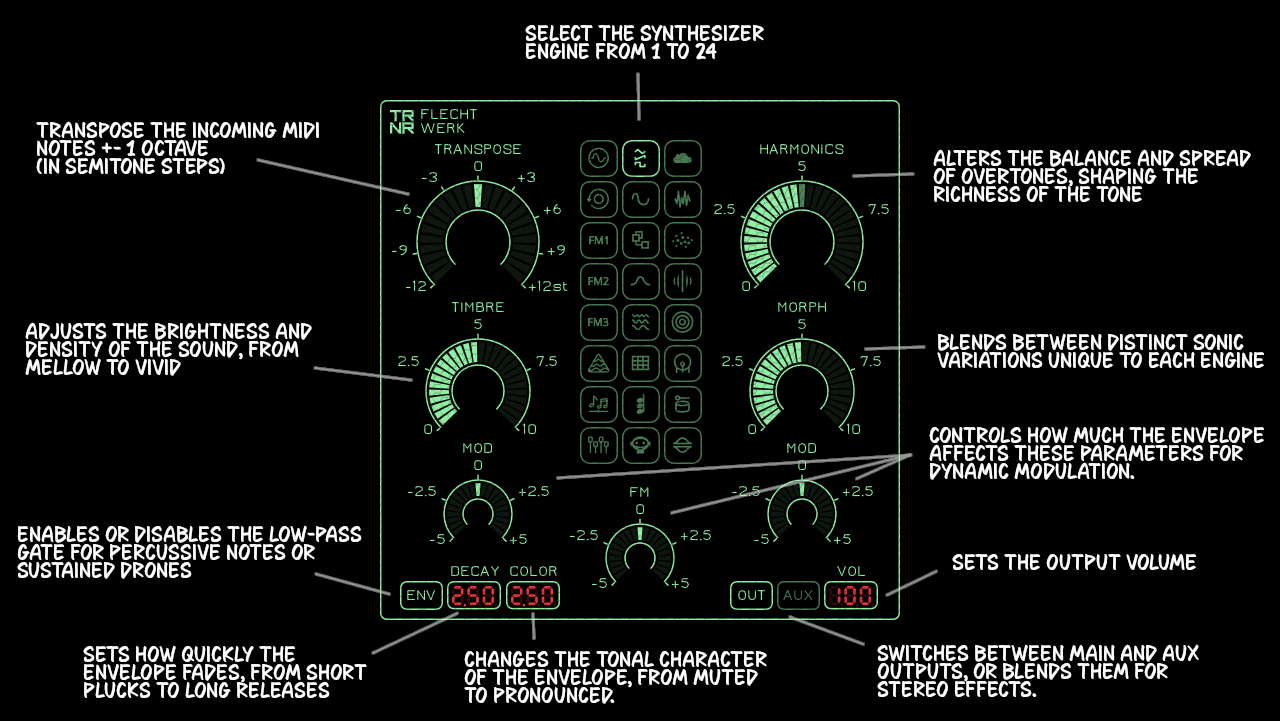
Flechtwerk doesn’t do anything groundbreakingly new, but I’ve never seen a plugin like it. And I’ve been using it a lot this year.
It’s a synth based on Mutable Instruments Plaits, offering multiple synthesis engines with macro controls. But the way it’s presented makes it feel more playful and exploratory than most synth plugins.
Instead of burying you in a bunch of parameters, Flechtwerk lets you browse different engines and shape the sounds through a small set of controls: Harmonics, Timbre, and Morph. That limitation actually makes experimentation more fun, especially if you’re more interested in hands-on sound design than traditional synth programming.
The retro-futuristic interface is what blew me away, though. I just love the vibe on this one. It looks like a device from a 90s video game, and I have a soft spot for such graphics.
Mouth of Sorrow – Psychological horror as a chorus plugin

Freakshow Industries plugins always feel like they’re trying to make you uncomfortable on purpose, and Mouth of Sorrow is no exception.
Underneath the disturbing visuals, it’s a multi-voice chorus, but it’s clearly designed for pushing sounds way off balance rather than smoothing them out like a normal chorus.
That said, at subtle settings, it can behave like a typical chorus. But once you start stacking voices with conflicting modulation, things quickly become unstable. That instability is the whole point here.
I like Mouth of Sorrow most when it’s used sparingly, just enough to make a sound feel uneasy without completely destroying it. Try it on some synth pads, and you’ll know what I mean.
The plugin isn’t freeware (costs $15), but the developer also lets you download it for free. However, the free download version is labeled STEAL on the website, so there’s that. Things are never a romcom with Freakshow Industries. It’s a weird psychological thriller all the way!
By the way, another unusual plugin that you can “steal” from the developer’s website is the SLURP spatial rotation FM synthesizer.
ModMan – Modulation powered by Perlin noise

ModMan stands out because of its modulation source. Instead of LFOs or envelopes, it uses Perlin noise, which creates smoother, more organic movement over time.
That difference is subtle, but you’ll definitely appreciate it if you’re fed up with the standard sine wave and triangle modulation curves.
Here, the modulation feels less repetitive and more natural, especially on pads or long textures. You can use it to add drift, stereo motion, or unpredictable changes without things sounding purely random.
It’s also very much in line with UnplugRed’s design philosophy. All of their plugins are quirky and experimental, but still practical.
maniFold Σ – Microloops for controlled chaos

maniFold Σ is one of those plugins where you don’t fully understand what’s happening. I haven’t figured it out completely, but it’s worked wonders for me as a starting point in the sound design process.
It combines microlooping with a complex delay network, and the interaction between its components can produce wildly different results from small adjustments.
What I like is how playable it feels. Tweaking buffer locks, feedback, and recirculation in real time quickly turns incoming audio into shimmering pads, rhythms, or some crazy textures that you’d never normally come up with.
For me, it’s especially effective on field recordings and acoustic instruments. I use it to get organic sounds and textures that feel familiar yet completely new.
It’s still technically in alpha, but it already feels more like an instrument than an effect. Also, maniFold Σ is a plugin that encourages recording everything and sorting it out later. So my advice is to load it on a channel, play around with the parameters while recording everything, and then save the good parts for a future project.
Hammer & Meißel – Turning anything into an instrument

Hammer & Meißel is one of the more complex plugins on this list. Still, its core idea is simple. It lets you turn incoming audio into something you can play melodically via modal filtering.
It works exceptionally well on non-tonal sources like noise, drums, or field recordings. Once MIDI is involved, those sounds become playable textures, and you can have lots of fun playing chords and turning various unusual audio sources into evolving pads and leads.
Despite the sheer number of parameters, it isn’t too hard to use. After a few minutes, I stopped worrying about understanding every parameter and simply tried getting some cool noises with it.
In other words, it works great as a “throw audio in and see what happens” kind of tool.
Resonarium – An experimental synth cocktail

Resonarium feels more like a work in progress than a finished instrument, but it’s still excellent.
The plugin combines waveguide synthesis, modal synthesis, and Karplus-Strong techniques into a semi-modular environment for abstract sound design.
It can be unstable, and the developer is upfront about that. But I think that even in its finished state, it will be a synth that doesn’t try to be polite. This one was made to be unpredictable, so definitely give it a go if you like a bit of chaos in your sound design setup.
That said, since it’s still in development, this is one to keep an eye on rather than rely on daily. But even in its early state, Resonarium shows a lot of promise.
Haze & Filter – Polished tools for unusual sounds

Lunacy Audio surprised me this year by releasing two free effects, Haze and Filter.
I’m a big fan of their commercial plugins like BEAM 2.0 and Cube Mini, both of which I use regularly for cinematic sound design, so it was amazing to see the same quality in their freebies.
Both plugins look great. I know flashy GUIs aren’t everyone’s thing, but I’m for plugins that look inviting, and these definitely do.
Haze is a modulation-based atmosphere builder that blends chorus, phasing, and reverb. What makes it feel different is Lunacy Audio’s “Spectral Dispersion” engine, which smears and resonates the signal in a way that goes beyond simple modulation.
Controls like Density, Decay, Motion, and Smear give you plenty of room to shape how static or animated the effect becomes.
Filter is more straightforward on the surface. Alongside standard filter types like low-pass and band-pass, you also get formant and comb filtering, slope scaling up to 8x, stereo shaping, and a handy note snap option that locks the cutoff to musical pitches.
It’s useful for precise filtering but works even better for experimental tonal shaping.
Haze and Filter are available in VST, AU, and AAX formats for macOS and Windows.
Daniel Gergely Spirals – Fun with delay and pitch shifting

Spirals has been around in some form since its early free beta back in 2022, but the 2025 release feels like the point where everything finally clicked.
Daniel Gergely introduced a proper free version alongside a more refined paid edition, and the free one feels like a complete product.
You get access to the core pitch-shifting delay engine with no time limits or registration, and it’s fantastic for producing all sorts of shimmer-style reverbs, pitched echoes, and washed-out textures.
I’ve mostly enjoyed using Spirals on pads and rhythmic material, where the pitch-shifted repeats can add a type of texture you can’t recreate with other effects.
The plugin itself feels noticeably smoother than earlier versions. Delay time changes no longer produce awkward artifacts, performance is much better, and the filter section now adds saturation when pushed, which helps the effect sit more naturally in a mix.
Eventide Temperance Lite – A Reverb for musical notes
For me, Temperance Lite was the most interesting reverb released this year. Definitely get this one if you haven’t done so already.
Instead of focusing on space or realism, Eventide’s approach is musical. The idea behind its “Modal Reverb” engine is that you can control which notes resonate inside the reverb tail and which ones don’t.
The central Temper control makes this easy to explore. At neutral settings, the plugin behaves much like a traditional reverb. Turn it one way and selected notes bloom inside the tail; turn it the other way and those notes are suppressed.
There are three core modal responses and a modest preset library, but the real strength (apart from the sound) is how intuitive the plugin feels.
The NoteScape visualizer makes it clear which frequencies are sustaining, and the additional spectrum and range controls help you focus the effect where it matters.
Temperance Lite is free until December 31st, 2025, and requires an iLok account (no dongle).
Witch Pig Starscraper – Chaotic reverse delay

Starscraper is Witch Pig doing what Witch Pig does best: taking a familiar effect and nudging it slightly off-center.
In this case, it’s a reverse delay combined with micro pitch shifting, with independent pitch control for the left and right channels.
The effect can sound quite tame when used subtly, especially on leads or melodic material, where a small amount of reverse delay and detuning adds depth without drawing too much attention. But it’s just as happy spiraling into chaos if you push the feedback and pitch controls.
The interface includes Witch Pig’s usual animated elements, which aren’t essential but do reinforce the sense that this is an effect meant for experimentation rather than precision. It’s not a workhorse delay, but it’s definitely a fun one.
Sinevibes Skew v2 – Less chaotic reverse delay
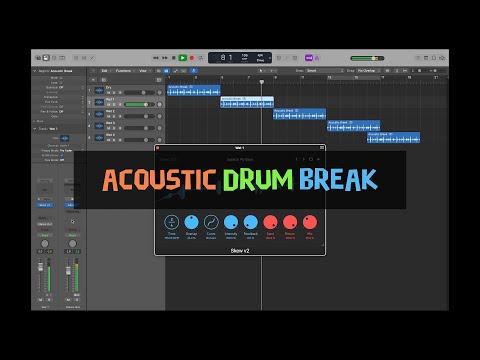
Skew v2 is a reverse delay that records incoming audio into a buffer and plays it back in reversed chunks. Then it applies non-linear curves that warp playback speed and pitch in unusual ways.
The result can range from subtle pitch movement and tape-style rewinds to aggressive glitches and mangled transitions. Despite how wild it can sound, Skew stays locked to the host tempo, and the three-playhead design helps keep pitch behavior consistent across feedback cycles.
I also appreciate how straightforward the interface is. Once you understand how Time, Intensity, Feedback, and Overlap interact, it’s easy to dial in repeatable results rather than pure chaos.
Drox II – Glitch processing still lives

Drox II started life as a Max for Live device, but its 2025 VST release opened it up to a much wider audience.
It’s a glitch-and-stutter effect inspired by skipping CDs and unstable playback, but it’s more flexible than that description suggests.
The plugin is split into several sections: Dropouts, Jumps, a more complex Stutter engine, and a utility section. Each part can be tempo-synced or free-running, which makes it easier to integrate into rhythmic material without things falling apart completely.
I like how Drox II transforms from being subtly glitchy to something way more extreme, but always maintains some coherence on the output. You can dial in a fair amount of chaos or push it toward total destruction, but it rarely feels purely random.
Drox II is a solid choice if you’re into glitch or IDM-style processing. For me, it sits in the weird stuff folder, and I fire it up when I need some inspiration for making new cinematic SFX.
A good year to explore weird plugins
None of these plugins is essential. But they remind me why free plugins are still exciting: they’re often the place where developers take risks.
If you’re feeling tired of seeing the same plugin ideas repackaged over and over, I hope these ones offer a different perspective. They might not all stick in your workflow, but they’re worth exploring, even if only to shake things up a bit.
And if you think I missed an unusual free plugin released in 2025, let me know. I’m always happy to add more weird tools to the collection.
Oh, and if you’re still here, I have four more to recommend. Ewan Bristow’s LOCD is a fantastic free phase-lock distortion plugin. There’s also the Body dynamic processor plugin from Playfair Audio, Philodendron ring buffer plugin by LNDF, and the lovely SyndtSphere v2 sound surfer by Klevgrand.
Last Updated on December 19, 2025 by Tomislav Zlatic.